
影响病毒学抑制的HIV-1感染者更换抗逆转录病毒疗法的因素:法国一项横断面多中心研究
Factors influencing antiretroviral therapy switching in people with virologically suppressed HIV-1: a cross-sectional multicenter study in France.
作者信息
Pourcher Valérie, Robineau Olivier, Parienti Jean-Jacques, Loubet Paul, Palacios Christia, Jacomet Christine, Benachir Haydar, Mariot Philippe, Spire Bruno, Slama Laurence
机构信息
AP-HP Pitié Salpêtrière, Paris.
CH Tourcoing, Tourcoing.
出版信息
AIDS. 2025 May 1;39(6):695-700. doi: 10.1097/QAD.0000000000004118. Epub 2025 Jan 20.
INTRODUCTION
In France, over 90% of people with HIV-1 (PWH) achieve virological suppression with effective combination of antiretroviral therapies (ART), but limited data exist on the motivation for switching ART.
OBJECTIVE
To describe the reasons and determinants for switching ART, with a particular focus on doravirine-based regimens, in routine clinical practice in France.
DESIGN
This analysis of cross-sectional baseline data is part of the DoraVIH study, a French, multicenter (15 sites), two-step observational cohort study that includes prospective follow-up for a subset of participants.
METHODS
Eligible participants were PWH under ART regimen, virologically suppressed for at least 6 months, doravirine-naive and switching ART regimen. Sociodemographic and clinical data, ART history and reasons for switching ART were assessed at baseline.
RESULTS
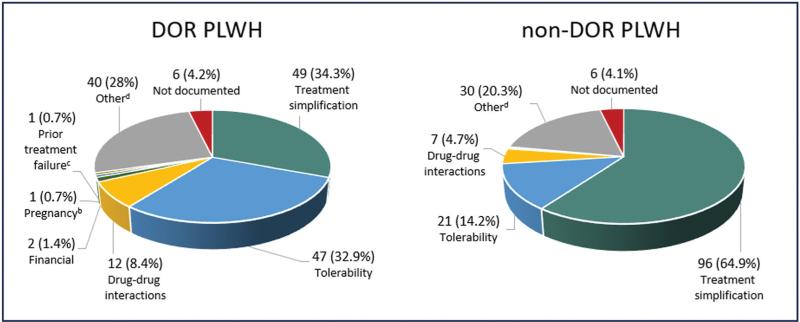
Inclusions occurred between 13 December 2021 and 21 September 2022. Of the 291 PWH included, whose data were analyzed, 143 switched to doravirine-based regimen (DOR PWH) and 148 to another combined regimen (non-DOR PWH). Mean age was 51.6 years, and 206 participants (70.8%) were men. At baseline, 35 (25.0%) DOR PWH and 15 (10.6%) non-DOR PWH had BMI at least 30 kg/m 2 ( P = 0.007). The most common reasons for switching were treatment simplification, tolerability and drug-drug interactions, accounting for 79.7% of all reasons. Among the 68 participants with prior tolerability issues, 47 (69.1%) switched to doravirine-based regimen.
CONCLUSION
Primary reasons for switch were treatment simplification and tolerability. Participants with obesity were more likely to switch to doravirine, reflecting physicians' favorable perception of doravirine potential benefits, particularly in managing weight gain.
引言
在法国,超过90%的HIV-1感染者(PWH)通过有效的抗逆转录病毒疗法(ART)组合实现了病毒学抑制,但关于更换ART的动机的数据有限。
目的
描述在法国常规临床实践中更换ART的原因和决定因素,特别关注基于多拉韦林的治疗方案。
设计
这项横断面基线数据分析是DoraVIH研究的一部分,该研究是一项法国多中心(15个地点)的两步观察性队列研究,包括对一部分参与者的前瞻性随访。
方法
符合条件的参与者是接受ART治疗方案、病毒学抑制至少6个月、未使用过多拉韦林且正在更换ART治疗方案的PWH。在基线时评估社会人口统计学和临床数据、ART治疗史以及更换ART的原因。
结果
纳入时间为2021年12月13日至2022年9月21日。在纳入并分析数据的291名PWH中,143人更换为基于多拉韦林的治疗方案(DOR PWH),148人更换为另一种联合治疗方案(非DOR PWH)。平均年龄为51.6岁,206名参与者(70.8%)为男性。基线时,35名(25.0%)DOR PWH和15名(10.6%)非DOR PWH的体重指数至少为30kg/m²(P = 0.007)。更换的最常见原因是治疗方案简化、耐受性和药物相互作用,占所有原因的79.7%。在68名既往有耐受性问题的参与者中,47名(69.1%)更换为基于多拉韦林的治疗方案。
结论
更换的主要原因是治疗方案简化和耐受性。肥胖参与者更有可能更换为多拉韦林,这反映了医生对多拉韦林潜在益处的良好认知,特别是在控制体重增加方面。
 Zotero 插件