Cools Julie M T, Goovaerts Bo K, Feyen Eline, Van den Bogaert Siel, Fu Yile, Civati Céline, Van Fraeyenhove Jens, Tubeeckx Michiel R L, Ott Jasper, Nguyen Long, Wülfers Eike M, Van Berlo Benji, De Vries Antoine A F, Vandersickel Nele, Pijnappels Daniël A, Audenaert Dominique, Roderick H Llewelyn, De Winter Hans, De Keulenaer Gilles W, Segers Vincent F M
Laboratory of PhysioPharmacology, University of Antwerp, Antwerp, Belgium.
Laboratory of Experimental Cardiology, Department of Cardiovascular Sciences, KU Leuven, Leuven, Belgium.
Nat Commun. 2025 Jan 10;16(1):576. doi: 10.1038/s41467-024-54908-5.
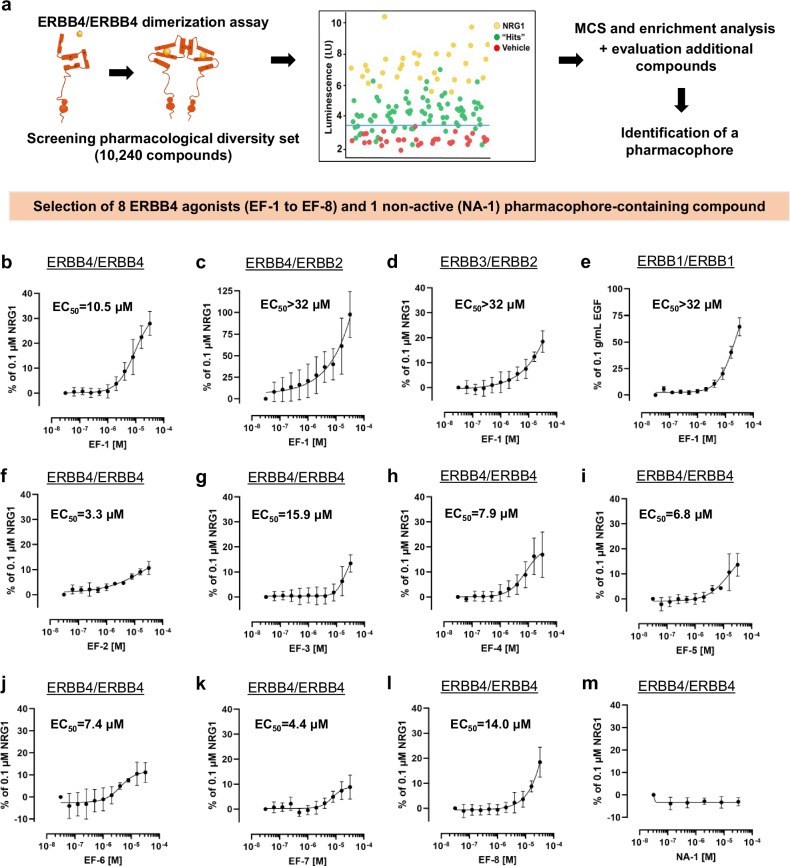
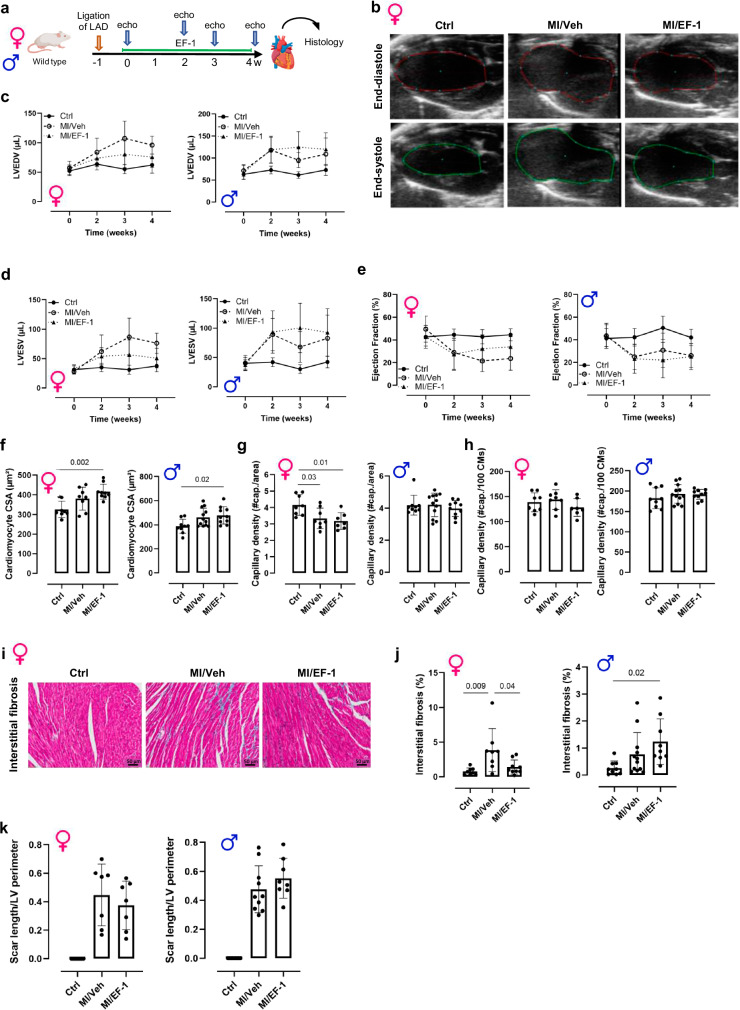
Heart failure is a common and deadly disease requiring new treatments. The neuregulin-1/ERBB4 pathway offers cardioprotective benefits, but using recombinant neuregulin-1 as therapy has limitations due to the need for intravenous delivery and lack of receptor specificity. We hypothesize that small-molecule activation of ERBB4 could protect against heart damage and fibrosis. To test this, we conduct a screening of 10,240 compounds and identify eight structurally similar ones (EF-1 to EF-8) that induce ERBB4 dimerization, with EF-1 being the most effective. EF-1 reduces cell death and hypertrophy in cardiomyocytes and decreases collagen production in cardiac fibroblasts in an ERBB4-dependent manner. In wild-type mice, EF-1 inhibits angiotensin-II-induced fibrosis in males and females and reduces heart damage caused by doxorubicin and myocardial infarction in females, but not in Erbb4-null mice. This study shows that small-molecule ERBB4 activation is feasible and may lead to a novel class of drugs for treating heart failure.
心力衰竭是一种常见的致命疾病,需要新的治疗方法。神经调节蛋白-1/ERBB4信号通路具有心脏保护作用,但使用重组神经调节蛋白-1进行治疗存在局限性,因为需要静脉给药且缺乏受体特异性。我们假设,小分子激活ERBB4可以预防心脏损伤和纤维化。为了验证这一点,我们对10240种化合物进行了筛选,鉴定出8种结构相似的化合物(EF-1至EF-8),它们可诱导ERBB4二聚化,其中EF-1最为有效。EF-1以依赖于ERBB4的方式减少心肌细胞的死亡和肥大,并降低心脏成纤维细胞中的胶原蛋白生成。在野生型小鼠中,EF-1可抑制雄性和雌性小鼠中血管紧张素-II诱导的纤维化,并减少雌性小鼠中由阿霉素和心肌梗死引起的心脏损伤,但在Erbb4基因敲除小鼠中则无此作用。这项研究表明,小分子激活ERBB4是可行的,可能会导致一类新型的治疗心力衰竭的药物。