Christensen Karen E, Faquette Marie-Lou, Leclerc Daniel, Keser Vafa, Luan Yan, Bennett-Firmin Jeanna L, Malysheva Olga V, Reagan Alaina M, Howell Gareth R, Caudill Marie A, Bottiglieri Teodoro, Rozen Rima
Departments of Human Genetics and Pediatrics, McGill University, Montreal, QC H3A 0C7, Canada.
The Research Institute of the McGill University Health Centre, Montreal, QC H4A 3J1, Canada.
Nutrients. 2024 Dec 28;17(1):82. doi: 10.3390/nu17010082.
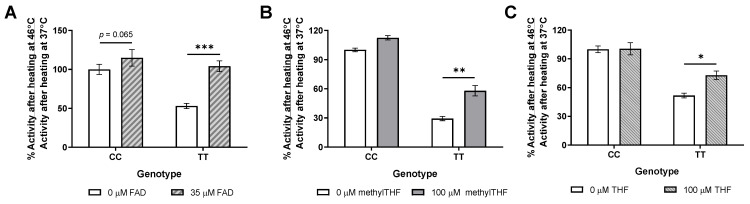
BACKGROUND/OBJECTIVES: The gene variant results in a thermolabile MTHFR enzyme associated with elevated plasma homocysteine in TT individuals. Health risks associated with the TT genotype may be modified by dietary and supplemental folate intake. Supplementation with methyltetrahydrofolate (methylTHF) may be preferable to folic acid because it is the MTHFR product, and does not require reduction by DHFR to enter one-carbon folate metabolism. In the mouse model for this variant, female 677TT (TT) mice have an increased incidence of hepatic steatosis. The objective of this study was to compare the effects of methylTHF and folic acid supplementation on hepatic steatosis and one-carbon metabolism in this model.
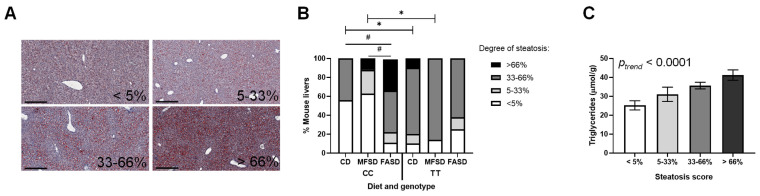
Male and female C57BL/6J 677CC (CC) and TT mice were fed control (CD), 5xmethylTHF-supplemented (MFSD), or 5xfolic-acid-supplemented (FASD) diets for 4 months. Liver sections were assessed for steatosis by Oil Red O staining. One-carbon metabolites were measured in the liver and plasma. MTHFR protein expression was evaluated in the liver.
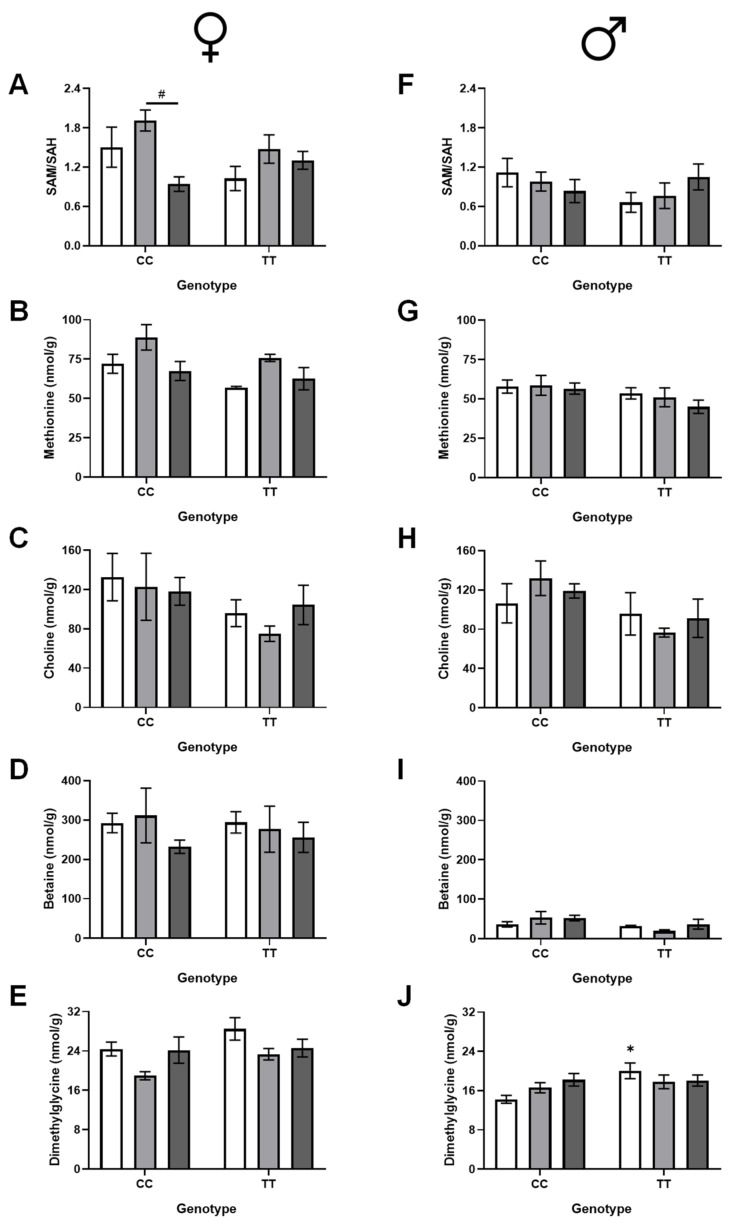
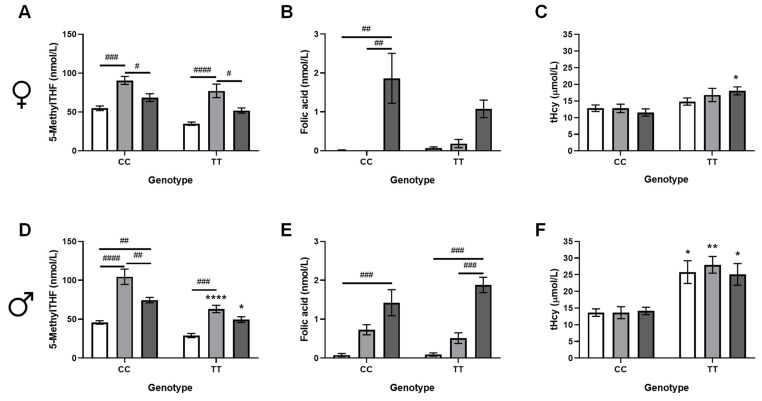
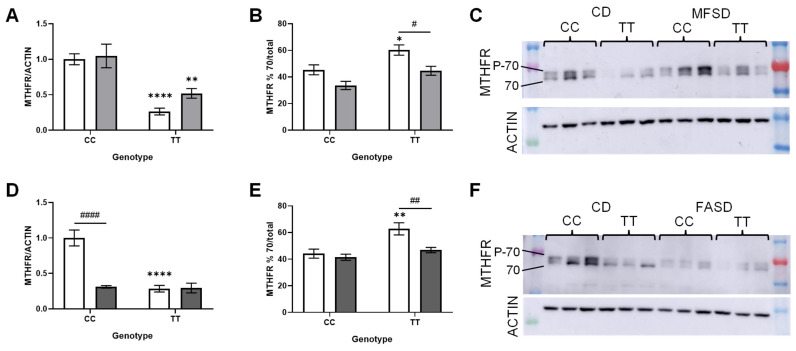
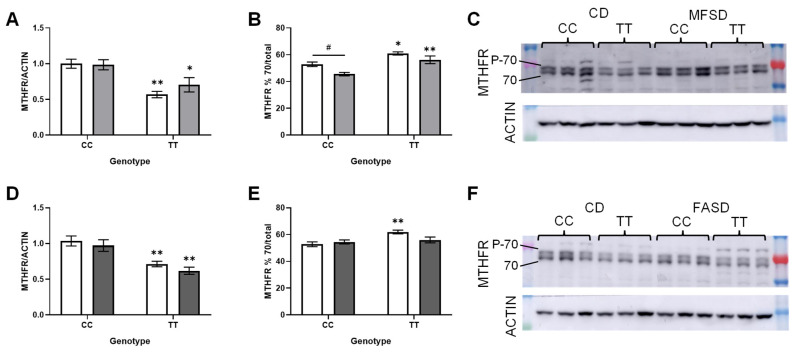
MFSD had no significant effect on plasma homocysteine, liver SAM/SAH ratios, or hepatic steatosis in males or females as compared to CD. MTHFR protein increased in MFSD TT female liver, but remained <50% of the CC. FASD had no effect on plasma homocysteine but it decreased the liver MTHFR protein and SAM/SAH ratios, and increased hepatic steatosis in CC females.
MethylTHF and folic acid supplementation had limited benefits for TT mice, while folic acid supplementation had negative effects on CC females. Further investigation is required to determine if these effects are relevant in humans.
背景/目的:该基因变异导致亚甲基四氢叶酸还原酶(MTHFR)酶不耐热,与TT个体血浆同型半胱氨酸水平升高有关。与TT基因型相关的健康风险可能会因饮食和补充叶酸摄入而改变。补充甲基四氢叶酸(methylTHF)可能比叶酸更可取,因为它是MTHFR的产物,不需要通过二氢叶酸还原酶(DHFR)还原就能进入一碳叶酸代谢。在该变异的小鼠模型中,雌性677TT(TT)小鼠肝脂肪变性的发生率增加。本研究的目的是比较补充methylTHF和叶酸对该模型中肝脂肪变性和一碳代谢的影响。
雄性和雌性C57BL/6J 677CC(CC)和TT小鼠分别喂食对照饮食(CD)、补充5倍甲基四氢叶酸的饮食(MFSD)或补充5倍叶酸的饮食(FASD)4个月。通过油红O染色评估肝切片中的脂肪变性情况。测量肝脏和血浆中的一碳代谢物。评估肝脏中MTHFR蛋白的表达。
与CD相比,MFSD对雄性或雌性小鼠的血浆同型半胱氨酸、肝脏S-腺苷甲硫氨酸/ S-腺苷高半胱氨酸(SAM/SAH)比值或肝脂肪变性均无显著影响。MFSD组TT雌性小鼠肝脏中的MTHFR蛋白增加,但仍低于CC组的50%。FASD对血浆同型半胱氨酸无影响,但降低了CC雌性小鼠肝脏中的MTHFR蛋白和SAM/SAH比值,并增加了肝脂肪变性。
补充甲基四氢叶酸和叶酸对TT小鼠的益处有限;而补充叶酸对CC雌性小鼠有负面影响。需要进一步研究以确定这些影响在人类中是否相关。