Niscola Pasquale, Gianfelici Valentina, Giovannini Marco, Piccioni Daniela, Mazzone Carla, Fabritiis Paolo de
Hematology Unit, S. Eugenio Hospital (ASL Roma 2), 00122 Rome, Italy.
Cancers (Basel). 2025 Jan 4;17(1):142. doi: 10.3390/cancers17010142.
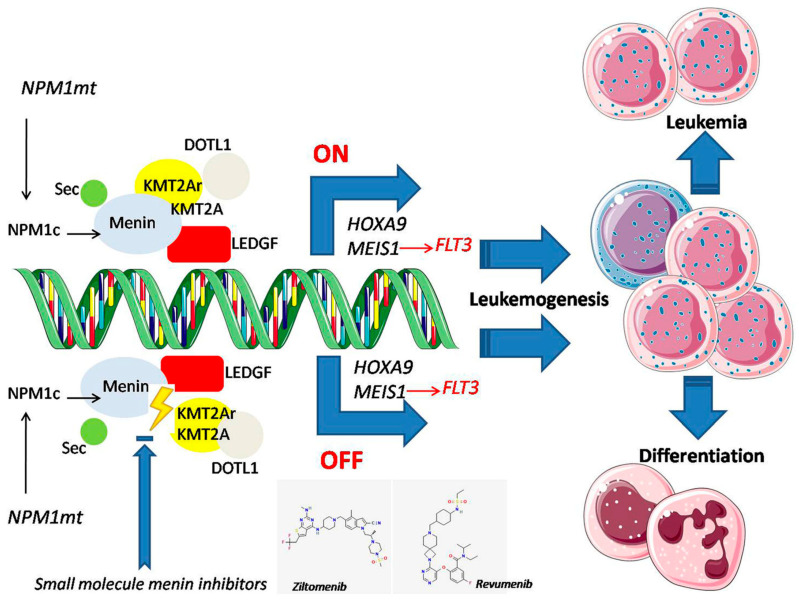
Menin (MEN1) is a well-recognized powerful tumor promoter in acute leukemias (AL) with KMT2A rearrangements (KMT2Ar, also known as MLL) and mutant nucleophosmin 1 (NPM1m) acute myeloid leukemia (AML). MEN1 is essential for sustaining leukemic transformation due to its interaction with wild-type KMT2A and KMT2A fusion proteins, leading to the dysregulation of KMT2A target genes. MEN1 inhibitors (MIs), such as revumenib, ziftomenib, and other active small molecules, represent a promising new class of therapies currently under clinical development. By disrupting the MEN1-KMT2Ar complex, a group of proteins involved in chromatin remodeling, MIs induce apoptosis and differentiation AL expressing KMT2Ar or NPM1m AML. Phase I and II clinical trials have evaluated MIs as standalone treatments and combined them with other synergistic drugs, yielding promising results. These trials have demonstrated notable response rates with manageable toxicities. Among MIs, ziftomenib received orphan drug and breakthrough therapy designations from the European Medicines Agency in January 2024 and the Food and Drug Administration (FDA) in April 2024, respectively, for treating R/R patients with NPM1m AML. Additionally, in November 2024, the FDA approved revumenib for treating R/R patients with KMT2Ar-AL. This review focuses on the pathophysiology of MI-sensitive AL, primarily AML. It illustrates data from clinical trials and discusses the emergence of resistance mechanisms. In addition, we outline future directions for the use of MIs and emphasize the need for further research to fully realize the potential of these novel compounds, especially in the context of specific genetic subtypes of challenging AL.
Menin(MEN1)是急性白血病(AL)中一种公认的强效肿瘤促进因子,这些急性白血病具有KMT2A重排(KMT2Ar,也称为MLL)和突变型核磷蛋白1(NPM1m)急性髓系白血病(AML)。由于MEN1与野生型KMT2A和KMT2A融合蛋白相互作用,导致KMT2A靶基因失调,因此它对于维持白血病转化至关重要。MEN1抑制剂(MIs),如瑞武尼布、齐夫托米尼和其他活性小分子,是目前正在临床开发中的一类有前景的新型疗法。通过破坏MEN1-KMT2Ar复合物(一组参与染色质重塑的蛋白质),MIs可诱导表达KMT2Ar或NPM1m AML的AL细胞凋亡和分化。I期和II期临床试验已评估MIs作为单一疗法,并将它们与其他协同药物联合使用,取得了有前景的结果。这些试验显示出显著的缓解率且毒性可控。在MIs中,齐夫托米尼分别于2024年1月和2024年4月获得了欧洲药品管理局和美国食品药品监督管理局(FDA)的孤儿药和突破性疗法认定,用于治疗NPM1m AML的复发/难治性(R/R)患者。此外,2024年11月,FDA批准瑞武尼布用于治疗KMT2Ar-AL的R/R患者。本综述聚焦于对MIs敏感的AL(主要是AML)的病理生理学。它阐述了临床试验数据并讨论了耐药机制的出现。此外,我们概述了MIs使用的未来方向,并强调需要进一步研究以充分实现这些新型化合物的潜力,特别是在具有挑战性的AL的特定基因亚型背景下。