Nesbitt Robin C, Kinya Asilaza Vincent, Alvarez Catia, Gitahi Priscillah, Nkemenang Patrick, Duncker Jetske, Haile Melat, Gakima Primitive, Wamala Joseph F, Loro Fredrick Beden, Koyuncu Aybüke, Biem Duol, Albela Manuel, Rull Monica, Gignoux Etienne, Rumunu John, Eckerle Isabella, Ciglenecki Iza, Azman Andrew S
Epicentre, Paris, France.
Médecins Sans Frontières, Juba, South Sudan.
Lancet Infect Dis. 2025 May;25(5):537-547. doi: 10.1016/S1473-3099(24)00657-1. Epub 2025 Jan 8.
Hepatitis E virus (HEV) is a leading cause of acute viral hepatitis, particularly in Asia and Africa, where HEV genotypes 1 and 2 are prevalent. Although a recombinant vaccine, Hecolin, is available, it has not been used to control outbreaks. The licensed three-dose regimen might pose challenges for it to be an impactful outbreak control tool. Our study aimed to estimate the effectiveness of two doses of Hecolin in the context of the first-ever reactive use of the vaccine.
We conducted a case-control study during an HEV outbreak in the Bentiu internally displaced persons camp, South Sudan. Patients with acute jaundice syndrome (suspected cases) seeking care at the Médecins Sans Frontières hospital were screened for study eligibility. Eligible participants were those that had been eligible for vaccination (ie, living in the camp and aged 16-40 years). Confirmed cases were defined as individuals who tested positive for hepatitis E by RT-PCR or anti-HEV IgM ELISA. Each case was matched to six controls by age, sex, pregnancy status, and residence. Self-reported vaccination status was verified through vaccination cards. The primary analysis was two-dose vaccine effectiveness, which we estimated with a matched case-control design using conditional logistic regression models. In secondary analyses we estimated vaccine effectiveness using a test-negative design and the screening method. We used test-negative cases and their matched controls as a bias indicator analysis to help quantify potential health seeking behaviour biases.
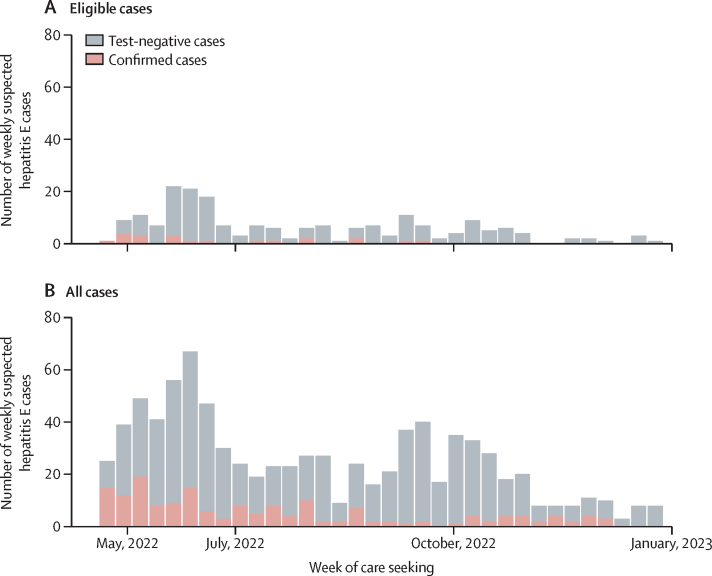
Between May 10 and Dec 30, 2022, we identified 859 patients with suspected hepatitis E. Of these, 201 met the eligibility criteria and 21 cases had laboratory confirmed hepatitis E. Among the confirmed cases, 10 (48%) were unvaccinated compared with 33 (27%) of 121 matched controls. In the primary analysis we estimated an unadjusted two-dose vaccine effectiveness of 67·8% (95% CI -28·6 to 91·9), and a two-dose vaccine effectiveness of 84·0% (-208·5 to 99·2) after adjustment for potential confounders. The bias indicator analysis suggested that test-negative cases might have been more likely to have been vaccinated than their matched community controls due to different health-care seeking behaviours, potentially meaning underestimation of effectiveness estimates. The test-negative design, which uses facility-matched controls, led to an adjusted two-dose effectiveness of 89·4% (56·4 to 98·0).
Despite the small sample size, our estimates provide evidence of effectiveness of a two-dose regimen against HEV genotype 1 during a protracted outbreak, supporting its use in similar contexts.
Médecins Sans Frontières.
戊型肝炎病毒(HEV)是急性病毒性肝炎的主要病因,在亚洲和非洲尤为常见,这些地区流行HEV 1型和2型。尽管有重组疫苗“益可宁”可用,但尚未用于控制疫情暴发。许可的三剂次接种方案可能使其难以成为有效的疫情控制工具。我们的研究旨在评估在首次应急使用该疫苗的情况下,两剂次“益可宁”的有效性。
我们在南苏丹本提乌境内流离失所者营地的一次戊型肝炎疫情期间开展了一项病例对照研究。在无国界医生组织医院寻求治疗的急性黄疸综合征(疑似病例)患者接受筛查以确定是否符合研究条件。符合条件的参与者是那些有资格接种疫苗的人(即居住在营地且年龄在16至40岁之间)。确诊病例定义为通过逆转录聚合酶链反应(RT-PCR)或抗HEV IgM酶联免疫吸附测定(ELISA)检测戊型肝炎呈阳性的个体。每个病例按年龄、性别、妊娠状态和居住地与六个对照进行匹配。通过接种卡核实自我报告的疫苗接种状态。主要分析是两剂次疫苗有效性,我们使用条件逻辑回归模型通过匹配病例对照设计进行估计。在二次分析中,我们使用检测阴性设计和筛查方法估计疫苗有效性。我们将检测阴性病例及其匹配对照用作偏倚指标分析,以帮助量化潜在的就医行为偏倚。
2022年5月10日至12月30日期间,我们确定了859例疑似戊型肝炎患者。其中,201例符合资格标准,21例经实验室确诊为戊型肝炎。在确诊病例中,10例(48%)未接种疫苗,而121例匹配对照中有33例(27%)未接种。在主要分析中,我们估计未调整的两剂次疫苗有效性为67.8%(95%CI -28.6至91.9),在对潜在混杂因素进行调整后,两剂次疫苗有效性为84.0%(-208.5至99.2)。偏倚指标分析表明,由于就医行为不同,检测阴性病例可能比其匹配的社区对照更有可能接种疫苗,这可能意味着有效性估计值被低估。使用机构匹配对照的检测阴性设计得出调整后的两剂次有效性为89.4%(56.4至98.0)。
尽管样本量较小,但我们的估计提供了在持续疫情期间两剂次接种方案对HEV 1型有效的证据,支持在类似情况下使用该方案。
无国界医生组织。