Kahraman Metin, Thybo Hans, Artemieva Irina M, Shulgin Alexey, Hedin Peter, Mjelde Rolf
Eurasia Institute of Earth Sciences, Istanbul Technical University, Maslak, İstanbul, Türkiye.
SinoProbe Laboratory, Chinese Academy of Geological Sciences, Beijing, China.
Nat Commun. 2025 Jan 11;16(1):606. doi: 10.1038/s41467-025-55865-3.
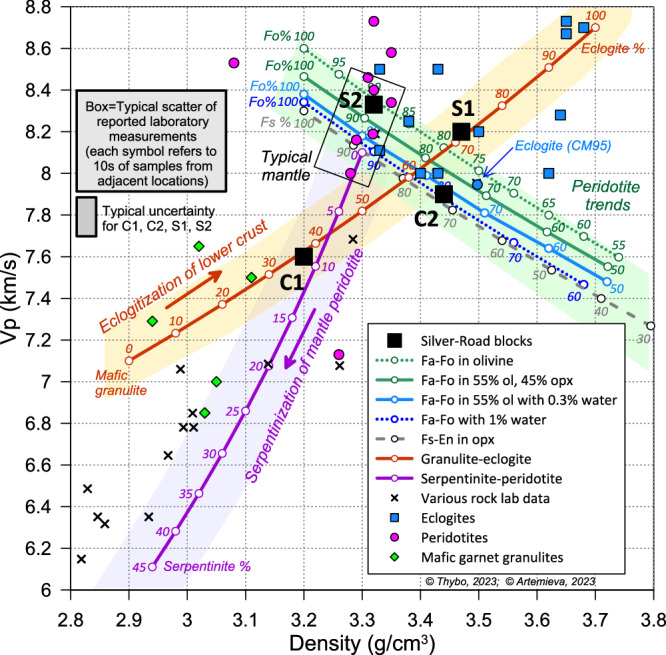
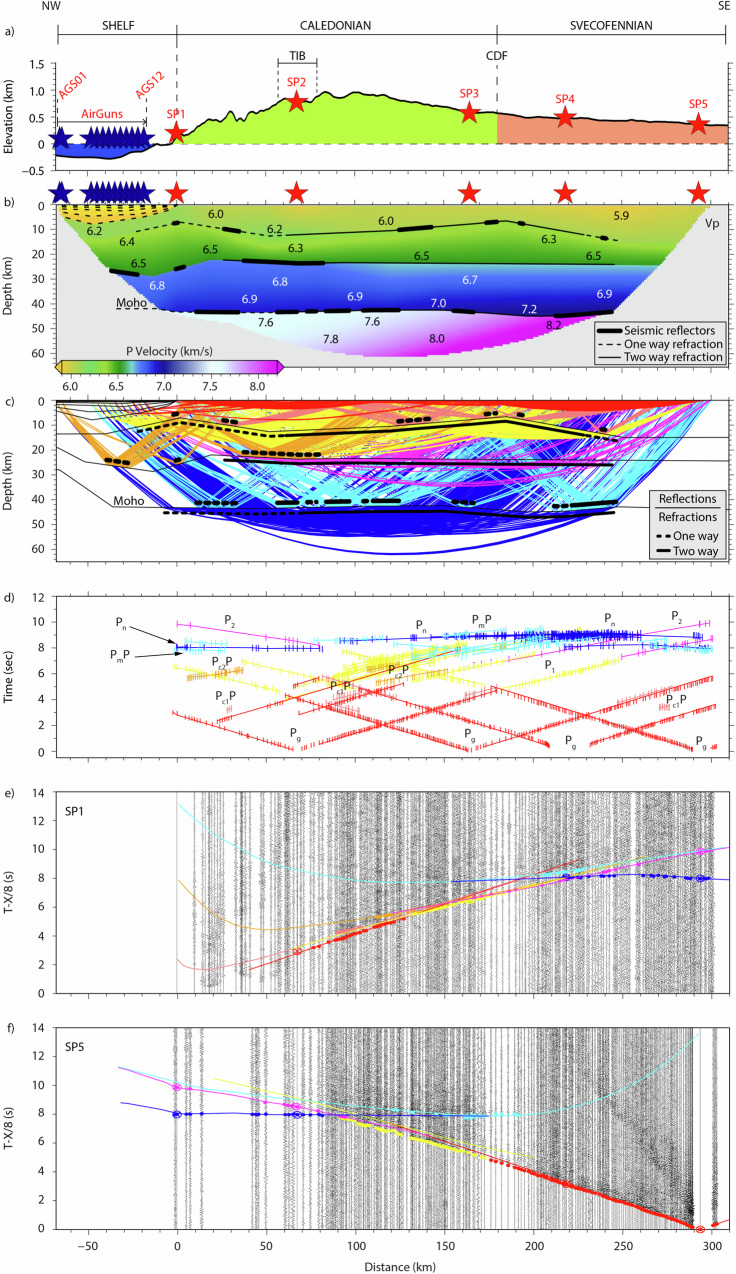
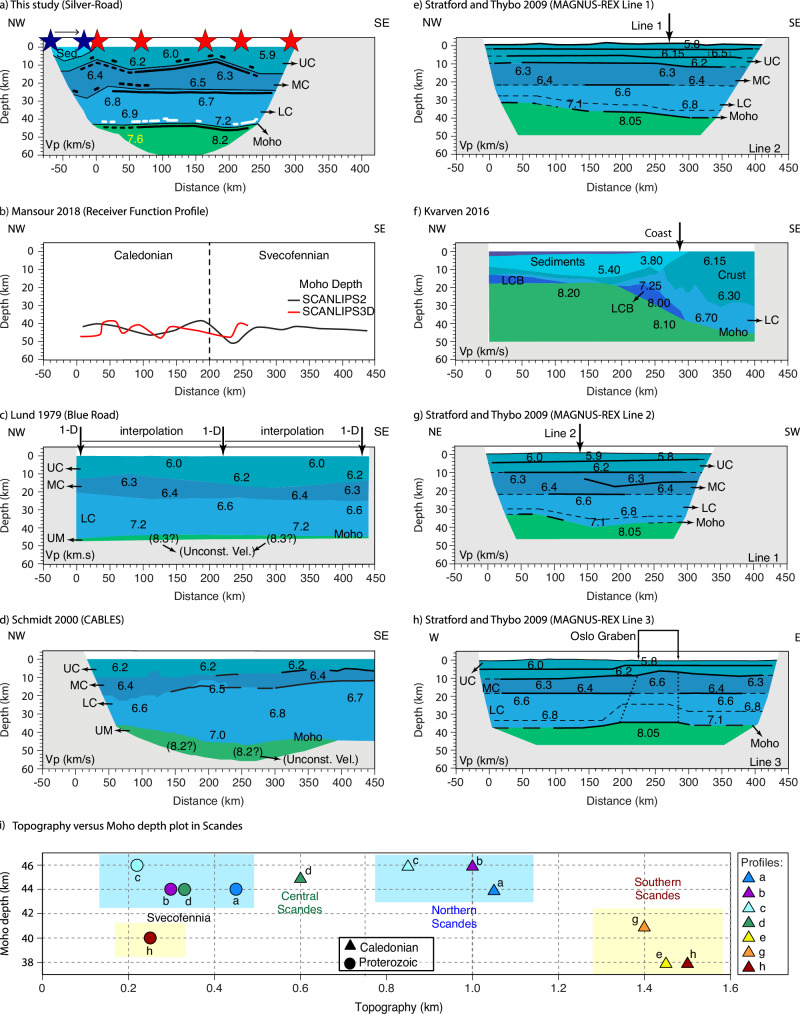
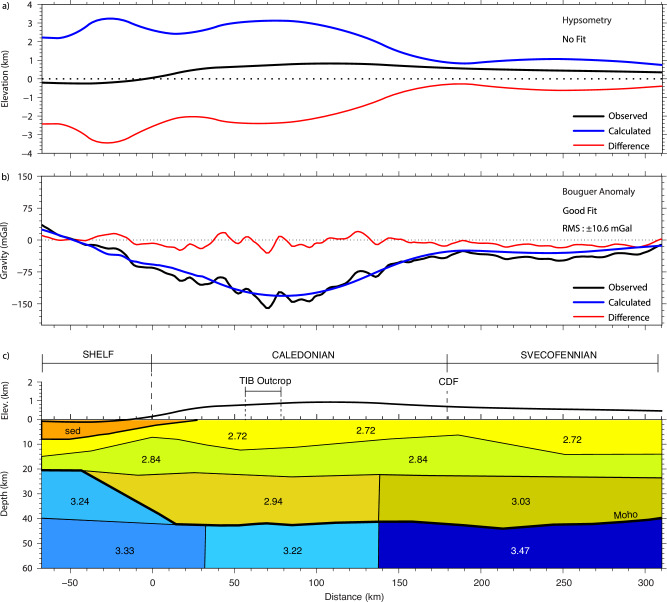
Plate tectonics predicts that mountain ranges form by tectono-magmatic processes at plate boundaries, but high topography is often observed along passive margins far from any plate boundary. The high topography of the Scandes range at the Atlantic coast of Fennoscandia is traditionally assumed isostatically supported by variation in crustal density and thickness. Here we demonstrate, by our Silverroad seismic profile, that the constantly ~44 km thick crust instead is homogenous above the Moho, and Pn-velocity abruptly change from 7.6 km s below the Scandes to >8.2 km s below the Proterozoic shield. By modelling gravity anomalies and topography, based on the seismic model, we demonstrate that this change corresponds to an increase in metamorphic eclogitic grade from 35% below the high-topography Scandes to 70% below the low-topography shield. The sharp contrast between the low-grade, reduced-density and the high-grade, high-density eclogitic bodies below the uniform seismological Moho explains the enigmatic topography of the mountain range without a crustal root.
板块构造学说预测山脉是由板块边界处的构造岩浆作用形成的,但在远离任何板块边界的被动大陆边缘常常能观察到高地势。传统观点认为,斯堪的纳维亚半岛大西洋沿岸的斯堪的纳维亚山脉的高地势是由地壳密度和厚度的变化通过均衡作用支撑的。在这里,通过我们的银路地震剖面,我们证明,在莫霍面之上,厚度恒定约44千米的地壳反而是均匀的,并且Pn速度从斯堪的纳维亚山脉下方的7.6千米/秒突然变为元古代地盾下方的大于8.2千米/秒。基于地震模型对重力异常和地形进行建模,我们证明这种变化对应着变质榴辉岩相等级从高地势的斯堪的纳维亚山脉下方的35%增加到低地势地盾下方的70%。在均匀的地震莫霍面之下,低等级、低密度的榴辉岩体与高等级、高密度的榴辉岩体之间的鲜明对比解释了该山脉没有地壳根的神秘地形。