Gupta Priyanka, Nasa Prashant, Shahabdeen Shuib Mohammed
Department of Pulmonary Medicine and Critical Care, Lifecare Hospital (Burjeel Group), Musaffah, Abu Dhabi, United Arab Emirates.
Department of Anaesthesia and ICCU, New Cross Hospital, The Royal Wolverhampton NHS trust, Wolverhampton, United Kingdom.
Indian J Crit Care Med. 2025 Jan;29(1):65-74. doi: 10.5005/jp-journals-10071-24861. Epub 2024 Dec 30.
Fluid resuscitation is the first-line treatment for patients with diabetic ketoacidosis (DKA). However, the optimal choice of resuscitative fluid remains controversial. This study aims to evaluate the impact of balanced electrolyte solution (BES) compared to 0.9% sodium chloride (NS) on various physiological and clinical outcomes in adult DKA patients.
An extensive search of electronic databases, including Embase, PubMed, Cochrane Library, Web of Science, and Google Scholar, was conducted to select studies that directly compared BES and NS in adult DKA patients. This systematic review and meta-analysis included nine studies, comprising both randomized controlled trials and retrospective studies. Combined estimates were expressed as mean differences (MDs) with 95% confidence intervals (CIs). The primary outcomes were time to resolution of DKA and length of hospital stay. The secondary outcomes were post-resuscitation chloride and bicarbonate levels and adverse events.
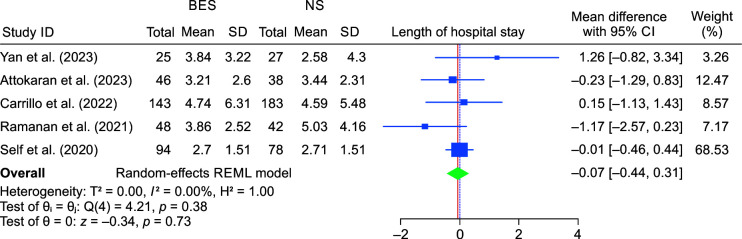
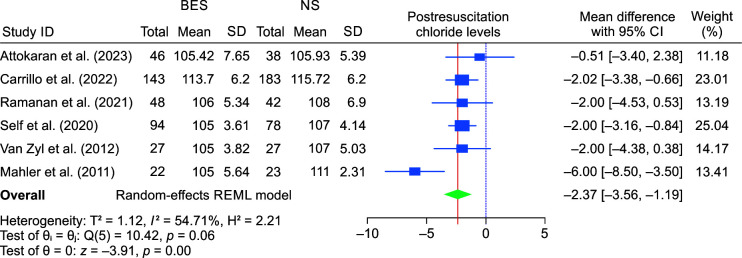
No significant difference was observed between BES and NS in the time to DKA resolution (MD: -1.63; 95% CI: -7.66-4.41; = 0.60) or length of hospital stay (MD: -0.07; 95% CI: -0.44-0.31; = 0.73). However, BES resulted in significantly higher post-resuscitation bicarbonate levels (MD: 1.63; 95% CI: 0.86-2.39; < 0.001) and lower post-resuscitation chloride levels (MD: -2.37; 95% CI: -3.56 to -1.19; < 0.001).
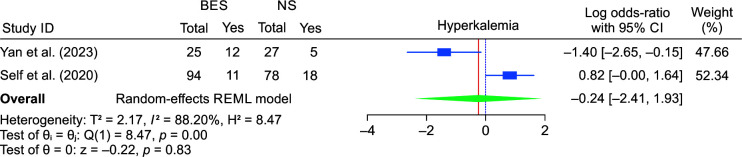
The use of BES is associated with improved post-resuscitation electrolyte balance and preventing hyperchloremic metabolic acidosis in DKA patients. While BES may offer some biochemical advantages, both BES and NS are safe for treating DKA.
Gupta P, Nasa P, Shahabdeen SM. Effectiveness of Balanced Electrolyte Solution vs Normal Saline in the Resuscitation of Adult Patients with Diabetic Ketoacidosis: An Updated Systematic Review and Meta-analysis. Indian J Crit Care Med 2025;29(1):65-74.
液体复苏是糖尿病酮症酸中毒(DKA)患者的一线治疗方法。然而,复苏液体的最佳选择仍存在争议。本研究旨在评估与0.9%氯化钠溶液(NS)相比,平衡电解质溶液(BES)对成年DKA患者各种生理和临床结局的影响。
广泛检索电子数据库,包括Embase、PubMed、Cochrane图书馆、科学网和谷歌学术,以选择直接比较成年DKA患者中BES和NS的研究。本系统评价和荟萃分析纳入了9项研究,包括随机对照试验和回顾性研究。合并估计值以均数差(MDs)及95%置信区间(CIs)表示。主要结局为DKA缓解时间和住院时间。次要结局为复苏后氯离子和碳酸氢根水平以及不良事件。
在DKA缓解时间(MD:-1.63;95%CI:-7.66至4.41;P = 0.60)或住院时间(MD:-0.07;95%CI:-0.44至0.31;P = 0.73)方面,BES与NS之间未观察到显著差异。然而,BES导致复苏后碳酸氢根水平显著升高(MD:1.63;95%CI:0.86至2.39;P < 0.001),复苏后氯离子水平降低(MD:-2.37;95%CI:-3.56至-1.19;P < 0.001)。
使用BES与改善复苏后电解质平衡以及预防DKA患者高氯性代谢性酸中毒相关。虽然BES可能具有一些生化优势,但BES和NS治疗DKA均安全。
Gupta P, Nasa P, Shahabdeen SM. 平衡电解质溶液与生理盐水在成年糖尿病酮症酸中毒患者复苏中的有效性:一项更新的系统评价和荟萃分析。《印度重症医学杂志》2025;29(1):65 - 74。