Gallego Juan-José, Ballester María-Pilar, Fiorillo Alessandra, Casanova-Ferrer Franc, López-Gramaje Adrià, Urios Amparo, Arenas Yaiza María, Ríos María-Pilar, Durbán Lucía, Megías Javier, San-Miguel Teresa, Benlloch Salvador, Lluch Paloma, Jalan Rajiv, Montoliu Carmina
Fundación de Investigación Hospital Clínico Universitario de Valencia-INCLIVA, Valencia, 46010, Spain.
Departamento de Patología, Universidad de Valencia, Valencia, 46010, Spain.
Metab Brain Dis. 2025 Jan 15;40(1):100. doi: 10.1007/s11011-024-01512-7.
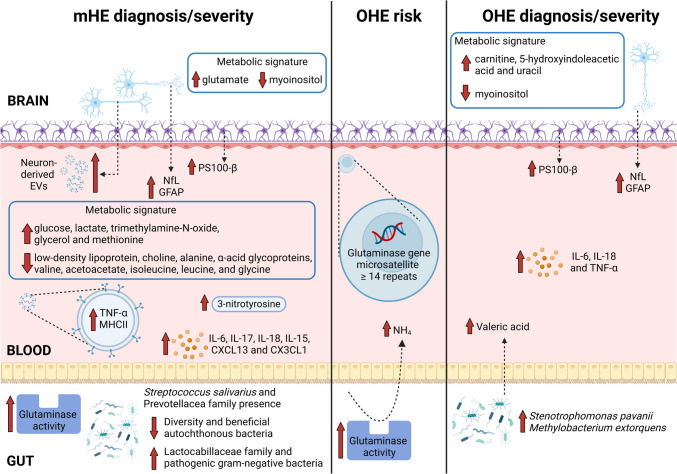
Ammonia is a product of amino acid metabolism that accumulates in the blood of patients with liver cirrhosis, leading to neurotoxic effects and hepatic encephalopathy (HE). HE manifestations can range from mild, subclinical disturbances in cognition, or minimal HE (mHE) to gross disorientation and coma, a condition referred to as overt HE. Many blood-based biomarkers reflecting these neurotoxic effects of ammonia and liver disease can be measured in the blood allowing the development of new biomarkers to diagnose cirrhosis patients at risk of developing HE. The effect of ammonia on the brain is modulated by severity of systemic inflammation, and both hyperammonemia and inflammation can induce oxidative stress, which may mediate the neurological alterations associated to HE. This review aims to provide the latest evidence on biomarkers of HE beyond ammonia. We present different approaches to predict overt HE based on the combination of blood ammonia with some analytical and clinical parameters. Magnetic resonance analysis of brain images could also provide sensitive diagnostic biomarkers based on neuroimaging parameters. Some reports suggest that markers of systemic inflammation, oxidative stress, and central nervous system-derived components, may serve as additional biomarkers of HE. The involvement of extracellular vesicles and microbiota in the pathophysiology of mHE and HE has recently acquired importance and it would be interesting to explore their usefulness as early biomarkers of the disease. It is important to have a biomarker or a combination of them for early diagnosis of mHE to improve its treatment and prevent progression to overt HE.
氨是氨基酸代谢的产物,在肝硬化患者的血液中蓄积,导致神经毒性作用和肝性脑病(HE)。HE的表现范围广泛,从轻度、认知方面的亚临床紊乱或轻微肝性脑病(mHE)到严重的定向障碍和昏迷,即显性HE。许多反映氨和肝脏疾病这些神经毒性作用的血液生物标志物可以在血液中检测到,这有助于开发新的生物标志物来诊断有发生HE风险的肝硬化患者。氨对大脑的影响受全身炎症严重程度的调节,高氨血症和炎症均可诱导氧化应激,氧化应激可能介导与HE相关的神经改变。本综述旨在提供除氨之外的关于HE生物标志物的最新证据。我们介绍了基于血氨与一些分析和临床参数相结合来预测显性HE的不同方法。脑图像的磁共振分析也可以基于神经影像学参数提供敏感的诊断生物标志物。一些报告表明,全身炎症、氧化应激和中枢神经系统衍生成分的标志物可能作为HE的额外生物标志物。细胞外囊泡和微生物群在mHE和HE病理生理学中的作用最近受到重视,探索它们作为该疾病早期生物标志物的有用性将很有意思。拥有一种生物标志物或其组合对于早期诊断mHE以改善其治疗并预防进展为显性HE很重要。