Wang Qin, Li Qing-Rong, Xu Lei, Yuan Zi-Chun, Liu Xiao, Tang Mao-Ju, Luo Man, Zhong Xiao-Wu, Ma Qiang, Guo Xiao-Lan
Department of Clinical Laboratory, Affiliated Hospital of North Sichuan Medical College, Nanchong 637000, Sichuan Province, China.
School of Laboratory Medicine & Translational Medicine Research Center, North Sichuan Medical College, Nanchong 637000, Sichuan Province, China.
World J Gastrointest Oncol. 2025 Jan 15;17(1):99376. doi: 10.4251/wjgo.v17.i1.99376.
Esophageal squamous cell carcinoma (ESCC) is a malignant tumor with high morbidity and mortality, and easy to develop resistance to chemotherapeutic agents. Telomeres are DNA-protein complexes located at the termini of chromosomes in eukaryotic cells, which are unreplaceable in maintaining the stability and integrity of genome. Telomerase, an RNA-dependent DNA polymerase, play vital role in telomere length maintain, targeting telomerase is a promising therapeutic strategy for cancer.
To investigate the efficacy and underlying mechanisms of BIBR1532, a telomerase inhibitor, in ESCC.
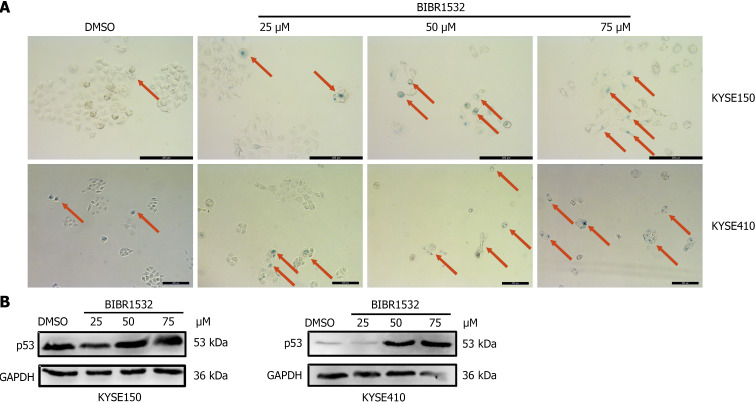
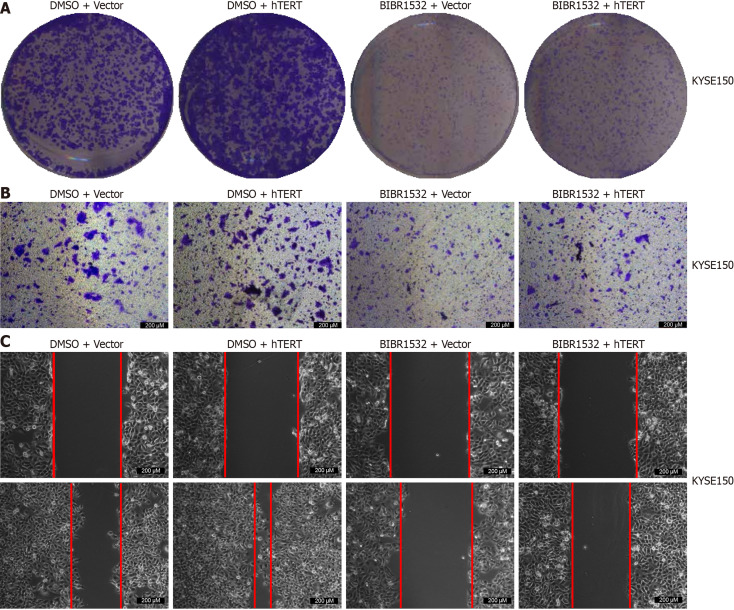
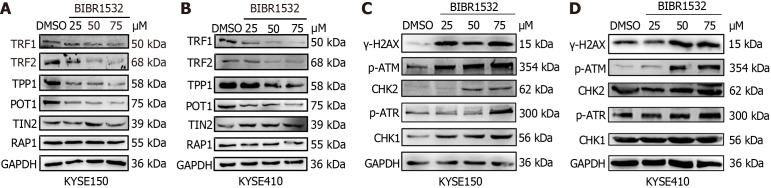
KYSE150 and KYSE410 cells were cultured and exposed to various concentrations of BIBR1532. Cell viability was assessed at 48 hours and 72 hours to determine the IC values. The effects of BIBR1532 on ESCC cell proliferation, migration, and cellular senescence were evaluated using the cell counting kit-8 assay, plate colony formation assay, scratch assay, transwell assay, and β-galactosidase staining, respectively. Western blotting was performed to detect the expression of proteins in BIBR1532-treated ESCC cells, such as human telomerase reverse transcriptase (hTERT), key molecules involved in DNA damage response (DDR) or cellular senescence, as well as telomere-binding proteins. Additionally, a tumor-bearing nude mouse model was established to evaluate the anti-cancer effect of BIBR1532 .
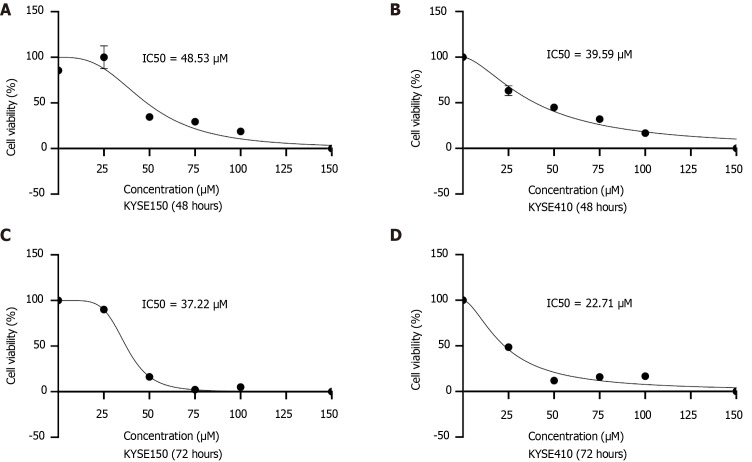
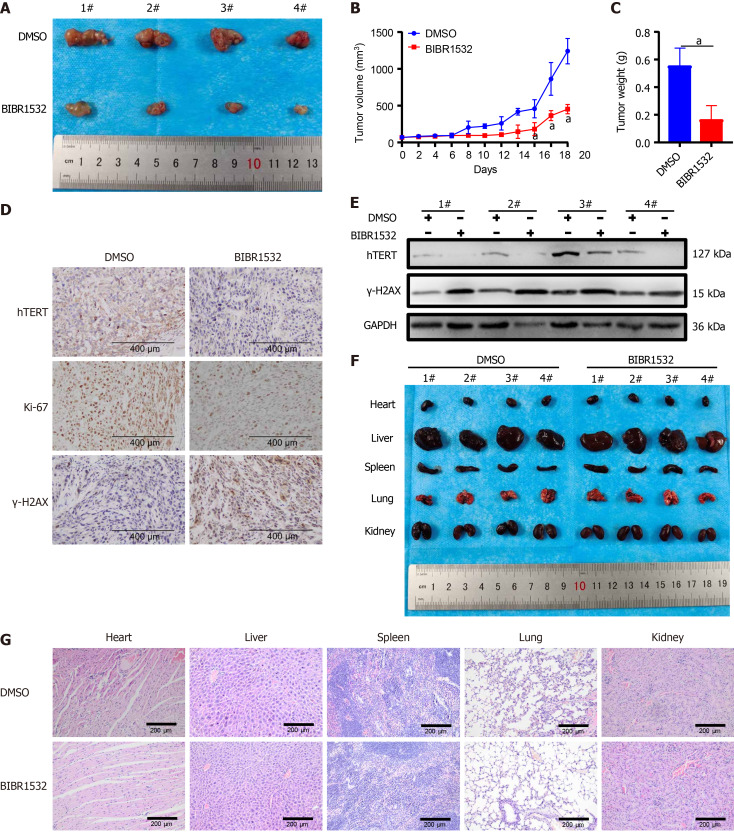
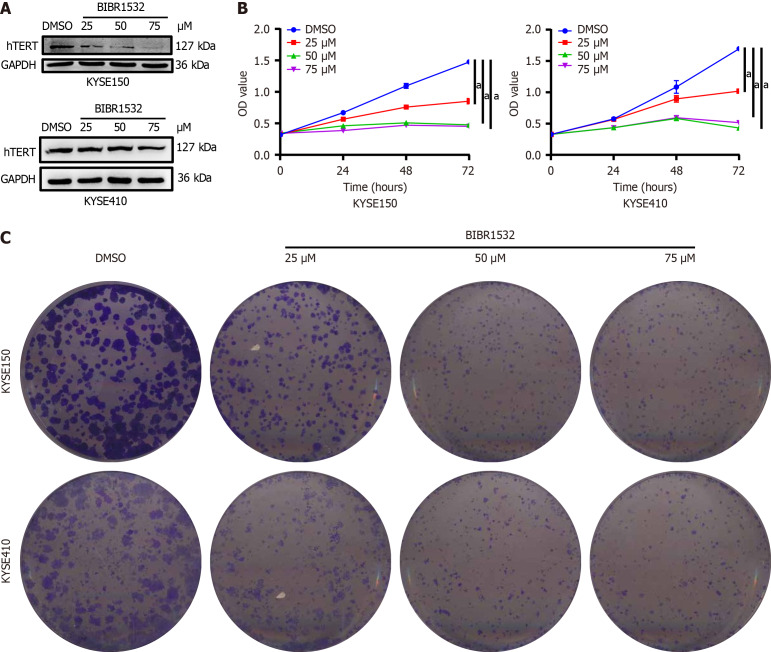
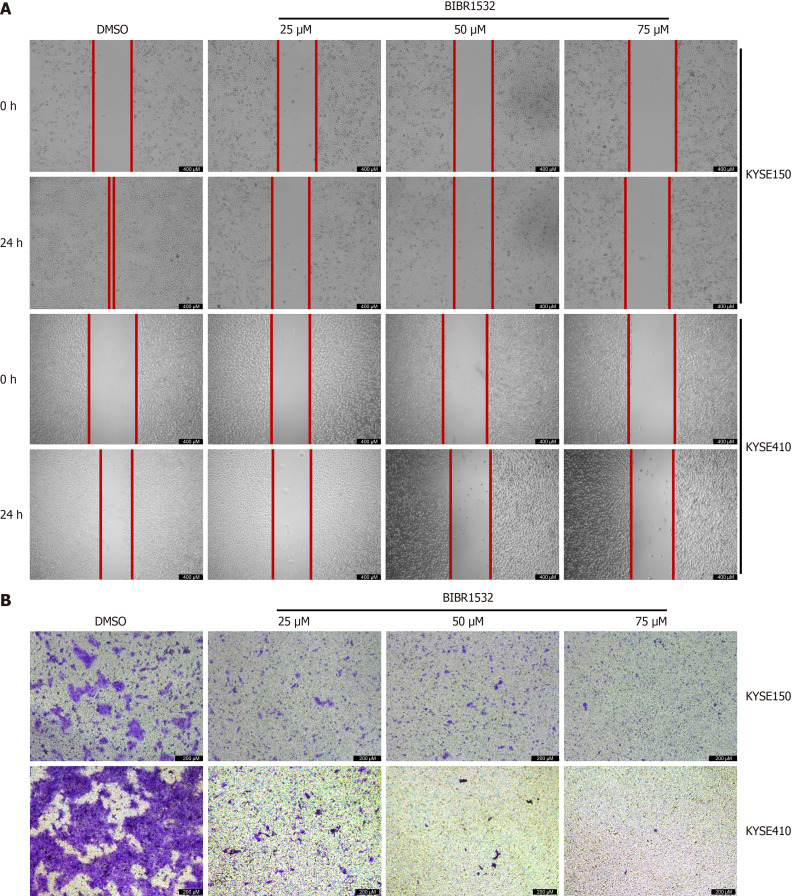
The IC values for KYSE150 and KYSE410 cells after 48 hours of BIBR1532 exposure were 48.53 μM and 39.59 μM, respectively. These values decreased to 37.22 μM and 22.71 μM, respectively, following a longer exposure of 72 hours. BIBR1532 exhibited dose-dependent effects on KYSE150 and KYSE410 cells, including decreased hTERT expression, inhibition of proliferation and metastasis, and induction of cellular senescence. Mechanistically, BIBR1532 upregulated the expression of the DDR protein, γ-H2AX, and activated the ataxia telangiectasia and Rad3-related protein (ATR)/ check point kinase 1 (CHK-1) and ataxia-telangiectasia mutated gene (ATM)/CHK2 pathways. BIBR1532 downregulated the expression of telomere-binding proteins, including telomeric-repeat binding factor 1 (TRF1), TRF2, protection of telomeres 1, and TIN2-interacting protein 1. In a nude mouse xenograft model, BIBR1532 significantly suppressed tumor growth, reduced hTERT expression, and increased γ-H2AX protein levels. Hematoxylin and eosin staining of various organs, including the heart, liver, spleen, lungs, and kidneys, revealed no apparent adverse effects.
BIBR1532 exerts anti-cancer effects on ESCC by inducing DDR through the ATR/CHK1 and ATM/CHK2 pathways and downregulating the expression of telomere-binding proteins.
食管鳞状细胞癌(ESCC)是一种发病率和死亡率都很高的恶性肿瘤,且容易对化疗药物产生耐药性。端粒是位于真核细胞染色体末端的DNA-蛋白质复合物,在维持基因组的稳定性和完整性方面具有不可替代的作用。端粒酶是一种依赖RNA的DNA聚合酶,在端粒长度维持中起关键作用,靶向端粒酶是一种很有前景的癌症治疗策略。
研究端粒酶抑制剂BIBR1532对食管鳞状细胞癌的疗效及潜在机制。
培养KYSE150和KYSE410细胞,并将其暴露于不同浓度的BIBR1532中。在48小时和72小时时评估细胞活力以确定IC值。分别使用细胞计数试剂盒-8法、平板克隆形成试验、划痕试验、Transwell试验和β-半乳糖苷酶染色来评估BIBR1532对食管鳞状细胞癌细胞增殖、迁移和细胞衰老的影响。进行蛋白质免疫印迹法检测BIBR1532处理的食管鳞状细胞癌细胞中蛋白质的表达,如人端粒酶逆转录酶(hTERT)、参与DNA损伤反应(DDR)或细胞衰老的关键分子以及端粒结合蛋白。此外,建立荷瘤裸鼠模型以评估BIBR1532的抗癌效果。
BIBR1532处理48小时后,KYSE150和KYSE410细胞的IC值分别为48.53 μM和39.59 μM。在延长至72小时的暴露后,这些值分别降至37.22 μM和22.71 μM。BIBR1532对KYSE150和KYSE410细胞表现出剂量依赖性作用,包括hTERT表达降低、增殖和转移抑制以及细胞衰老诱导。机制上,BIBR1532上调DDR蛋白γ-H2AX的表达,并激活共济失调毛细血管扩张症和Rad3相关蛋白(ATR)/检验点激酶1(CHK-1)以及共济失调毛细血管扩张症突变基因(ATM)/CHK2通路。BIBR1532下调端粒结合蛋白的表达,包括端粒重复结合因子1(TRF1)、TRF2、端粒保护蛋白1和TIN2相互作用蛋白1。在裸鼠异种移植模型中,BIBR1532显著抑制肿瘤生长,降低hTERT表达,并增加γ-H2AX蛋白水平。对心脏、肝脏、脾脏、肺和肾脏等各种器官进行苏木精-伊红染色,未发现明显不良反应。
BIBR1532通过ATR/CHK1和ATM/CHK2通路诱导DDR并下调端粒结合蛋白的表达,从而对食管鳞状细胞癌发挥抗癌作用。