Luo Bingqing, Wu Xia, Zhu Jing, Chen Shu, Lou Shifeng, Tan Xiaoyan
Department of Hematology, The Second Affiliated Hospital, Chongqing Medical University, Jiangnan, Chongqing, China.
Blood Coagul Fibrinolysis. 2025 Mar 1;36(2):44-50. doi: 10.1097/MBC.0000000000001340. Epub 2025 Jan 6.
Congenital factor VII (FVII) deficiency is a genetic disorder characterized by decreased FVII activity, which sometimes leads to fatal bleeding. Numerous variants have been found in FVII deficiency, but mutations vary among patients. Each mutation deserves further exploration for each patient at risk of bleeding. We previously reported a Chinese patient with p.L68R∗37 and p.T241N compound heterozygous mutations. In this study, we further investigated the impact of these two mutations on the FVII expression through in vitro expression experiments.
Mutations were introduced into the FVII coding region using site-directed mutagenesis, and recombinant FVII was combined with two different plasmids, and then quantitative PCR and western blot analyses were performed subsequently.
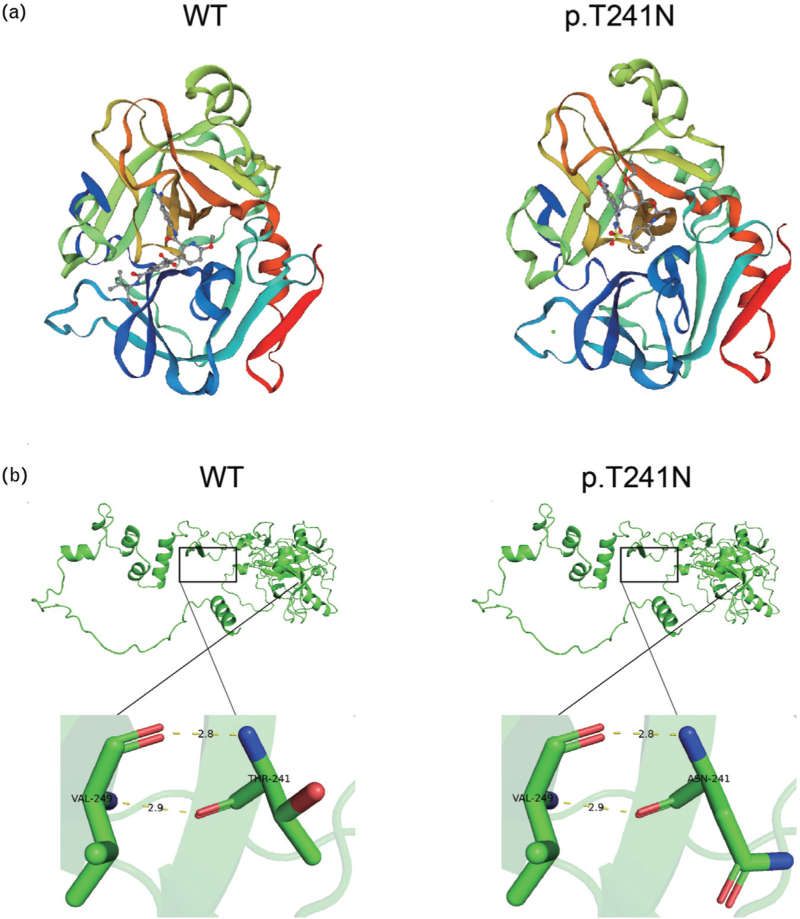
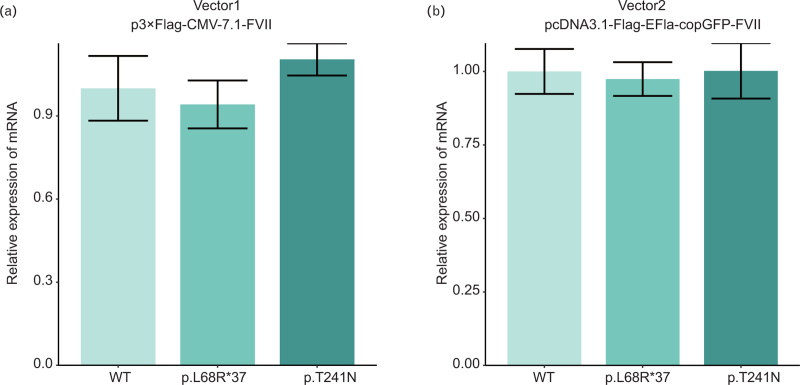
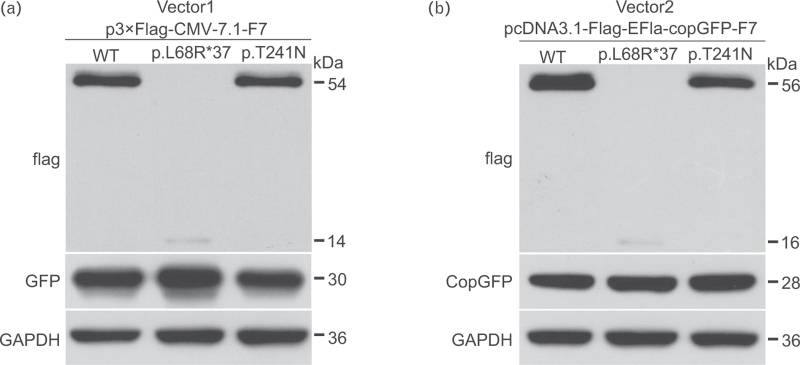
The p.L68R∗37 mutation had no effect on mRNA levels but caused a significant decrease in protein levels. In the p.T241N mutant vector, mRNA levels did not show a noticeable decrease, but protein levels exhibited a slight decrease. Structural analysis revealed that the p.T241N mutation resulted in an altered secondary structure and protein instability, indicating impaired functional properties.
Our study demonstrated that the p.L68R∗37 and p.T241N mutations impacted the protein levels and function of FVII, ultimately leading to a severe reduction in FVII activity. This study may contribute to further understanding of the molecular pathogenesis of FVII deficiency and offer insights for genetic counseling.
先天性凝血因子VII(FVII)缺乏是一种遗传性疾病,其特征是FVII活性降低,有时会导致致命性出血。在FVII缺乏症中已发现众多变异,但不同患者的突变情况各异。对于每一位有出血风险的患者,每种突变都值得进一步探究。我们之前报道过一位携带p.L68R∗37和p.T241N复合杂合突变的中国患者。在本研究中,我们通过体外表达实验进一步研究了这两种突变对FVII表达的影响。
使用定点诱变技术将突变引入FVII编码区,将重组FVII与两种不同质粒组合,随后进行定量PCR和蛋白质印迹分析。
p.L68R∗37突变对mRNA水平无影响,但导致蛋白质水平显著降低。在p.T241N突变载体中,mRNA水平未出现明显下降,但蛋白质水平略有降低。结构分析表明,p.T241N突变导致二级结构改变和蛋白质不稳定,提示功能特性受损。
我们的研究表明,p.L68R∗37和p.T241N突变影响了FVII的蛋白质水平和功能,最终导致FVII活性严重降低。本研究可能有助于进一步了解FVII缺乏的分子发病机制,并为遗传咨询提供见解。