Polizzi Alessandro, Boato Mattia, Serra Sara, D'Antò Vincenzo, Leonardi Rosalia
Department of General Surgery and Surgical-Medical Specialties, Section of Orthodontics, University of Catania, Via S. Sofia 68, Catania, 95124, Italy.
Department of Neurosciences, Reproductive Sciences and Oral Sciences, Section of Orthodontics, University of Naples "Federico II", via Pansini, 5, Naples, 80131, Italy.
Clin Oral Investig. 2025 Jan 16;29(1):65. doi: 10.1007/s00784-025-06158-y.
To conduct a comprehensive bibliometric analysis of the literature on artificial intelligence (AI) applications in orthodontics to provide a detailed overview of the current research trends, influential works, and future directions.
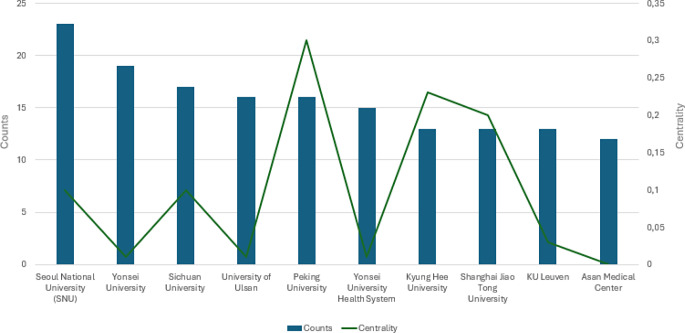
A research strategy in The Web of Science Core Collection has been conducted to identify original articles regarding the use of AI in orthodontics. Articles were screened and selected by two independent reviewers and the following data were imported and processed for analysis: rankings, centrality metrics, publication trends, co-occurrence and clustering of keywords, journals, articles, authors, nations, and organizations. Data were analyzed using CiteSpace 6.3.R2 and VOSviewer.
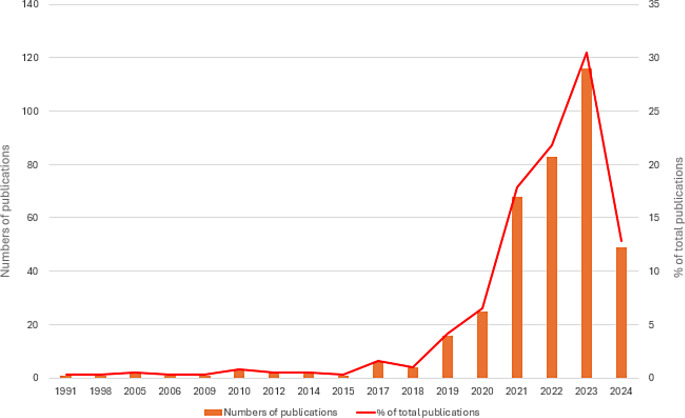
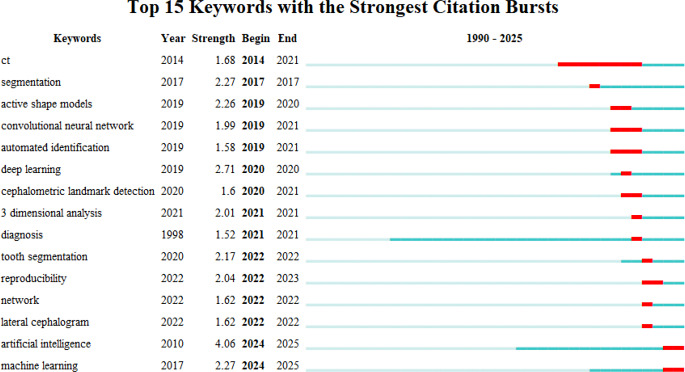
Almost 83% of the 381 chosen articles were released in the last three and a half years. Studies were published either in highly impacted orthodontic journals and also in journals related to informatics engineering, computer science, and medical imaging. Two-thirds of the available literature originated from China, the USA, and South Korea. AI-driven cephalometric landmarking and automatic segmentation were the main areas of research.
This report offers a thorough overview of the AI current trend in orthodontics and it highlights prominent research areas focused on increasing the speed and efficiency of orthodontic care. Furthermore, it offers insight into potential directions for future research.
Collaborative research efforts will be necessary to strengthen the maturity and robustness of AI models and to make AI-based clinical research sufficiently reliable for routine orthodontic clinical practice.
对正畸学中人工智能(AI)应用的文献进行全面的文献计量分析,以详细概述当前的研究趋势、有影响力的著作和未来方向。
在科学网核心合集中开展了一项研究策略,以识别有关正畸学中使用AI的原始文章。由两名独立审稿人对文章进行筛选和选择,并导入和处理以下数据进行分析:排名、中心性指标、发表趋势、关键词的共现和聚类、期刊、文章、作者、国家和组织。使用CiteSpace 6.3.R2和VOSviewer对数据进行分析。
在所选的381篇文章中,近83%是在过去三年半内发表的。研究发表在影响较大的正畸学期刊以及与信息工程、计算机科学和医学成像相关的期刊上。三分之二的现有文献来自中国、美国和韩国。AI驱动的头影测量标志点定位和自动分割是主要研究领域。
本报告全面概述了正畸学中AI的当前趋势,并突出了专注于提高正畸治疗速度和效率的突出研究领域。此外,它还提供了对未来研究潜在方向的见解。
加强AI模型的成熟度和稳健性,并使基于AI的临床研究对于常规正畸临床实践足够可靠,需要开展合作研究。