
人工智能相关的牙科研究:文献计量学与替代计量学分析
Artificial Intelligence-Related Dental Research: Bibliometric and Altmetric Analysis.
作者信息
Lu Wei, Yu Xueqian, Li Yueyang, Cao Yi, Chen Yanning, Hua Fang
机构信息
State Key Laboratory of Oral & Maxillofacial Reconstruction and Regeneration, Key Laboratory of Oral Biomedicine Ministry of Education, Hubei Key Laboratory of Stomatology, School & Hospital of Stomatology, Wuhan University, Wuhan, China.
State Key Laboratory of Oral & Maxillofacial Reconstruction and Regeneration, Key Laboratory of Oral Biomedicine Ministry of Education, Hubei Key Laboratory of Stomatology, School & Hospital of Stomatology, Wuhan University, Wuhan, China; Library, School & Hospital of Stomatology, Wuhan University, Wuhan, China.
出版信息
Int Dent J. 2025 Feb;75(1):166-175. doi: 10.1016/j.identj.2024.08.004. Epub 2024 Sep 11.
BACKGROUND
Recent years have witnessed an explosive surge in dental research related to artificial intelligence (AI). These applications have optimised dental workflows, demonstrating significant clinical importance. Understanding the current landscape and trends of this topic is crucial for both clinicians and researchers to utilise and advance this technology. However, a comprehensive scientometric study regarding this field had yet to be performed.
METHODS
A literature search was conducted in the Web of Science Core Collection database to identify eligible "research articles" and "reviews." Literature screening and exclusion were performed by 2 investigators. Thereafter, VOSviewer was utilised in co-occurrence analysis and CiteSpace in co-citation analysis. R package Bibliometrix was employed to automatically calculate scientific impacts, determining the core authors and journals. Altmetric data were described narratively and supplemented with Spearman correlation analysis.
RESULTS
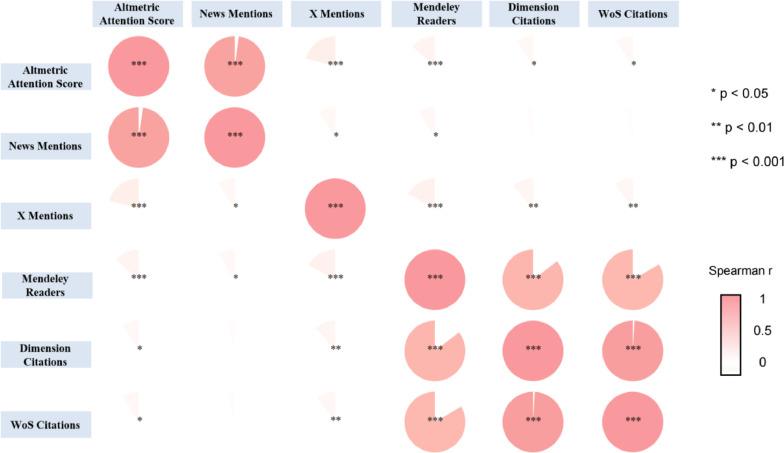
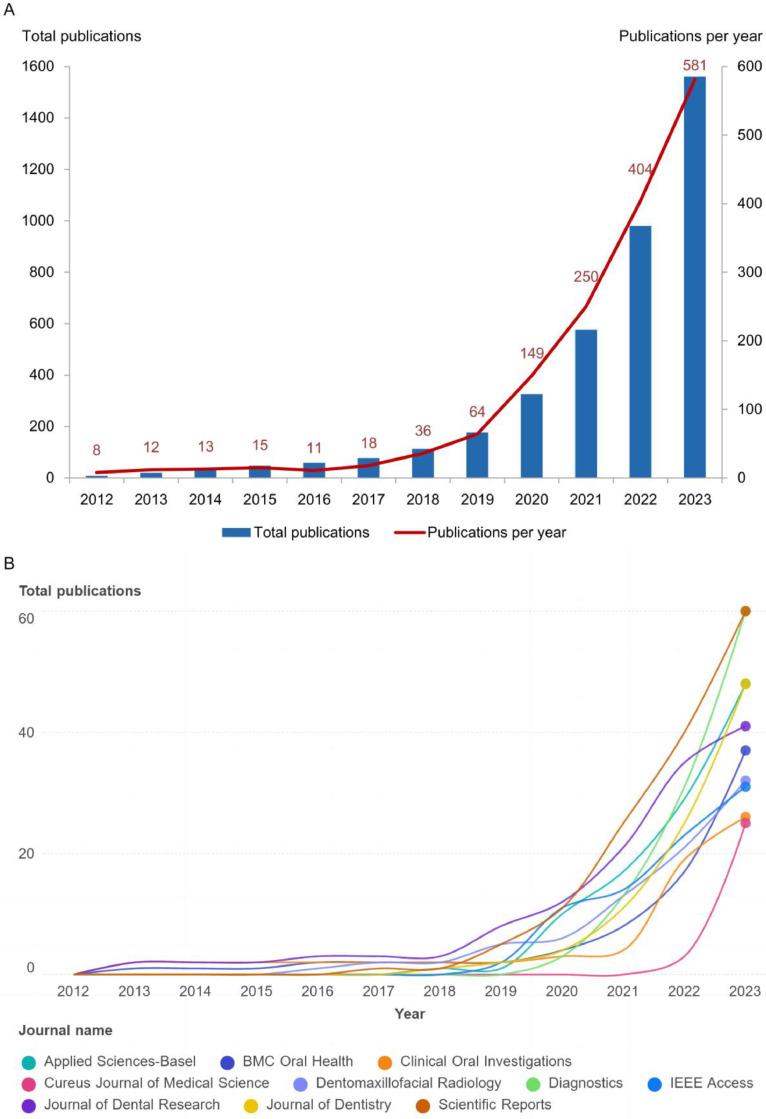
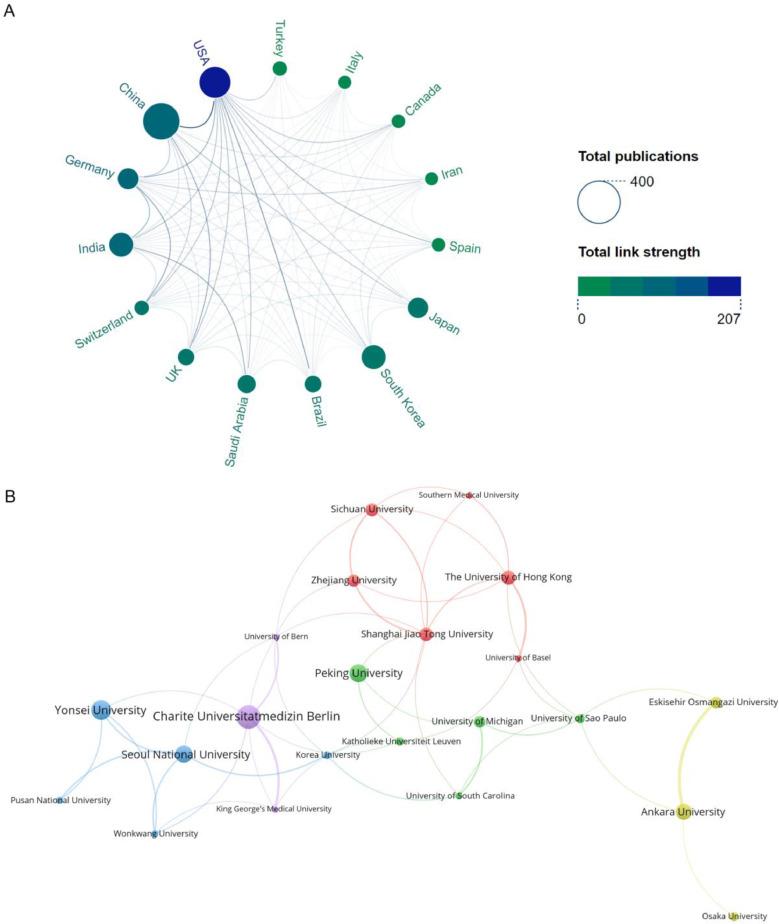
A total of 1558 research publications were included. During the past 5 years, AI-related dental publications drastically increased in number, from 36 to 581. Diagnostics and Scientific Reports published the most articles, whereas Journal of Dental Research received the highest number of citations per article. China, the US, and South Korea emerged as the most prolific countries, whilst Germany received the highest number of citations per article (23.29). Charité Universitätsmedizin Berlin was the institution with the highest number of publications and citations per article (29.16). Altmetric Attention Score was correlated with News Mentions (P < .001), and significant associations were observed amongst Dimension Citations, Mendeley Readers, and Web of Science Citations (P < .001).
CONCLUSIONS
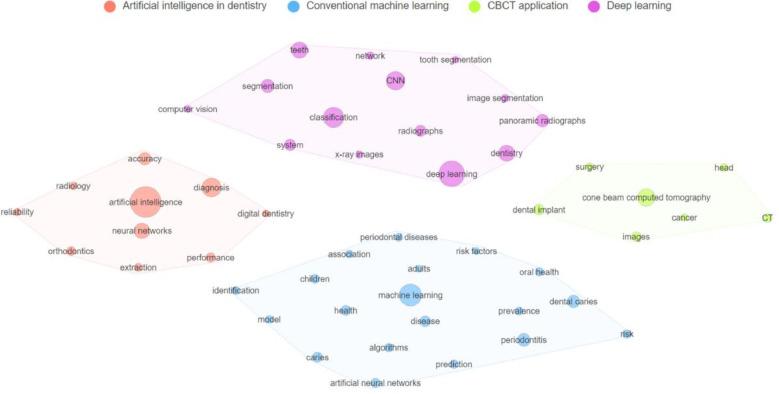
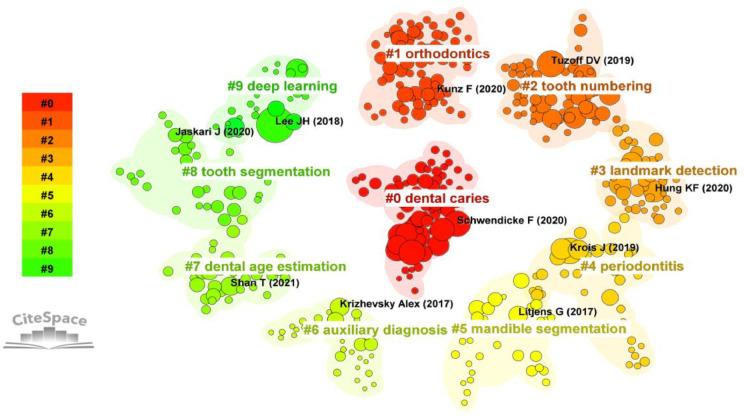
The publication numbers regarding AI-related dental research have been rising rapidly and may continue their upwards trend. China, the US, South Korea, and Germany had promoted the progress of AI-related dental research. Disease diagnosis, orthodontic applications, and morphology segmentation were current hotspots. Attention mechanism, explainable AI, multimodal data fusion, and AI-generated text assistants necessitate future research and exploration.
背景
近年来,与人工智能(AI)相关的牙科研究呈爆发式增长。这些应用优化了牙科工作流程,具有重要的临床意义。了解该主题的当前状况和趋势对于临床医生和研究人员利用和推进这项技术至关重要。然而,尚未对该领域进行全面的科学计量学研究。
方法
在科学网核心合集数据库中进行文献检索,以识别符合条件的“研究文章”和“综述”。由两名研究人员进行文献筛选和排除。此后,使用VOSviewer进行共现分析,使用CiteSpace进行共被引分析。采用R包Bibliometrix自动计算科学影响力,确定核心作者和期刊。对Altmetric数据进行描述性叙述,并辅以Spearman相关性分析。
结果
共纳入1558篇研究出版物。在过去5年中,与AI相关的牙科出版物数量急剧增加,从36篇增至581篇。《诊断学》和《科学报告》发表的文章最多,而《牙科研究杂志》每篇文章的被引次数最高。中国、美国和韩国是发文量最多的国家,而德国每篇文章的被引次数最高(23.29)。柏林夏里特大学医学院是发文量和每篇文章被引次数最高的机构(29.16)。Altmetric关注度得分与新闻提及相关(P <.001),并且在维度引用次数、Mendeley读者数和科学网引用次数之间观察到显著关联(P <.001)。
结论
与AI相关的牙科研究的出版物数量一直在迅速上升,并且可能继续呈上升趋势。中国、美国、韩国和德国推动了与AI相关的牙科研究的进展。疾病诊断、正畸应用和形态学分割是当前热点。注意力机制、可解释AI、多模态数据融合和AI生成的文本助手需要未来的研究和探索。
 Zotero 插件