Mohammadi Laleh, Tagharrobi Zahra, Sharifi Khadijeh, Sooki Zahra, Zare Mohammad, Zare Joshaghani Fatemeh
Student Research Committee, Faculty of Nursing and Midwifery, Kashan University of Medical Sciences, Kashan, IR, Iran.
Trauma Nursing Research Center, Kashan University of Medical Sciences, Kashan, Iran.
BMC Pediatr. 2025 Jan 20;25(1):48. doi: 10.1186/s12887-024-05371-0.
Considering the importance of sleep disorders in children with attention-deficit/hyperactivity disorder (ADHD) and effective therapeutic strategies, the present study aimed to investigate the effects of auriculotherapy on sleep quality in children with ADHD.
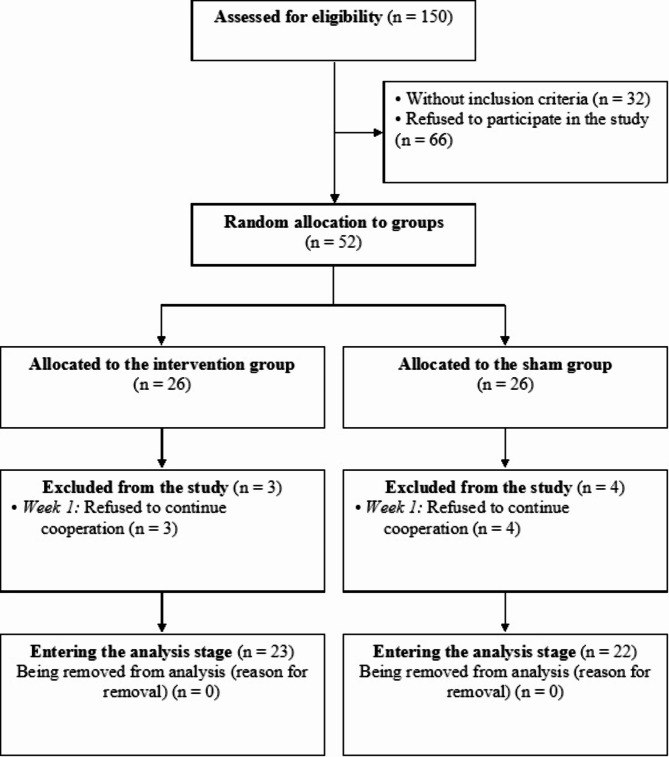
This clinical trial was conducted in children with ADHD in Kashan, Iran, 2021-2022. Fifty-two eligible samples were selected using convenience sampling and randomly assigned to intervention and sham groups. The intervention group used Vacaria seeds to apply ear acupressure to Shenmen, Sympathetic, Subcortex, Heart, and Endocrine points for four weeks, while the sham group received adhesives without seeds and pressure. Sleep quality was assessed using children's sleep habits questionnaire at the beginning (T0), at the end of the intervention (T1), and one month later (T2). Data from 45 children (23 and 22 children in the intervention and sham groups, respectively) were analyzed using the per-protocol and intention-to-treat designs using repeated measures analysis of variance.
The background variables did not significantly differ between two groups. The between-group analysis revealed a significant interaction effect of time and intervention on sleep quality (Effect Size = 0.545, p < 0.0001). The sleep quality score in the intervention group was significantly greater than in the sham group at T1 and T2 (p < 0.0001). The within-group analysis of the intervention group revealed a significant difference in sleep quality scores at three time points (Effect Size = 0.672, p < 0.05). In the sham group, sleep quality score increased significantly over time (Effect Size = 0.511, p < 0.05).
The findings suggest that auriculotherapy may be a beneficial complementary treatment for improving sleep quality in children with ADHD.
鉴于睡眠障碍在注意力缺陷多动障碍(ADHD)儿童中的重要性以及有效的治疗策略,本研究旨在探讨耳穴疗法对ADHD儿童睡眠质量的影响。
本临床试验于2021 - 2022年在伊朗卡尚的ADHD儿童中进行。采用便利抽样法选取52例符合条件的样本,并随机分为干预组和假治疗组。干预组使用王不留行籽对神门、交感、皮质下、心、内分泌等耳穴进行按压,持续四周,而假治疗组接受不含籽的胶布且不施加压力。在干预开始时(T0)、干预结束时(T1)和一个月后(T2),使用儿童睡眠习惯问卷评估睡眠质量。采用重复测量方差分析,对45例儿童(干预组23例,假治疗组22例)的数据按照符合方案分析和意向性分析设计进行分析。
两组的基线变量无显著差异。组间分析显示时间和干预对睡眠质量有显著的交互作用(效应量 = 0.545,p < 0.0001)。在T1和T2时,干预组的睡眠质量得分显著高于假治疗组(p < 0.0001)。干预组的组内分析显示三个时间点的睡眠质量得分有显著差异(效应量 = 0.672,p < 0.05)。在假治疗组中,睡眠质量得分随时间显著增加(效应量 = 0.511,p < 0.05)。
研究结果表明,耳穴疗法可能是改善ADHD儿童睡眠质量的一种有益的辅助治疗方法。