Gubbiotti Maria A, McCutcheon Ian E, Rao Priya, Genovese Giannicola, Wang Linghua, Tarasov Artem, Putintsev Vladislav, Berlinski Amber, Stupichev Danil, Kriukov Kirill, Davitavyan Suren, Salem Basim, Sarachakov Alexander, Lebedev Dmitry, Hensley Michael, Bagaev Alexander, Paradiso Francesca, Kushnarev Vladimir, Khegai Gleb, Tannir Nizar M, Msaouel Pavlos
Department of Pathology, The University of Texas MD Anderson Cancer Center, 1515 Holcombe Boulevard, Unit 85, Houston, TX, 77030-3721, USA.
Department of Neurosurgery, University of Texas MD Anderson Cancer Center, Houston, TX, USA.
Acta Neuropathol Commun. 2025 Jan 20;13(1):12. doi: 10.1186/s40478-025-01929-w.
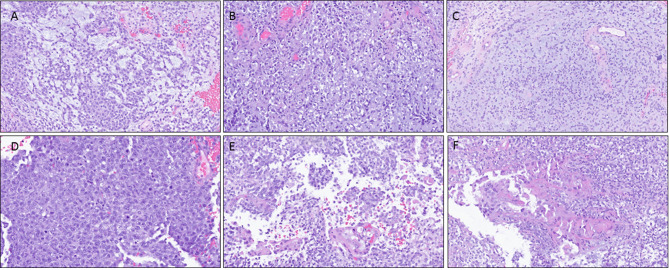
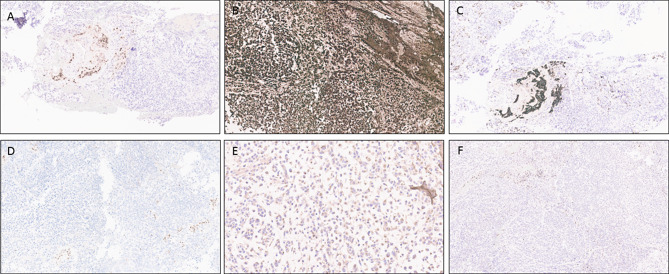
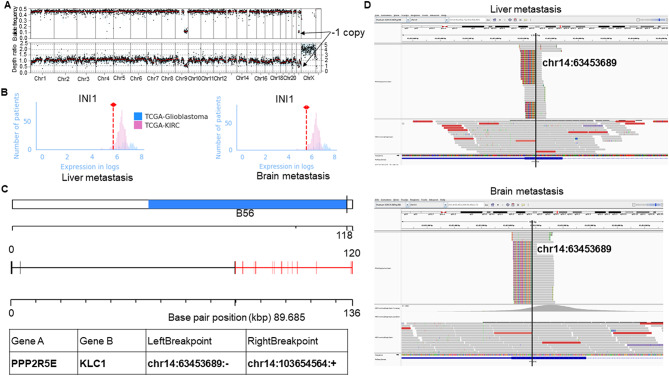
Renal medullary carcinoma is a rare undifferentiated tumor of the kidney associated with sickle cell trait and characterized by INI1 (SMARCB1) loss. Although metastasis to lungs, lymph nodes, and bone is commonly reported, distant spread to the central nervous system almost never occurs. Here we present an unusual case of a patient with renal medullary carcinoma with metastasis to the brain following treatment which included tazemetostat, an EZH2 inhibitor. The metastatic brain lesion harbored morphologic, immunohistochemical, and methylation profile supportive of a primary CNS phenotype with loss of the trimethylated lysine 27 residue of histone 3 while maintaining INI1 loss and a specific gene fusion shared with the patient's tumor prior to initiation of tazemetostat therapy. Therefore, given the common genetic signatures in the brain metastasis and the patient's prior tumor, this case represents a rare event of glial transdifferentiation in a brain metastasis of renal medullary carcinoma following the use of an epigenetic modulator. As renal medullary carcinoma has been known to cleverly utilize adaptive mechanisms for survival, we propose that such cell plasticity seen in this case may have been provoked by the use of a drug that alters the epigenetic signature of the tumor cells. Thus, careful assessment of tumor biology following novel therapeutic treatment options must be performed in order to note such unexpected consequences of treatment.
肾髓质癌是一种罕见的肾脏未分化肿瘤,与镰状细胞性状相关,其特征是INI1(SMARCB1)缺失。虽然肺、淋巴结和骨转移较为常见,但几乎从未发生过远处转移至中枢神经系统的情况。在此,我们报告一例不寻常的病例,一名肾髓质癌患者在接受包括EZH2抑制剂他泽司他的治疗后发生脑转移。转移性脑病变具有形态学、免疫组化和甲基化特征,支持原发性中枢神经系统表型,伴有组蛋白3赖氨酸27三甲基化残基缺失,同时维持INI1缺失以及与患者在开始他泽司他治疗前的肿瘤共有的特定基因融合。因此,鉴于脑转移灶与患者先前肿瘤存在共同的基因特征,该病例代表了肾髓质癌脑转移在使用表观遗传调节剂后罕见的神经胶质转分化事件。由于已知肾髓质癌巧妙地利用适应性机制来生存,我们提出该病例中所见的这种细胞可塑性可能是由改变肿瘤细胞表观遗传特征的药物所引发。因此,在采用新的治疗方案后,必须仔细评估肿瘤生物学特性,以便注意到此类意外的治疗后果。