Ye Zixiang, Xie Enmin, Guo Ziyu, Gao Yanxiang, Han Zhongwei, Dou Kefei, Zheng Jingang
Department of Cardiology, Fuwai Hospital, National Center for Cardiovascular Diseases, Chinese Academy of Medical Sciences and Peking Union Medical College, Beijing, China.
Department of Cardiology, Peking University China-Japan Friendship School of Clinical Medicine, Beijing, China.
Cardiorenal Med. 2025;15(1):153-163. doi: 10.1159/000543500. Epub 2025 Jan 21.
The objective of this research was to explore the possible link between markers of liver fibrosis and survival rates in a group of adults who have been diagnosed with both chronic kidney disease (CKD) and coronary artery disease (CAD).
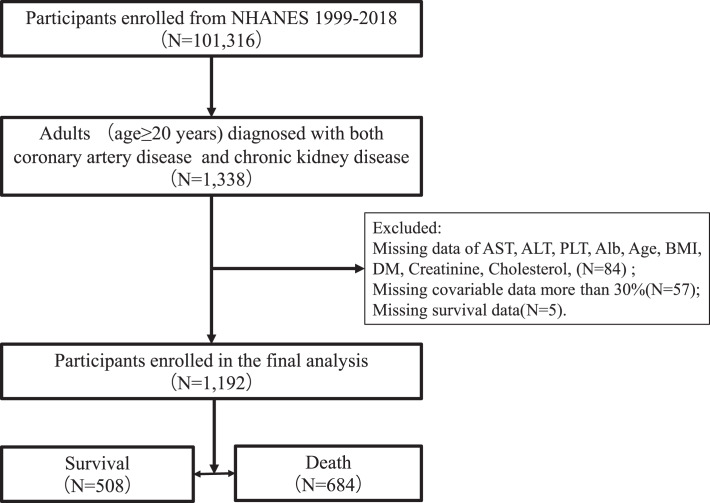
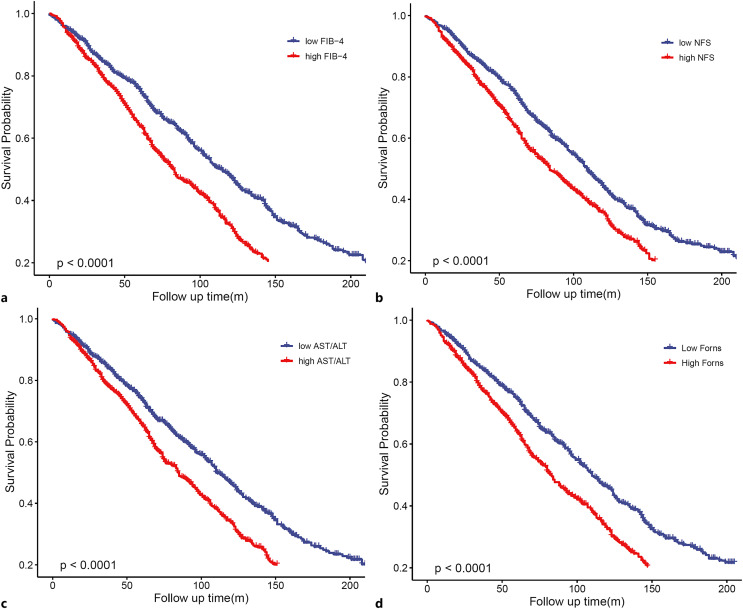
The National Health and Nutrition Examination Survey (NHANES) data (1999-2018) for participants with both CAD and CKD were analyzed. The fibrosis-4 index (FIB-4), Nonalcoholic Fatty Liver Score (NFS), Forns index, and aspartate aminotransferase/alanine aminotransferase (AST/ALT) ratio were identified as crucial biomarkers. All-cause and cardiovascular disease (CVD) mortality were primary outcomes, assessed using Cox models, Kaplan-Meier curves, and receiver operating characteristic (ROC) analysis.
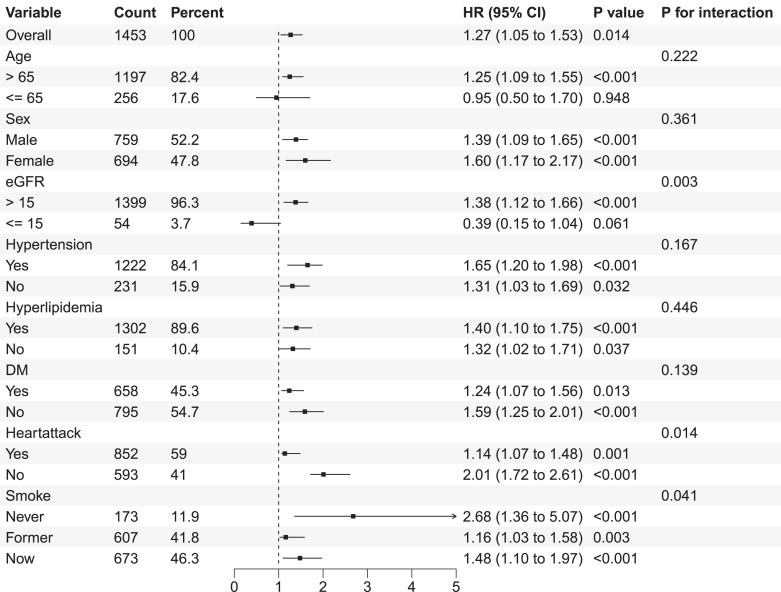
A total of 1,192 CKD and CAD patients were included. The Cox regression analysis revealed substantial correlations between elevated FIB-4, NFS, Forns index, and AST/ALT levels and a heightened risk of all-cause (hazard ratio [HR]: 1.188, 95% confidence interval [CI]: 1.108-1.274; HR: 1.145, 95% CI: 1.069-1.227; HR: 1.142, 95% CI: 1.081-1.201; HR: 1.316, 95% CI: 1.056-1.639, respectively) and CVD mortality (HR: 1.133, 95% CI: 1.007-1.275; HR: 1.155, 95% CI: 1.024-1.303; HR: 1.208, 95% CI: 1.109-1.316 and HR: 1.636, 95% CI: 1.203-2.224, respectively). The ROC analysis indicated comparable predictive accuracy for all three biomarkers, with AST/ALT showing slightly superior performance.
Liver fibrosis markers, including AST/ALT, NFS, Forns index and FIB-4, are significant mortality predictors in CAD-CKD patients. The AST/ALT ratio, being easily measurable, may serve as an effective predictive tool for risk stratification in this population.
本研究的目的是探讨一组同时被诊断患有慢性肾脏病(CKD)和冠状动脉疾病(CAD)的成年人中,肝纤维化标志物与生存率之间的可能联系。
分析了患有CAD和CKD的参与者的美国国家健康与营养检查调查(NHANES)数据(1999 - 2018年)。纤维化-4指数(FIB-4)、非酒精性脂肪肝评分(NFS)、福恩斯指数以及天冬氨酸转氨酶/丙氨酸转氨酶(AST/ALT)比值被确定为关键生物标志物。全因死亡率和心血管疾病(CVD)死亡率是主要结局,使用Cox模型、Kaplan-Meier曲线和受试者工作特征(ROC)分析进行评估。
共纳入1192例CKD和CAD患者。Cox回归分析显示,FIB-4、NFS、福恩斯指数升高以及AST/ALT水平升高与全因死亡风险增加(风险比[HR]:1.188,95%置信区间[CI]:1.108 - 1.274;HR:1.145,95% CI:1.069 - 1.227;HR:1.142,95% CI:1.081 - 1.201;HR:1.316,95% CI:1.056 - 1.639,分别)和CVD死亡风险增加(HR:1.133,95% CI:1.007 - 1.275;HR:1.155,95% CI:1.024 - 1.303;HR:1.208,95% CI:1.109 - 1.316;HR:1.636,95% CI:1.203 - 2.224,分别)之间存在显著相关性。ROC分析表明,这三种生物标志物的预测准确性相当,其中AST/ALT表现略优。
包括AST/ALT、NFS、福恩斯指数和FIB-4在内的肝纤维化标志物是CAD-CKD患者死亡率的重要预测指标。AST/ALT比值易于测量,可作为该人群风险分层的有效预测工具。