Kimura Noriyuki, Sasaki Kotaro, Masuda Teruaki, Ataka Takuya, Matsumoto Mariko, Kitamura Mika, Nakamura Yosuke, Matsubara Etsuro
Department of Neurology, Faculty of Medicine, Oita University, 1-1 Idaigaoka, Hasama-machi, Yufu, Oita, 879-5593, Japan.
Human Biology Integration Foundation, Deep Human Biology Learning, Eisai Co., Ltd, 4-6-10 Koishikawa, Bunkyo-ku, Tokyo, 112-8088, Japan.
Alzheimers Res Ther. 2025 Jan 21;17(1):25. doi: 10.1186/s13195-024-01650-1.
Intracerebral amyloid β (Aβ) accumulation is considered the initial observable event in the pathological process of Alzheimer's disease (AD). Efficient screening for amyloid pathology is critical for identifying patients for early treatment. This study developed machine learning models to classify positron emission tomography (PET) Aβ-positivity in participants with preclinical and prodromal AD using data accessible to primary care physicians.
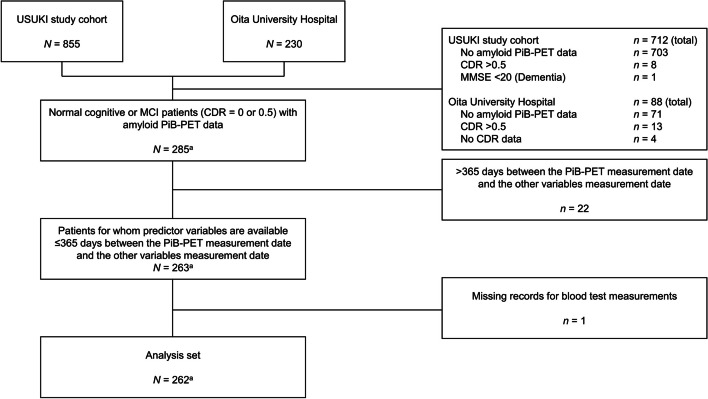
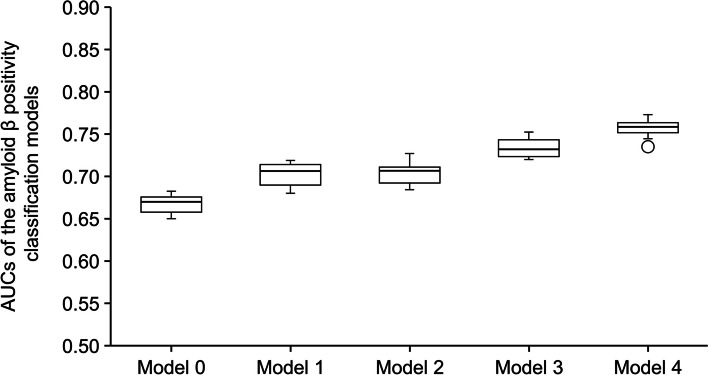
This retrospective observational study assessed the classification performance of combinations of demographic characteristics, routine blood test results, and cognitive test scores to classify PET Aβ-positivity using machine learning. Participants with mild cognitive impairment (MCI) or normal cognitive function who visited Oita University Hospital or had participated in the USUKI study and met the study eligibility criteria were included. The primary endpoint was assessment of the classification performance of the presence or absence of intracerebral Aβ accumulation using five machine learning models (i.e., five combinations of variables), each constructed with three classification algorithms, resulting in a total of 15 patterns. L2-regularized logistic regression, and kernel Support Vector Machine (SVM) and Elastic Net algorithms were used to construct the classification models using 34 pre-selected variables (12 demographic characteristics, 11 blood test results, 11 cognitive test results).
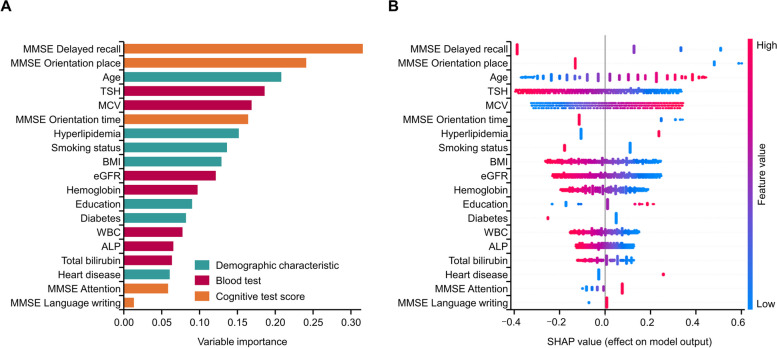
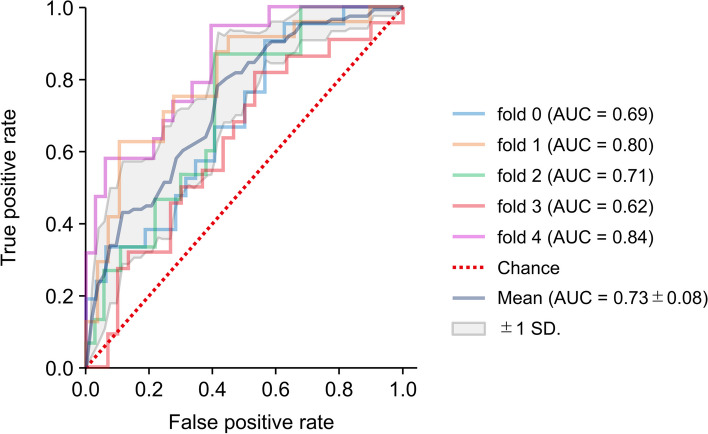
Data from 262 records (260 unique participants) were analyzed. The mean (standard deviation [SD]) participant age was 73.8 (7.8) years. Using L2-regularized logistic regression, the mean receiver operating characteristic (ROC) area under the curve (AUC) (SD) in Model 0 (basic demographic characteristics) was 0.67 (0.01). Classification performance was similar in Model 1 (basic demographic characteristics and Mini Mental State Examination [MMSE] subscores) and Model 2 (demographic characteristics and blood test results) with a cross-validated mean ROC AUC (SD) of 0.70 (0.01) for both. Model 3 (demographic characteristics, blood test results, MMSE subscores) and Model 4 (Model 3 and ApoE4 phenotype) showed improved performance with a mean ROC AUC (SD) of 0.73 (0.01) and 0.76 (0.01), respectively. In models using blood test results, thyroid-stimulating hormone and mean corpuscular volume tended to be the largest contributors to classification. Classification performances were similar using the SVM and Elastic Net algorithms.
The machine learning models used in this study were useful for classifying PET Aβ-positivity using data from routine physician visits.
UMIN Clinical Trials Registry (UMIN000051776, registered on 31/08/2023).
脑内淀粉样β(Aβ)沉积被认为是阿尔茨海默病(AD)病理过程中最初可观察到的事件。有效筛查淀粉样蛋白病理对于识别早期治疗的患者至关重要。本研究开发了机器学习模型,以使用基层医疗医生可获取的数据对临床前和前驱期AD参与者的正电子发射断层扫描(PET)Aβ阳性进行分类。
这项回顾性观察研究评估了人口统计学特征、常规血液检查结果和认知测试分数的组合对PET Aβ阳性进行分类的机器学习分类性能。纳入了访问大分大学医院或参加了USUKI研究并符合研究纳入标准的轻度认知障碍(MCI)或认知功能正常的参与者。主要终点是使用五种机器学习模型(即五种变量组合)评估脑内Aβ沉积存在与否的分类性能,每个模型由三种分类算法构建,总共产生15种模式。使用L2正则化逻辑回归、核支持向量机(SVM)和弹性网络算法,利用34个预先选择的变量(12个人口统计学特征、11项血液检查结果、11项认知测试结果)构建分类模型。
分析了来自262份记录(260名独特参与者)的数据。参与者的平均(标准差[SD])年龄为73.8(7.8)岁。使用L2正则化逻辑回归,模型0(基本人口统计学特征)中曲线下平均受试者工作特征(ROC)面积(AUC)(SD)为0.67(0.01)。模型1(基本人口统计学特征和简易精神状态检查表[MMSE]子分数)和模型2(人口统计学特征和血液检查结果)的分类性能相似,交叉验证的平均ROC AUC(SD)均为0.70(0.01)。模型3(人口统计学特征、血液检查结果、MMSE子分数)和模型4(模型3和ApoE4表型)表现出更好的性能,平均ROC AUC(SD)分别为0.73(0.01)和0.76(0.01)。在使用血液检查结果的模型中,促甲状腺激素和平均红细胞体积往往是对分类贡献最大的因素。使用SVM和弹性网络算法的分类性能相似。
本研究中使用的机器学习模型有助于利用常规医生问诊数据对PET Aβ阳性进行分类。
UMIN临床试验注册中心(UMIN000051776,于2023年8月31日注册)。