
脓毒症预后生物标志物的鉴定及ceRNA调控网络的构建
Identification of prognostic biomarkers of sepsis and construction of ceRNA regulatory networks.
作者信息
Chen Guihong, Zhang Wen, Wang Chenglin, Chen Muhu, Hu Yingchun, Wang Zheng
机构信息
Department of Hepatobiliary Surgery, The First Affiliated Hospital of Xi'an Jiaotong University, Xi'an, Shaanxi, China.
Department of Emergency Medicine, The Affiliated Hospital of Southwest Medical University, Luzhou, Sichuan, China.
出版信息
Sci Rep. 2025 Jan 22;15(1):2850. doi: 10.1038/s41598-024-78502-3.
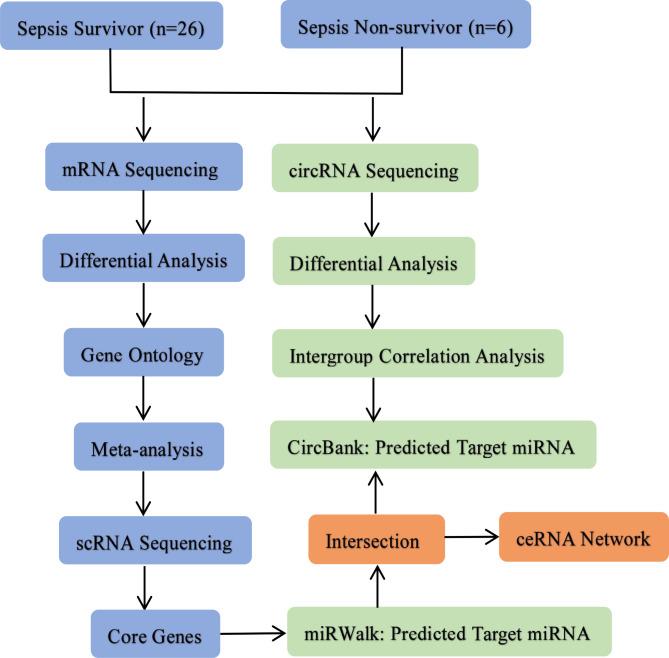
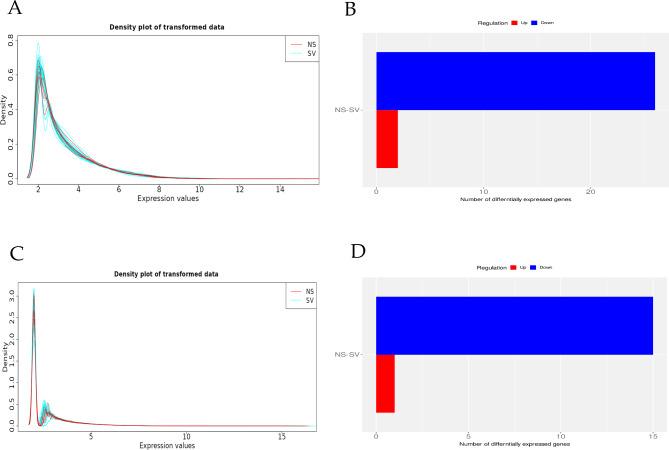
Sepsis is a life-threatening severe organ dysfunction, and the pathogenesis remains uncertain. Increasing evidence suggests that circRNAs, mRNAs, and microRNAs can interact to jointly regulate the development of sepsis. Identifying the interaction between ceRNA regulatory networks and sepsis may contribute to our deeper understanding of the pathogenesis of sepsis, bring new insights into early recognition and treatment of sepsis. Blood samples from sepsis patients in the Affiliated Hospital of Southwest Medical University were collected. RNA sequencing (mRNA/circRNA) was performed on Survivor group (n = 26) and Non-survivor group (n = 6), then quality control and differential expression analysis were performed. Subsequently, GO analysis was performed on the differential expression genes; Meta-analysis was used to screen for prognostic related genes; 10 × Single-cell RNA sequencing was used to annotate the cell distribution of core genes. Finally, combined with base complementary pairing and intergroup correlation analysis, a sepsis-associated circRNA-miRNA-mRNA regulatory network was constructed. Differential expression analysis screened 28 mRNAs and 16 circRNAs. GO results showed that differential expression genes were mainly involved in membrane raft, actin cytoskeleton, regulation of immune response, negative regulation of cAMP-dependent protein kinase activity, etc. Meta-analysis screened 2 core genes, GSPT1 and NPRL3, which are associated with sepsis prognosis. 10 × Single-cell RNA sequencing showed that GSPT1 and NPRL3 were widely localized in immune cells, mainly macrophages and T cells. A ceRNA network consisting of 4 circRNA, 26 miRNA, and 2 mRNA was constructed. GSPT1 and NPRL3 were lowly expressed in the sepsis Survivor group, compared with Non-survivor group, which may become novel prognostic biomarkers for sepsis. A sepsis-related ceRNA networks, which consists of 4 circRNA, 26 miRNA, and 2 core gene, may guide mechanistic studies.
脓毒症是一种危及生命的严重器官功能障碍,其发病机制尚不确定。越来越多的证据表明,环状RNA、信使核糖核酸和微小核糖核酸可以相互作用,共同调节脓毒症的发展。确定竞争性内源RNA(ceRNA)调控网络与脓毒症之间的相互作用,可能有助于我们更深入地了解脓毒症的发病机制,为脓毒症的早期识别和治疗带来新的见解。收集了西南医科大学附属医院脓毒症患者的血液样本。对存活组(n = 26)和非存活组(n = 6)进行了RNA测序(信使核糖核酸/环状RNA),然后进行质量控制和差异表达分析。随后,对差异表达基因进行基因本体(GO)分析;采用荟萃分析筛选预后相关基因;使用10×单细胞RNA测序对核心基因的细胞分布进行注释。最后,结合碱基互补配对和组间相关性分析,构建了脓毒症相关的环状RNA-微小核糖核酸-信使核糖核酸调控网络。差异表达分析筛选出28个信使核糖核酸和16个环状RNA。GO结果显示,差异表达基因主要参与膜筏、肌动蛋白细胞骨架、免疫反应调节、环磷酸腺苷依赖性蛋白激酶活性的负调控等。荟萃分析筛选出2个与脓毒症预后相关的核心基因,即GSPT1和NPRL3。10×单细胞RNA测序显示,GSPT1和NPRL3广泛定位于免疫细胞,主要是巨噬细胞和T细胞。构建了一个由4个环状RNA、26个微小核糖核酸和2个信使核糖核酸组成的ceRNA网络。与非存活组相比,GSPT1和NPRL3在脓毒症存活组中低表达,这可能成为脓毒症新的预后生物标志物。一个由4个环状RNA、26个微小核糖核酸和2个核心基因组成的脓毒症相关ceRNA网络可能会指导机制研究。



 Zotero 插件