
卢旺达穆汉加区15至19岁女孩中与青少年怀孕相关的因素。
Factors associated with adolescent pregnancy among girls aged between 15 and 19 years in Muhanga district, Rwanda.
作者信息
Nshimiyimana Isaie, Monica Mochama, Habimana Amos
机构信息
Mr. Isaie Nshimiyimana, Department of Public Health, Mount Kenya University, Kigali, Rwanda.
Department of Public Health, Mount Kenya University, Kigali, Rwanda.
出版信息
BMC Public Health. 2025 Jan 22;25(1):272. doi: 10.1186/s12889-025-21504-1.
BACKGROUND
Adolescent pregnancy, also known as teenage pregnancy, is an unwanted pregnancy affecting girls aged 15-19 years. With a global prevalence of 25%, Africa has 18.8% of female adolescents become pregnant, preventing them from a better standard of living, such as good education and parental care, and adolescent pregnancy, which poses health risks, educational and career disruptions, financial strain, and lower academic achievement, while also increasing public costs and social service demand. This study aimed to determine the prevalence and factors associated with adolescent pregnancy among girls aged 15-19 years in Muhanga district, Rwanda.
METHODS
The study involved 392 female adolescents aged 15-19 years in Muhanga district, Rwanda. The participants were selected through a multistage sampling method, and the study ensured voluntary participation whereby the assent and consent forms were signed. Data were collected through questionnaires and analyzed via STATA v.18, and statistical analysis, including chi-square tests and multivariate logistic regression, was used to control for confounders. Ethical approval was obtained from Mount Kenya University and Muhanga district administration.
RESULTS
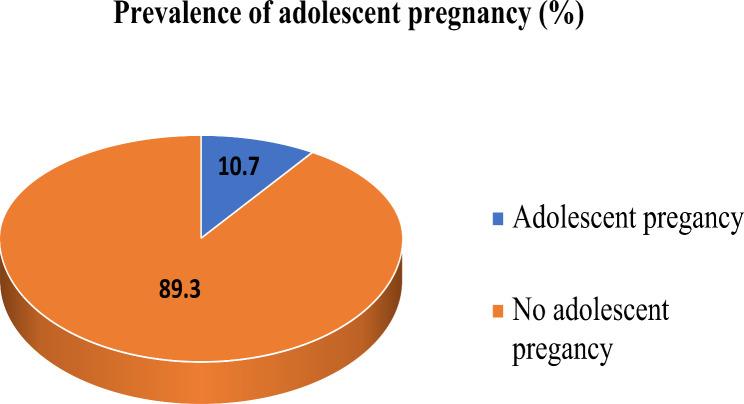
The study reported an adolescent pregnancy rate of 10.7% (95% CI: 7.7-13.7). Adolescents financially supported by others (not their parents or guardians) had higher odds of having pregnancy (AOR = 3.9, 95% CI: 1.431-10.467, p < 0.01). Those not in school and primary school showed higher odds of having a pregnancy (AOR = 23.76, 95% CI: 6.833-82.630, p < 0.001) and (AOR = 25.60, 95% CI: 7.224-90.741, p < 0.001), respectively, compared to those in secondary school. Receiving SRH education was associated with lower odds of having a pregnancy (AOR = 0.2, 95% CI: 0.80-0.514, p < 0.001). Experiencing peer pressure increased the odds of having a pregnancy (AOR = 4.12, 95% CI: 1.521-11.131, p < 0.01).
CONCLUSIONS
This study highlights a significant adolescent pregnancy rate in Muhanga district, emphasizing the need for targeted interventions. Addressing educational gaps, improving financial support systems, and enhancing sexual and reproductive health education are crucial steps. Policymakers should focus on these areas to reduce adolescent pregnancies and improve outcomes for young girls. Future efforts should also include strategies to counteract peer pressure and integrate comprehensive support programs.
背景
青少年怀孕,也称为少女怀孕,是指影响15至19岁女孩的意外怀孕。全球患病率为25%,非洲有18.8%的少女怀孕,这使她们无法享有更好的生活水平,如良好的教育和父母关爱,而青少年怀孕会带来健康风险、教育和职业中断、经济压力以及学业成绩下降,同时还会增加公共成本和社会服务需求。本研究旨在确定卢旺达穆汉加区15至19岁女孩中青少年怀孕的患病率及相关因素。
方法
该研究涉及卢旺达穆汉加区392名15至19岁的女性青少年。参与者通过多阶段抽样方法选取,研究确保自愿参与,即签署同意书和知情同意书。通过问卷调查收集数据,并使用STATA v.18进行分析,采用卡方检验和多因素逻辑回归等统计分析方法来控制混杂因素。获得了肯尼亚山大学和穆汉加区行政当局的伦理批准。
结果
该研究报告青少年怀孕率为10.7%(95%置信区间:7.7 - 13.7)。由他人(非父母或监护人)提供经济支持的青少年怀孕几率更高(调整优势比[AOR]=3.9,95%置信区间:1.431 - 10.467,p<0.01)。与中学生相比,未上学和小学阶段的青少年怀孕几率分别更高(AOR = 23.76,95%置信区间:6.833 - 82.630,p<0.001)和(AOR = 25.60,95%置信区间:7.224 - 90.741,p<0.001)。接受性与生殖健康(SRH)教育与较低的怀孕几率相关(AOR = 0.2,95%置信区间:0.80 - 0.514,p<0.001)。经历同伴压力会增加怀孕几率(AOR = 4.12,95%置信区间:1.521 - 11.131,p<0.01)。
结论
本研究突出了穆汉加区显著的青少年怀孕率,强调了针对性干预措施的必要性。解决教育差距、改善经济支持系统以及加强性与生殖健康教育是关键步骤。政策制定者应关注这些领域以减少青少年怀孕并改善年轻女孩的结局。未来的努力还应包括应对同伴压力的策略以及整合综合支持项目。
 Zotero 插件