• 文献检索
  • 文档翻译
  • 深度研究
  • 学术资讯
  • Suppr Zotero 插件Zotero 插件
  • 邀请有礼
  • 套餐&价格
  • 历史记录
应用&插件
Suppr Zotero 插件Zotero 插件浏览器插件Mac 客户端Windows 客户端微信小程序
定价
高级版会员购买积分包购买API积分包
服务
文献检索文档翻译深度研究API 文档MCP 服务
关于我们
关于 Suppr公司介绍联系我们用户协议隐私条款
关注我们

Suppr 超能文献

核心技术专利:CN118964589B侵权必究
粤ICP备2023148730 号-1Suppr @ 2026

文献检索

告别复杂PubMed语法,用中文像聊天一样搜索,搜遍4000万医学文献。AI智能推荐,让科研检索更轻松。

立即免费搜索

文件翻译

保留排版,准确专业,支持PDF/Word/PPT等文件格式,支持 12+语言互译。

免费翻译文档

深度研究

AI帮你快速写综述,25分钟生成高质量综述,智能提取关键信息,辅助科研写作。

立即免费体验

北京新冠疫情非药物干预措施实施前、期间及之后婴儿呼吸道病原体的变化

Changes in infant respiratory pathogens pre-, during, and post-COVID-19 non-pharmacological interventions in Beijing.

作者信息

Han Tongying, Wang Yajuan, Zhang Di, Li Ying, Zhang Li, Yan Jin, Li Chi, Yang Shengnan, Guo Litao, Yan Huijuan

机构信息

Department of Neonatology, Children's Hospital, Capital Institute of Pediatrics, Beijing, 100020, China.

出版信息

Ital J Pediatr. 2025 Jan 22;51(1):8. doi: 10.1186/s13052-025-01848-5.

DOI:10.1186/s13052-025-01848-5
PMID:39844210
原文链接:https://pmc.ncbi.nlm.nih.gov/articles/PMC11752787/
Abstract

BACKGROUND

To explore the effect of non-pharmacological interventions (NPIs) on respiratory pathogen profiles among hospitalized infants aged 0-3 months in Beijing during the coronavirus disease 2019 (COVID-19) pandemic.

METHODS

Respiratory specimens were collected from 1,184 infants aged 0-3 months who were hospitalized for acute respiratory infection at the Children's Hospital affiliated with the Capital Institute of Pediatrics from January 2018 to December 2023. The data were divided into three groups-the pre-epidemic (January 2018 to December 2019), epidemic prevention and control (January 2020 to December 2022), and post-epidemic (January 2023 to December 2023) groups-based on the outbreak of COVID-19 and the implementation and termination of NPIs. The specimens were tested for 14 respiratory pathogens, including influenza virus A (Flu A), influenza virus B, respiratory syncytial virus, parainfluenza virus (PIV), adenovirus (ADV), human metapneumovirus (HMPV), human bocavirus, human rhinovirus (HRV), coronavirus, Chlamydia trachomatis, Chlamydia pneumoniae (C.pn), Mycoplasma pneumoniae, Bordetella pertussis, and severe acute respiratory syndrome coronavirus 2 (SARS-CoV-2).

RESULTS

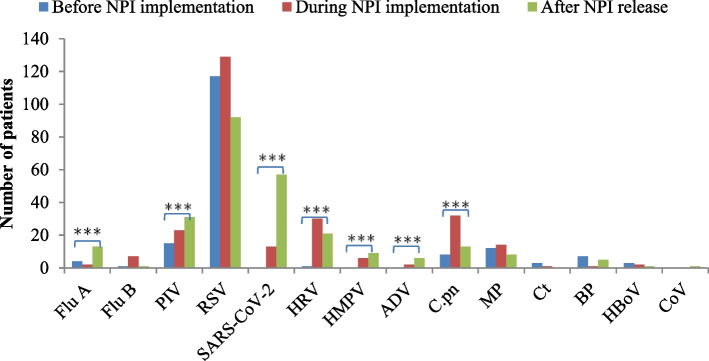
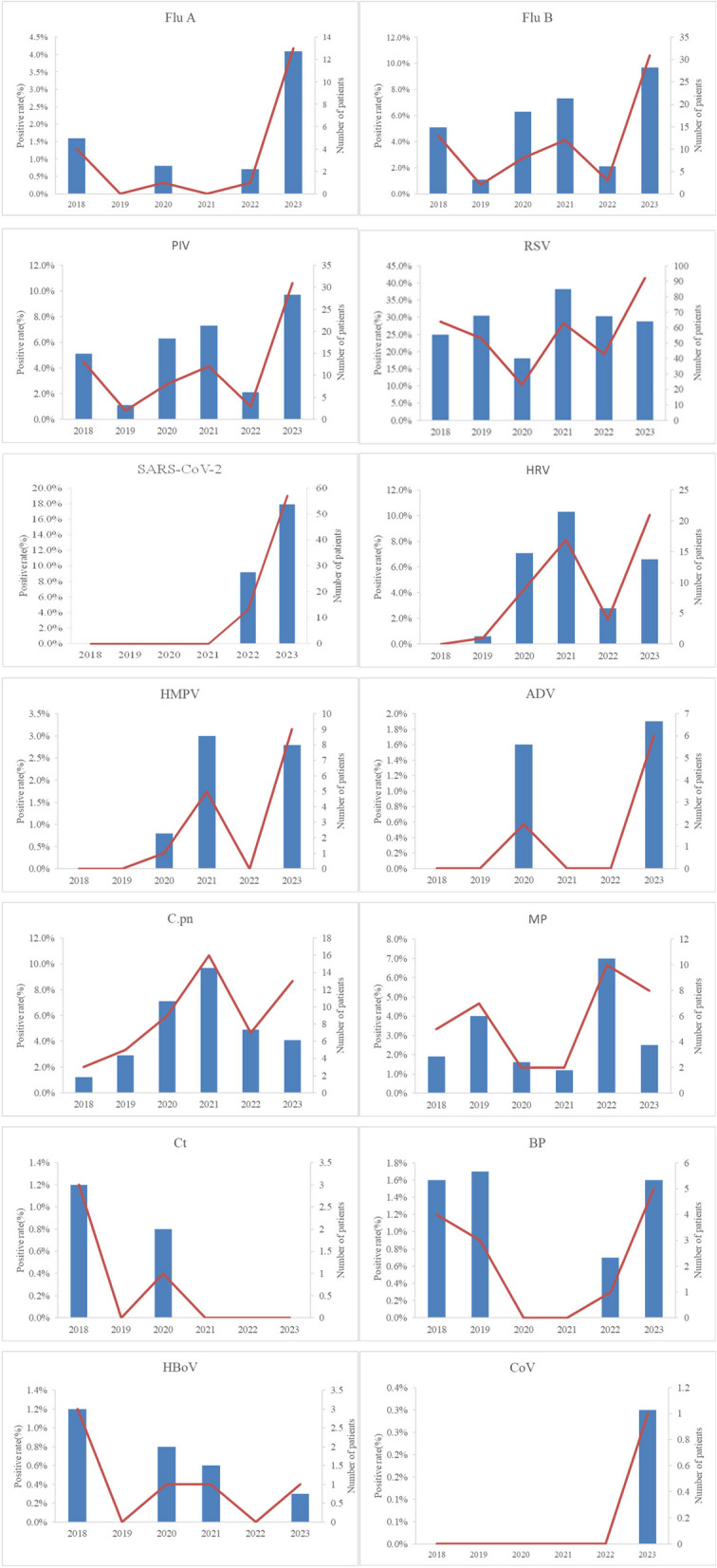
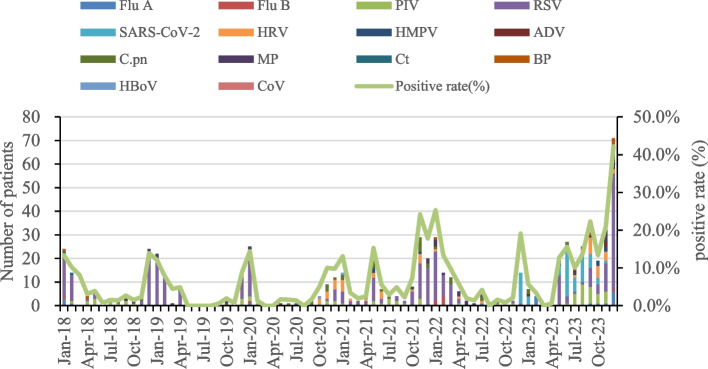
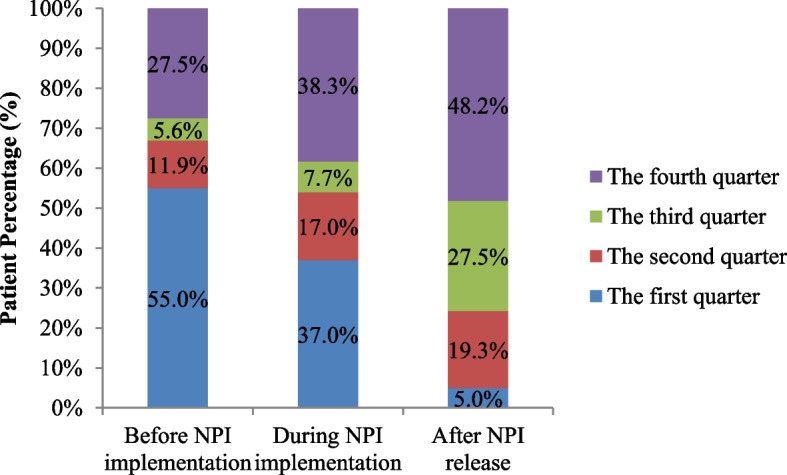
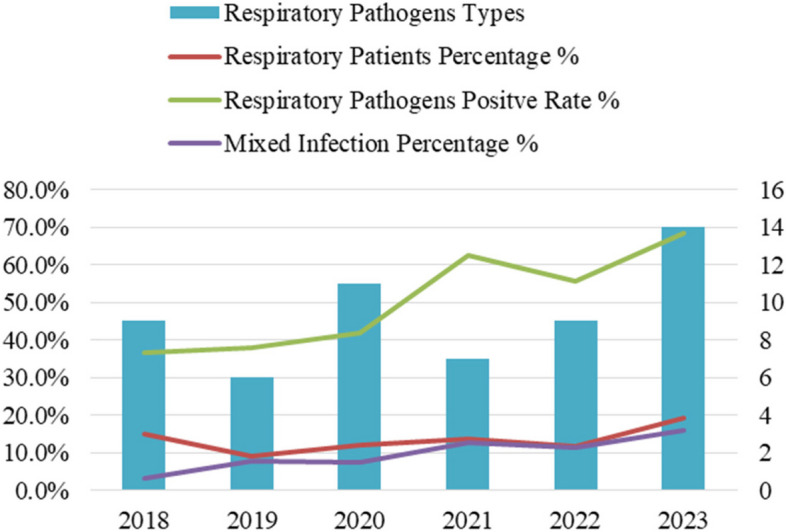
A total of 1,184 infants, including 649 males and 535 females, with acute respiratory infections were admitted. The positive detection rate for respiratory pathogens was 51.77% (n = 613). In 2023, the proportion of infants with respiratory infections after the epidemic was 19.4% (319/1646), the positive detection rate of respiratory pathogens was 68.3% (218/319), and the mixed infection detection rate of respiratory pathogens was 16.1% (35/218). Prior to the epidemic, these rates were 11.9% (431/3611), 37.1% (160/431), and 5.0% (8/160), respectively. During the epidemic prevention and control period, these rates significantly increased to 12.4% (434/3486), 54.1% (235/434), and 11.1% (26/235) (P < 0.05), respectively. Post-epidemic, the proportion of newborns testing positive for respiratory pathogens decreased, while the number of infants aged 29-90 days significantly increased. The proportion of admission weight and contact history with respiratory patients increased significantly compared to before and during the epidemic, with statistical significance (P < 0.05). After the epidemic, a total of 13 respiratory pathogens were detected throughout the year. There were statistically significant differences in the detection rates of Flu A, PIV, SARS-CoV-2, HRV, HMPV, ADV, and C.pn before, during, and after implementation of the NPIs during the COVID-19 epidemic (P < 0.05). Post-epidemic, the detection rates of Flu A, PIV, and SARS-CoV-2 were significantly higher than those before and during the epidemic (P < 0.017). The detection rates of HRV, HMPV, and ADV significantly increased after the epidemic compared to those before the epidemic (P < 0.017). Before the epidemic, the positivity rate of respiratory pathogens was high in the first and fourth quarters. After the termination of NPIs, the positive detection rate decreased in the first quarter but increased in the second, third, and fourth quarters, with a statistically significant difference (P < 0.05).

CONCLUSION

The implementation and lifting of COVID-19 NPIs have caused significant changes in the detection and seasonal distribution of respiratory pathogens in infants aged 0-3 months in Beijing. NPIs temporarily reduced the detection rate of respiratory pathogens in infants during the prevalence of COVID-19. Understanding the prevalence of respiratory pathogens before and after the epidemic is particularly important for the prevention and control of respiratory diseases in infants.

摘要

背景

探讨2019年冠状病毒病(COVID-19)大流行期间非药物干预措施(NPIs)对北京0至3个月住院婴儿呼吸道病原体谱的影响。

方法

收集2018年1月至2023年12月在首都儿科研究所附属儿童医院因急性呼吸道感染住院的1184例0至3个月婴儿的呼吸道标本。根据COVID-19疫情爆发以及NPIs的实施和终止情况,将数据分为三组:疫情前(2018年1月至2019年12月)、疫情防控期(2020年1月至2022年12月)和疫情后(2023年1月至2023年12月)。对标本进行14种呼吸道病原体检测,包括甲型流感病毒(Flu A)、乙型流感病毒、呼吸道合胞病毒、副流感病毒(PIV)、腺病毒(ADV)、人偏肺病毒(HMPV)、人博卡病毒、人鼻病毒(HRV)、冠状病毒、沙眼衣原体、肺炎衣原体(C.pn)、肺炎支原体、百日咳博德特氏菌和严重急性呼吸综合征冠状病毒2(SARS-CoV-2)。

结果

共收治1184例急性呼吸道感染婴儿,其中男649例,女535例。呼吸道病原体阳性检出率为51.77%(n = 613)。2023年,疫情后呼吸道感染婴儿比例为19.4%(319/1646),呼吸道病原体阳性检出率为68.3%(218/319),呼吸道病原体混合感染检出率为16.1%(35/218)。疫情前,这些比率分别为11.9%(431/3611)、37.1%(160/431)和5.0%(8/160)。在疫情防控期间,这些比率分别显著增至12.4%(434/3486)、54.1%(235/434)和11.1%(26/235)(P < 0.05)。疫情后,呼吸道病原体检测呈阳性的新生儿比例下降,而29至90天龄婴儿数量显著增加。与疫情前和疫情期间相比,入院体重和与呼吸道疾病患者接触史的比例显著增加,具有统计学意义(P < 0.05)。疫情后,全年共检测到13种呼吸道病原体。在COVID-19疫情期间实施NPIs之前、期间和之后,Flu A、PIV、SARS-CoV-2、HRV、HMPV、ADV和C.pn的检出率存在统计学显著差异(P < 0.05)。疫情后,Flu A、PIV和SARS-CoV-2的检出率显著高于疫情前和疫情期间(P < 0.017)。与疫情前相比,疫情后HRV、HMPV和ADV的检出率显著增加(P < 0.017)。疫情前,呼吸道病原体阳性率在第一和第四季度较高。NPIs终止后,第一季度阳性检出率下降,但第二、第三和第四季度上升,差异有统计学意义(P < 0.05)。

结论

COVID-19 NPIs的实施和解除导致北京0至3个月婴儿呼吸道病原体的检测和季节分布发生了显著变化。NPIs在COVID-19流行期间暂时降低了婴儿呼吸道病原体的检出率。了解疫情前后呼吸道病原体的流行情况对于婴儿呼吸道疾病的防控尤为重要。
https://cdn.ncbi.nlm.nih.gov/pmc/blobs/15eb/11752787/79d424e68148/13052_2025_1848_Fig5_HTML.jpg
https://cdn.ncbi.nlm.nih.gov/pmc/blobs/15eb/11752787/ce7caa541360/13052_2025_1848_Fig1_HTML.jpg
https://cdn.ncbi.nlm.nih.gov/pmc/blobs/15eb/11752787/6bf9e1bc5f5f/13052_2025_1848_Fig2_HTML.jpg
https://cdn.ncbi.nlm.nih.gov/pmc/blobs/15eb/11752787/ad21cf475c54/13052_2025_1848_Fig3_HTML.jpg
https://cdn.ncbi.nlm.nih.gov/pmc/blobs/15eb/11752787/955eda30ff3a/13052_2025_1848_Fig4_HTML.jpg
https://cdn.ncbi.nlm.nih.gov/pmc/blobs/15eb/11752787/79d424e68148/13052_2025_1848_Fig5_HTML.jpg
https://cdn.ncbi.nlm.nih.gov/pmc/blobs/15eb/11752787/ce7caa541360/13052_2025_1848_Fig1_HTML.jpg
https://cdn.ncbi.nlm.nih.gov/pmc/blobs/15eb/11752787/6bf9e1bc5f5f/13052_2025_1848_Fig2_HTML.jpg
https://cdn.ncbi.nlm.nih.gov/pmc/blobs/15eb/11752787/ad21cf475c54/13052_2025_1848_Fig3_HTML.jpg
https://cdn.ncbi.nlm.nih.gov/pmc/blobs/15eb/11752787/955eda30ff3a/13052_2025_1848_Fig4_HTML.jpg
https://cdn.ncbi.nlm.nih.gov/pmc/blobs/15eb/11752787/79d424e68148/13052_2025_1848_Fig5_HTML.jpg

相似文献

1
Changes in infant respiratory pathogens pre-, during, and post-COVID-19 non-pharmacological interventions in Beijing.北京新冠疫情非药物干预措施实施前、期间及之后婴儿呼吸道病原体的变化
Ital J Pediatr. 2025 Jan 22;51(1):8. doi: 10.1186/s13052-025-01848-5.
2
[Investigation of pathogenic agents causing acute respiratory tract infections in pediatric patients in a children's hospital assigned for case screening in Beijing during the outbreak of COVID-19].[新型冠状病毒肺炎疫情期间北京某儿童医院儿科急性呼吸道感染病原筛查]
Zhonghua Er Ke Za Zhi. 2020 Aug 2;58(8):635-639. doi: 10.3760/cma.j.cn112140-20200426-00437.
3
[Analysis of epidemiological characteristics of respiratory pathogens in children with influenza-like illnesses in a children's hospital in Beijing from 2022 to 2023].[2022至2023年北京某儿童医院流感样病例儿童呼吸道病原体流行病学特征分析]
Zhonghua Yu Fang Yi Xue Za Zhi. 2024 Jun 6;58(6):905-909. doi: 10.3760/cma.j.cn112150-20230829-00137.
4
Epidemiological characteristics of respiratory viruses in hospitalized children during the COVID-19 pandemic in southwestern China.中国西南部 COVID-19 大流行期间住院儿童呼吸道病毒的流行病学特征。
Front Cell Infect Microbiol. 2023 Apr 4;13:1142199. doi: 10.3389/fcimb.2023.1142199. eCollection 2023.
5
Epidemiology of respiratory pathogens in patients with acute respiratory infections during the COVID-19 pandemic and after easing of COVID-19 restrictions.COVID-19 大流行期间和放宽 COVID-19 限制后急性呼吸道感染患者中呼吸道病原体的流行病学。
Microbiol Spectr. 2024 Nov 5;12(11):e0116124. doi: 10.1128/spectrum.01161-24. Epub 2024 Sep 25.
6
Epidemiological characteristics of respiratory pathogens infections among children after the removal of non-pharmaceutical interventions in central China.中国中部地区取消非药物干预措施后儿童呼吸道病原体感染的流行病学特征。
Virol J. 2024 Nov 26;21(1):303. doi: 10.1186/s12985-024-02579-5.
7
The epidemiological features of respiratory tract infection using the multiplex panels detection during COVID-19 pandemic in Shandong province, China.中国山东省 COVID-19 大流行期间使用多重检测面板检测呼吸道感染的流行病学特征。
Sci Rep. 2023 Apr 18;13(1):6319. doi: 10.1038/s41598-023-33627-9.
8
Analysis of respiratory pathogen detection in hospitalized children with acute respiratory tract infections after ending the zero COVID policy.“动态清零”政策结束后住院急性呼吸道感染儿童呼吸道病原体检测分析
Sci Rep. 2024 Dec 30;14(1):31784. doi: 10.1038/s41598-024-82660-9.
9
Impact of COVID-19 pandemic measures on hospitalizations and epidemiological patterns of twelve respiratory pathogens in children with acute respiratory infections in southern China.新冠疫情防控措施对中国南方急性呼吸道感染儿童中12种呼吸道病原体的住院情况及流行模式的影响
BMC Infect Dis. 2025 Jan 22;25(1):103. doi: 10.1186/s12879-025-10463-y.
10
[Pathogenic agents causing acute respiratory tract infections in pediatric patients in Spring, 2023, in Beijing].[2023年春季北京地区儿科患者急性呼吸道感染的致病原]
Zhonghua Er Ke Za Zhi. 2024 Feb 2;62(2):159-164. doi: 10.3760/cma.j.cn112140-20230723-00025.

引用本文的文献

1
Non-Influenza and Non-SARS-CoV-2 Viruses Among Patients with Severe Acute Respiratory Infections in Tanzania: A Post-COVID-19 Pandemic Snapshot.坦桑尼亚严重急性呼吸道感染患者中的非流感和非SARS-CoV-2病毒:COVID-19大流行后的情况快照
Viruses. 2025 Jul 25;17(8):1042. doi: 10.3390/v17081042.
2
Epidemiologic characteristics of immunoglobulin M antibodies in lower respiratory tract infection pathogens of children: association with severe pneumonia in Chengdu city from 2019 to 2023.儿童下呼吸道感染病原体中免疫球蛋白M抗体的流行病学特征:与2019年至2023年成都市重症肺炎的相关性
Am J Transl Res. 2025 Jul 15;17(7):5271-5283. doi: 10.62347/BBXL3592. eCollection 2025.
3

本文引用的文献

1
Non-pharmaceutical interventions for COVID-19 transiently reduced pneumococcal and carriage in a cross-sectional pediatric cohort in Southampton, UK.针对新冠病毒的非药物干预措施在英国南安普敦的一个儿科横断面队列中短暂降低了肺炎球菌携带率。
Microbiol Spectr. 2024 Aug 6;12(8):e0022424. doi: 10.1128/spectrum.00224-24. Epub 2024 Jul 11.
2
Where Birth Month, Sex and Age Matters: The Burden of Severe Respiratory Disease in Danish Children <5 Years, 2016-2022.出生月份、性别和年龄的影响:2016-2022 年丹麦 5 岁以下儿童严重呼吸道疾病负担
Pediatr Infect Dis J. 2024 Sep 1;43(9):851-856. doi: 10.1097/INF.0000000000004399. Epub 2024 May 15.
3
hMPV Outbreaks: Worldwide Implications of a Re-Emerging Respiratory Pathogen.
人偏肺病毒(hMPV)疫情:一种再度出现的呼吸道病原体的全球影响
Microorganisms. 2025 Jun 27;13(7):1508. doi: 10.3390/microorganisms13071508.
4
Epidemiological, clinical, and molecular analysis of human adenovirus infections in hospitalized children with acute respiratory infections in Tianjin, China.中国天津急性呼吸道感染住院儿童人腺病毒感染的流行病学、临床及分子分析
Front Cell Infect Microbiol. 2025 Jul 14;15:1600990. doi: 10.3389/fcimb.2025.1600990. eCollection 2025.
RSV Disease Burden in Primary Care in Italy: A Multi-Region Pediatric Study, Winter Season 2022-2023.
意大利初级保健中的 RSV 疾病负担:2022-2023 年冬季多地区儿科研究。
Influenza Other Respir Viruses. 2024 Apr;18(4):e13282. doi: 10.1111/irv.13282.
4
SARS-CoV-2 pandemic non-pharmacologic interventions temporally associated with reduced pediatric infections due to and co-infecting respiratory viruses in Arkansas.由于 SARS-CoV-2 大流行,阿肯色州采取了非药物干预措施,暂时减少了儿童感染 和合并感染呼吸道病毒的病例。
Microbiol Spectr. 2024 Apr 2;12(4):e0290823. doi: 10.1128/spectrum.02908-23. Epub 2024 Mar 15.
5
Investigating epidemiological distribution (temporality and intensity) of respiratory pathogens following COVID-19 de-escalation process in Catalonia, September 2016-June 2021: Analysis of regional surveillance data.调查 COVID-19 降级后 2016 年 9 月至 2021 年 6 月期间加泰罗尼亚呼吸道病原体的流行病学分布(时间和强度):区域监测数据分析。
PLoS One. 2024 Feb 9;19(2):e0285892. doi: 10.1371/journal.pone.0285892. eCollection 2024.
6
[Pathogenic agents causing acute respiratory tract infections in pediatric patients in Spring, 2023, in Beijing].[2023年春季北京地区儿科患者急性呼吸道感染的致病原]
Zhonghua Er Ke Za Zhi. 2024 Feb 2;62(2):159-164. doi: 10.3760/cma.j.cn112140-20230723-00025.
7
Respiratory syncytial virus disease morbidity in Australian infants aged 0 to 6 months: a systematic review with narrative synthesis.澳大利亚 0-6 月龄婴儿呼吸道合胞病毒疾病发病率:系统评价与叙述性综合。
BMC Public Health. 2023 Dec 21;23(1):2560. doi: 10.1186/s12889-023-17474-x.
8
The Impact of Non-pharmacological Interventions Measures Against COVID-19 on Respiratory Virus in Preschool Children in Henan, China.中国河南针对新冠肺炎的非药物干预措施对学龄前儿童呼吸道病毒的影响
J Epidemiol Glob Health. 2024 Mar;14(1):54-62. doi: 10.1007/s44197-023-00168-3. Epub 2023 Dec 4.
9
Old foes following news ways?-Pandemic-related changes in the epidemiology of viral respiratory tract infections.旧敌追寻新途径?-病毒呼吸道感染流行病学与大流行相关的变化。
Infection. 2024 Feb;52(1):209-218. doi: 10.1007/s15010-023-02085-w. Epub 2023 Aug 29.
10
Immediate and long-term changes in the epidemiology, infection spectrum, and clinical characteristics of viral and bacterial respiratory infections in Western China after the COVID-19 outbreak: a modeling study.新冠疫情后中国西部病毒性和细菌性呼吸道感染的流行病学、感染谱和临床特征的即时和长期变化:一项建模研究。
Arch Virol. 2023 Mar 28;168(4):120. doi: 10.1007/s00705-023-05752-3.