Tian Hui, Li Yong-Meng, Wang Cheng-Qiang, Chen Guo-Qiang, Lian Ying
Department of Thoracic surgery, Shandong Key Laboratory of Digital Diagnosis and Treatment of Thoracic Tumor, Shandong Engineering Research Center of Intelligent Surgery, The First Affiliated Hospital of Shandong First Medical University & Shandong Provincial Qianfoshan Hospital, No.16766, Jingshi Rd, Jinan, 250014, China.
G.E.R.N. Research Center for Tissue Replacement, Regeneration & Neogenesis, Department of Orthopedics and Trauma Surgery, Faculty of Medicine, Medical Cente-Albert-Ludwigs-University of Freiburg, Freiburg im Breisgau, Germany.
Cardiovasc Diabetol. 2025 Jan 22;24(1):31. doi: 10.1186/s12933-025-02597-9.
Insulin resistance (IR) is linked to an increased risk of frailty, yet it remains unclear whether the non-insulin-based IR indicators are associated with frailty trajectories and physical function decline. It aimed to examine the associations of triglyceride-glucose (TyG) index, metabolic score for insulin resistance (METS-IR), estimated glucose disposal rate (eGDR) and with long-term deficit-accumulation frailty trajectories and physical function decline.
Data from 6722 participants in the China Health and Retirement Longitudinal Study (CHARLS) were analyzed. Baseline TyG index, METS-IR, eGDR, along with the frailty index (FI) over nine years, were calculated. FI trajectories were assessed using group-based trajectory model (GBTM). Logistic regression models were used to analyze the associations between IR indicators with FI trajectory and frailty risk. Restricted cubic splines (RCS) models were utilized to detect potential dose-response associations. Linear mixed-effects model was used to evaluate associations with FI development speed. Age, gender, educational level, marital status, smoking status, drinking status, life satisfaction, social activity and sleep duration were adjusted. Additionally, a two-sample Mendelian randomization (MR) was performed to assess the causality of observed associations.
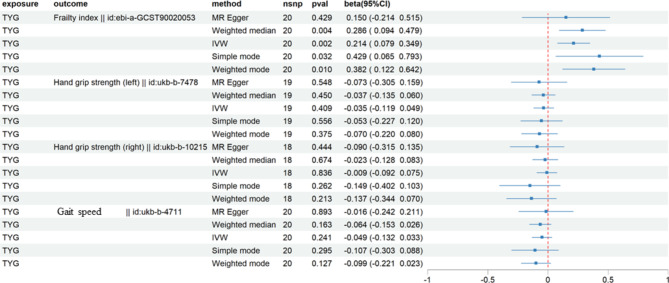
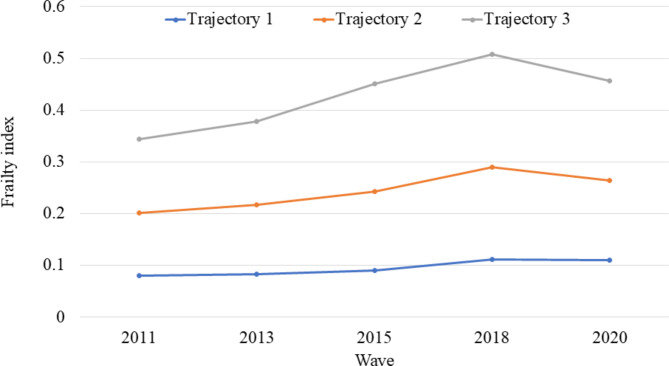
Three FI trajectories including low-stable frailty, moderate-increasing frailty, and accelerated rising frailty were identified. Regarding the frail risk, each SD increment in TyG index was associated with a 16.1% increase in the risk of frailty (OR = 1.161; 95%CI: 1.092, 1.235). An inverse association was observed for eGDR with the OR (95%CI) being 0.741 (0.696, 0.788). A linear relationship was observed between baseline TyG index and frailty risk (P nonlinear = 0.696), but nonlinear association patterns for eGDR (P nonlinearity < 0.010) and METS-IR (P nonlinearity < 0.010). Each SD increment of TyG index was associated with greater FI increase (β = 0.005 SD/y; 95%CI = 0.002, 0.008 SD/y; P < 0.001). A similar association pattern was observed for METS-IR, and participants in the highest quartile of METS-IR showed significantly greater FI progression, with β value of 0.013 (95% CI = 0.004, 0.022). Each SD increment of eGDR was associated with a slower increase in FI (β=-0.006 SD/y, 95% CI=-0.009, -0.003 SD/y; P < 0.001). Participants in the highest quartile of eGDR presented a lower annual change in FI compared with participants in quartile 1 group during follow-up (β=-0.013 SD/y, 95% CI=-0.022, -0.005 SD/y; P for trend = 0.001). Similar findings were observed for physical function decline. Findings from MR analysis showed a causal relationship between higher TyG index and increased risk of frailty (β = 0.214, 95% CI = 0.079, 0.349; P = 0.002).
The non-insulin-based IR indicators, including TyG index, METS-IR and eGDR, were independently associated with the frailty progression and physical function decline. Monitoring and managing abnormal glucose metabolism should be recommended as a part of comprehensive strategies to prevent or delay the progression of frailty.
胰岛素抵抗(IR)与衰弱风险增加有关,但基于非胰岛素的IR指标是否与衰弱轨迹和身体功能下降相关尚不清楚。本研究旨在探讨甘油三酯-葡萄糖(TyG)指数、胰岛素抵抗代谢评分(METS-IR)、估计葡萄糖处置率(eGDR)与长期累积缺陷型衰弱轨迹及身体功能下降之间的关联。
分析了中国健康与养老追踪调查(CHARLS)中6722名参与者的数据。计算了基线TyG指数、METS-IR、eGDR以及九年间的衰弱指数(FI)。使用基于群组的轨迹模型(GBTM)评估FI轨迹。采用逻辑回归模型分析IR指标与FI轨迹及衰弱风险之间的关联。利用限制立方样条(RCS)模型检测潜在的剂量反应关联。采用线性混合效应模型评估与FI发展速度的关联。对年龄、性别、教育程度、婚姻状况、吸烟状况、饮酒状况、生活满意度、社交活动和睡眠时间进行了调整。此外,还进行了两样本孟德尔随机化(MR)分析以评估观察到的关联的因果关系。
确定了三条FI轨迹,包括低稳定型衰弱、中度增加型衰弱和加速上升型衰弱。关于衰弱风险,TyG指数每增加一个标准差,衰弱风险增加16.1%(OR = 1.161;95%CI:1.092,1.235)。观察到eGDR与衰弱风险呈负相关,OR(95%CI)为0.741(0.696,0.788)。观察到基线TyG指数与衰弱风险之间存在线性关系(P非线性 = 0.696),但eGDR(P非线性 < 0.010)和METS-IR(P非线性 < 0.010)呈现非线性关联模式。TyG指数每增加一个标准差,FI增加幅度更大(β = 0.005标准差/年;95%CI = 0.002,0.008标准差/年;P < 0.001)。METS-IR也观察到类似的关联模式,METS-IR最高四分位数的参与者FI进展明显更大,β值为0.013(95%CI = 0.004,0.022)。eGDR每增加一个标准差,FI增加速度减慢(β = -0.006标准差/年,95%CI = -0.009,-0.003标准差/年;P < 0.001)。在随访期间,eGDR最高四分位数的参与者与第一四分位数组的参与者相比,FI的年变化较低(β = -0.013标准差/年,95%CI = -0.022,-0.005标准差/年;趋势P = 0.001)。身体功能下降也观察到类似结果。MR分析结果显示,较高的TyG指数与增加的衰弱风险之间存在因果关系(β = 0.214,95%CI = 0.079,0.349;P = 0.002)。
基于非胰岛素的IR指标,包括TyG指数、METS-IR和eGDR,与衰弱进展和身体功能下降独立相关。建议将监测和管理异常糖代谢作为预防或延缓衰弱进展的综合策略的一部分。