Aqel Sami, Thalappil Sherin, Imameldin Asaad, Mudawi Dalal, Al Maslamani Muna, Al-Khal Abdullatif, Mobayed Hassan, Al-Nesf Maryam Ali, Ibrahim Tayseer
Allergy and Immunology Division, Department of Medicine, Hamad Medical Corporation, Doha, Qatar.
Communicable Disease Center, Hamad Medical Corporation, Doha, Qatar.
Front Allergy. 2025 Jan 7;5:1502285. doi: 10.3389/falgy.2024.1502285. eCollection 2024.
COVID-19 vaccination has been a key intervention in reducing the severity of symptoms; however, concerns about vaccine safety, particularly regarding allergic reactions, arose early on. Healthcare workers faced the challenge of addressing these concerns to ensure safe vaccine administration. This study aimed to review the practical aspects of using allergy skin testing for COVID-19 vaccine excipients in patients with a history of allergic reactions developed following mRNA COVID-19 vaccination.
A retrospective chart review was conducted for patients who reported allergic reactions after the COVID-19 vaccine and underwent allergy skin testing for COVID-19 vaccine excipients in the Adult Allergy and Immunology Service at Hamad Medical Corporation, Doha, Qatar. The testing protocol, developed based on published data during the pandemic, included skin prick (SPT) and intradermal (ID) testing using medications containing polysorbate 80 and polyethylene glycol (PEG), the primary excipients in the COVID-19 vaccines suspected of triggering allergic responses.
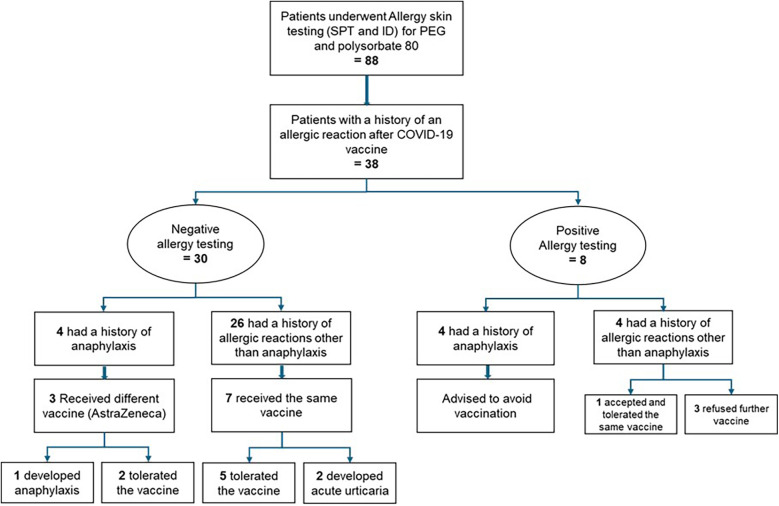
Of the 88 patients reviewed, 38 reported different types of allergic reactions following mRNA COVID-19 vaccination, with the majority being female. Anaphylaxis was reported in 21.1% of the patients, while the remaining experienced less severe allergic reactions. All patients underwent SPT and ID testing with PEG and polysorbate 80. By SPT, two patients tested positive for PEG and none for polysorbate 80. By ID, seven tested positive for polysorbate 80 and one for PEG. Among patients who experienced anaphylaxis, 50% had positive allergy test results. Twenty-three percent of patients with negative test results could receive additional vaccine doses without adverse reactions.
Managing patients with a history of allergic reactions to the COVID-19 vaccine is challenging, as the exact mechanisms and accurate and valid allergy testing are yet to be determined. In our cohort, most patients had mild allergic reactions following vaccination. Excipients' allergy skin testing has helped to reduce vaccine hesitancy despite its questionable utility in clinical practice.
新冠病毒疫苗接种一直是减轻症状严重程度的关键干预措施;然而,对疫苗安全性的担忧,尤其是关于过敏反应的担忧,在早期就出现了。医护人员面临着应对这些担忧以确保安全接种疫苗的挑战。本研究旨在回顾对有mRNA新冠病毒疫苗接种后出现过敏反应病史的患者进行新冠病毒疫苗辅料过敏皮肤试验的实际情况。
对在卡塔尔多哈哈马德医疗公司成人过敏与免疫科报告新冠病毒疫苗接种后过敏反应并接受新冠病毒疫苗辅料过敏皮肤试验的患者进行回顾性病历审查。根据疫情期间公布的数据制定的检测方案包括使用含有聚山梨醇酯80和聚乙二醇(PEG)的药物进行皮肤点刺试验(SPT)和皮内试验(ID),这两种药物是怀疑引发过敏反应的新冠病毒疫苗中的主要辅料。
在审查的88例患者中,38例报告在mRNA新冠病毒疫苗接种后出现不同类型的过敏反应,其中大多数为女性。21.1%的患者报告有过敏反应,其余患者经历的过敏反应较轻。所有患者均接受了PEG和聚山梨醇酯80的SPT和ID检测。通过SPT,两名患者对PEG检测呈阳性,对聚山梨醇酯80检测均为阴性。通过ID,七名患者对聚山梨醇酯80检测呈阳性,一名患者对PEG检测呈阳性。在经历过敏反应的患者中,50%的患者过敏试验结果呈阳性。23%试验结果为阴性的患者可以接种额外剂量的疫苗而无不良反应。
管理有新冠病毒疫苗过敏反应病史的患者具有挑战性,因为确切机制以及准确有效的过敏检测方法尚未确定。在我们的队列中,大多数患者在接种疫苗后出现轻度过敏反应。辅料过敏皮肤试验有助于减少疫苗犹豫情绪,尽管其在临床实践中的效用存在疑问。