Karimzadeh Amir, Hansen Kimberley, Hasa Ergela, Haller Bernhard, Heck Matthias M, Tauber Robert, D Alessandria Calogero, Weber Wolfgang A, Eiber Matthias, Rauscher Isabel
Department of Nuclear Medicine, School of Medicine, Technical University of Munich, Munich, Germany.
Department of Diagnostic and Interventional Radiology and Nuclear Medicine, University Medical Center Hamburg-Eppendorf, Martinistr. 52, 20246, Hamburg, Germany.
Eur J Nucl Med Mol Imaging. 2025 May;52(6):2041-2050. doi: 10.1007/s00259-024-07003-2. Epub 2025 Jan 23.
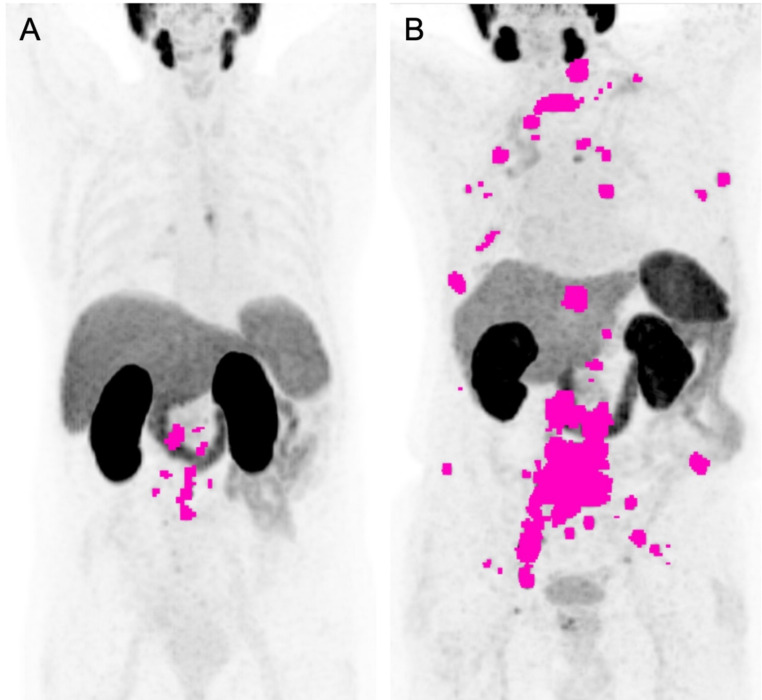
This retrospective analysis evaluates baseline F-flotufolastat positron emission tomography (PET) parameters as prognostic parameters for treatment response and outcome in patients with metastatic castration-resistant prostate cancer (mCRPC) undergoing treatment with [Lu]Lu-PSMA-I&T.
A total of 188 mCRPC patients with baseline F-flotufolastat PET scans were included. Tumor lesions were semiautomatically delineated, with imaging parameters including volume-based and standardized uptake value (SUV)-based metrics. Outcome measures included prostate-specific antigen (PSA) response, PSA-progression-free survival (PSA-PFS), and overall survival (OS). Univariate and multivariate regression analyses assessed the impact of baseline imaging and pretherapeutic clinical parameters on outcome. Event time distributions were estimated with the Kaplan-Meier method, and groups were compared with log-rank tests.
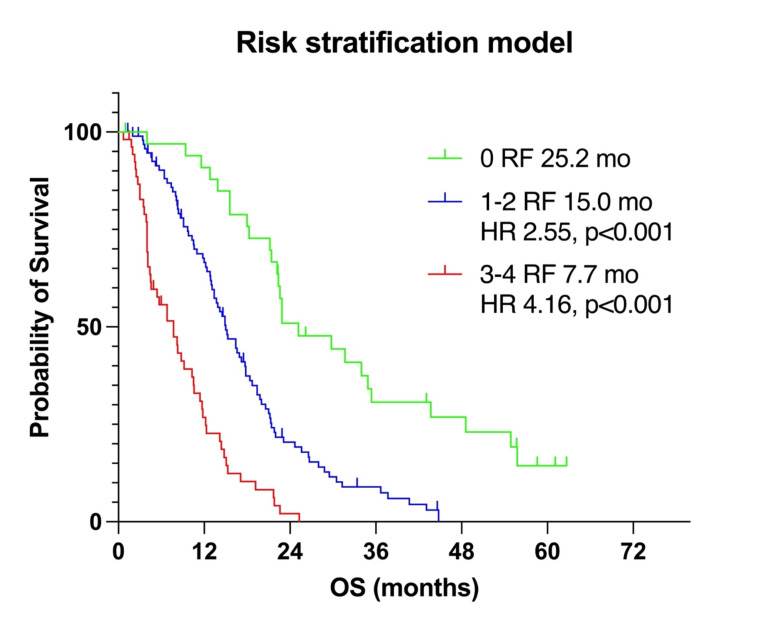
Significant prognostic parameters for PSA response and PSA-PFS included log-transformed whole-body SUVmax (odds ratio (OR), 3.26, 95% confidence interval (CI), 2.01-5.55 and hazard ratio (HR), 0.51, 95% CI, 0.4-0.66; both p < 0.001) and prior chemotherapy (OR 0.3, 95% CI, 0.12-0.72 and HR 1.64, 95% CI, 1.07-2.58; p = 0.008 and p = 0.028, respectively). For OS, significant prognosticators were the following log-transformed parameters: number of lesions (HR 1.38, 95% CI, 1.24-1.53; p < 0.001), TTV (HR 1.27, 95% CI, 1.18-1.37; p < 0.001), and ITLV (HR 1.24, 95% CI, 1.16-1.33; p < 0.001), with log-transformed TTV (HR 1.15, 95% CI, 1.04-1.27; p = 0.008) remaining significant in multivariate analysis.
At baseline, SUV-based F-flotufolastat PET metrics (e.g., whole-body SUVmax) serve as significant positive prognosticators for short-term outcomes (PSA response and PSA-PFS). In contrast, volume-based metrics (e.g., TTV) are significant negative prognosticators for long-term outcome (OS), in mCRPC patients treated with [Lu]Lu-PSMA-I&T.
本回顾性分析评估基线F-氟托泊司他正电子发射断层扫描(PET)参数,作为接受[镥]镥-PSMA-I&T治疗的转移性去势抵抗性前列腺癌(mCRPC)患者治疗反应和预后的预后参数。
纳入188例有基线F-氟托泊司他PET扫描的mCRPC患者。肿瘤病灶通过半自动勾勒,成像参数包括基于体积和基于标准化摄取值(SUV)的指标。结局指标包括前列腺特异性抗原(PSA)反应、无PSA进展生存期(PSA-PFS)和总生存期(OS)。单因素和多因素回归分析评估基线影像和治疗前临床参数对结局的影响。用Kaplan-Meier方法估计事件时间分布,并用对数秩检验比较各组。
PSA反应和PSA-PFS的显著预后参数包括对数转换后的全身SUVmax(优势比(OR),3.26,95%置信区间(CI),2.01-5.55;风险比(HR),0.51,95%CI,0.4-0.66;均p<0.001)和既往化疗史(OR 0.3,95%CI,0.12-0.72;HR 1.64,95%CI,1.07-2.58;p分别为0.008和0.028)。对于OS,显著的预后因素是以下对数转换参数:病灶数量(HR 1.38,95%CI,1.24-1.53;p<0.001)、总肿瘤体积(TTV)(HR 1.27,95%CI,1.18-1.37;p<0.001)和髂内淋巴结体积(ITLV)(HR 1.24,95%CI,1.16-1.33;p<0.001),对数转换后的TTV(HR 1.15,95%CI,1.04-1.27;p=0.008)在多因素分析中仍具有显著性。
在基线时,基于SUV的F-氟托泊司他PET指标(如全身SUVmax)是短期结局(PSA反应和PSA-PFS)的显著阳性预后因素。相比之下,在接受[镥]镥-PSMA-I&T治疗的mCRPC患者中,基于体积的指标(如TTV)是长期结局(OS)的显著阴性预后因素。