Papantoniou Panagiotis, Maniadakis Nikolaos
Department of Public Health Policy, School of Public Health, University of West Attica, 196 Alexandras Avenue, 115 21, Athens, Greece.
Pharmacoecon Open. 2025 May;9(3):487-497. doi: 10.1007/s41669-025-00561-7. Epub 2025 Jan 23.
Obesity is a global health issue with significant economic implications for health systems. Pharmacotherapy, including semaglutide 2.4 mg and liraglutide 3 mg, offers a treatment option for weight management; however, its cost-effectiveness requires evaluation. This study assesses the short-term cost-effectiveness of semaglutide 2.4 mg versus liraglutide 3 mg in achieving clinically relevant weight loss targets at 68 weeks in Greece.
A short-term cost-effectiveness analysis was conducted from the perspective of the Greek third-party payer [National Organization for the Provision of Health Services (EOPYY)], comparing costs and outcomes for semaglutide 2.4 mg and liraglutide 3 mg over a 68-week horizon. Effectiveness was measured by the proportion of patients achieving weight loss targets of ≥ 5%, ≥ 10%, ≥ 15%, and ≥ 20%, using efficacy data from the STEP-8 head-to-head trial, a 68-week, randomized, double-blind study conducted in the USA, comparing semaglutide 2.4 mg versus liraglutide 3 mg in adults who were overweight or had obesity without diabetes. Only direct medical costs were included, reflecting the payer perspective, and no discounting was applied owing to the short time horizon. Deterministic and probabilistic sensitivity analyses assessed the results' robustness.
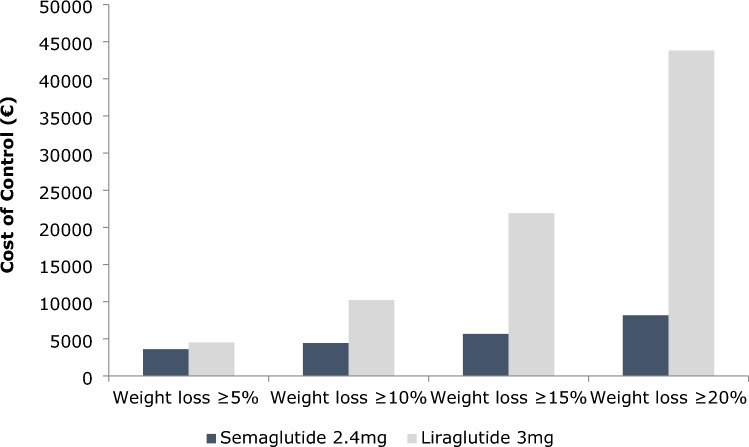
Semaglutide 2.4 mg had higher treatment costs (€3285.55) compared with liraglutide 3 mg (€2742.47) but demonstrated greater efficacy and a lower cost of control across all weight loss targets. The cost per patient achieving ≥ 5% weight loss was €3768.72 for semaglutide and €4718.66 for liraglutide, corresponding to a difference of €949.95 per patient. The cost difference widened at higher weight loss targets, with semaglutide showing differences of €6064.20 for ≥ 10% weight loss, €17,005.23 for ≥ 15%, and €37,296.00 for ≥ 20%. These findings were consistent across sensitivity analyses.
Semaglutide 2.4 mg is likely to be a short-term, cost-effective treatment option for adults who are overweight or have obesity without diabetes in Greece.
肥胖是一个全球性的健康问题,对卫生系统具有重大经济影响。药物治疗,包括2.4毫克司美格鲁肽和3毫克利拉鲁肽,为体重管理提供了一种治疗选择;然而,其成本效益需要评估。本研究评估了在希腊,2.4毫克司美格鲁肽与3毫克利拉鲁肽在68周内实现临床相关体重减轻目标的短期成本效益。
从希腊第三方支付方[国家卫生服务提供组织(EOPYY)]的角度进行了短期成本效益分析,比较了2.4毫克司美格鲁肽和3毫克利拉鲁肽在68周内的成本和结果。使用来自STEP-8头对头试验的疗效数据来衡量有效性,该试验是一项在美国进行的为期68周的随机双盲研究,比较了2.4毫克司美格鲁肽与3毫克利拉鲁肽在超重或肥胖但无糖尿病的成年人中的疗效。仅纳入直接医疗成本,以反映支付方的观点,并且由于时间跨度短未进行贴现。确定性和概率敏感性分析评估了结果的稳健性。
与3毫克利拉鲁肽(2742.47欧元)相比,2.4毫克司美格鲁肽的治疗成本更高(3285.55欧元),但在所有体重减轻目标方面均显示出更高的疗效和更低的控制成本。达到体重减轻≥5%的每位患者的成本,司美格鲁肽为3768.72欧元,利拉鲁肽为4718.66欧元,每位患者相差949.95欧元。在更高的体重减轻目标下,成本差异扩大,司美格鲁肽在体重减轻≥10%时差异为6064.20欧元,≥15%时为17005.23欧元,≥20%时为37296.00欧元。这些发现在敏感性分析中是一致的。
对于希腊超重或肥胖但无糖尿病的成年人,2.4毫克司美格鲁肽可能是一种短期、具有成本效益的治疗选择。