
线粒体移植:一种治疗视网膜退行性疾病的有前景的策略。
Mitochondrial transplantation: a promising strategy for the treatment of retinal degenerative diseases.
作者信息
Chi Jing, Fan Bin, Li Yulin, Jiao Qing, Li Guang-Yu
机构信息
Department of Ophthalmology, The Second Norman Bethune Hospital of Jilin University, Changchun, Jilin Province, China.
出版信息
Neural Regen Res. 2025 Dec 1;20(12):3370-3387. doi: 10.4103/NRR.NRR-D-24-00851. Epub 2024 Dec 7.
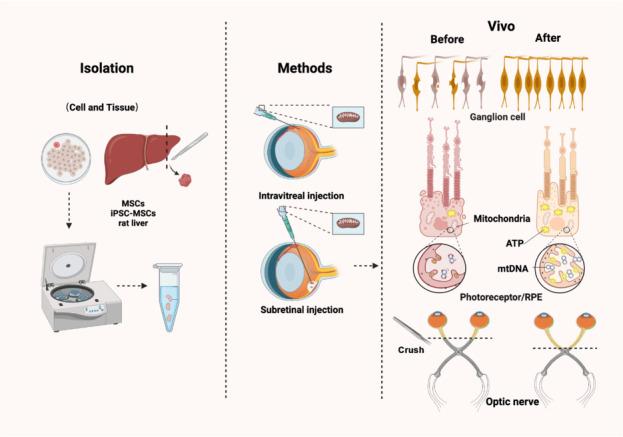
The retina, a crucial neural tissue, is responsible for transforming light signals into visual information, a process that necessitates a significant amount of energy. Mitochondria, the primary powerhouses of the cell, play an integral role in retinal physiology by fulfilling the high-energy requirements of photoreceptors and secondary neurons through oxidative phosphorylation. In a healthy state, mitochondria ensure proper visual function by facilitating efficient conversion and transduction of visual signals. However, in retinal degenerative diseases, mitochondrial dysfunction significantly contributes to disease progression, involving a decline in membrane potential, the occurrence of DNA mutations, increased oxidative stress, and imbalances in quality-control mechanisms. These abnormalities lead to an inadequate energy supply, the exacerbation of oxidative damage, and the activation of cell death pathways, ultimately resulting in neuronal injury and dysfunction in the retina. Mitochondrial transplantation has emerged as a promising strategy for addressing these challenges. This procedure aims to restore metabolic activity and function in compromised cells through the introduction of healthy mitochondria, thereby enhancing the cellular energy production capacity and offering new strategies for the treatment of retinal degenerative diseases. Although mitochondrial transplantation presents operational and safety challenges that require further investigation, it has demonstrated potential for reviving the vitality of retinal neurons. This review offers a comprehensive examination of the principles and techniques underlying mitochondrial transplantation and its prospects for application in retinal degenerative diseases, while also delving into the associated technical and safety challenges, thereby providing references and insights for future research and treatment.
视网膜是一种关键的神经组织,负责将光信号转化为视觉信息,这一过程需要大量能量。线粒体是细胞的主要能量产生细胞器,通过氧化磷酸化满足光感受器和二级神经元的高能量需求,在视网膜生理过程中发挥着不可或缺的作用。在健康状态下,线粒体通过促进视觉信号的有效转换和转导来确保正常的视觉功能。然而,在视网膜退行性疾病中,线粒体功能障碍显著促进疾病进展,涉及膜电位下降、DNA突变的发生、氧化应激增加以及质量控制机制失衡。这些异常导致能量供应不足、氧化损伤加剧以及细胞死亡途径的激活,最终导致视网膜神经元损伤和功能障碍。线粒体移植已成为应对这些挑战的一种有前景的策略。该程序旨在通过引入健康的线粒体来恢复受损细胞的代谢活性和功能,从而提高细胞的能量产生能力,并为视网膜退行性疾病的治疗提供新策略。尽管线粒体移植存在需要进一步研究的操作和安全挑战,但它已显示出恢复视网膜神经元活力的潜力。本综述全面审视了线粒体移植的原理和技术及其在视网膜退行性疾病中的应用前景,同时深入探讨了相关的技术和安全挑战,从而为未来的研究和治疗提供参考和见解。


 Zotero 插件