Curelaru Mihai, Curelaru Versavia
Department of Psychology, Faculty of Psychology and Educational Sciences, Alexandru Ioan Cuza University of Iasi, 700506 Iasi, Romania.
Department of Teacher Training, Faculty of Psychology and Educational Sciences, Alexandru Ioan Cuza University of Iasi, 700506 Iasi, Romania.
Behav Sci (Basel). 2024 Dec 30;15(1):26. doi: 10.3390/bs15010026.
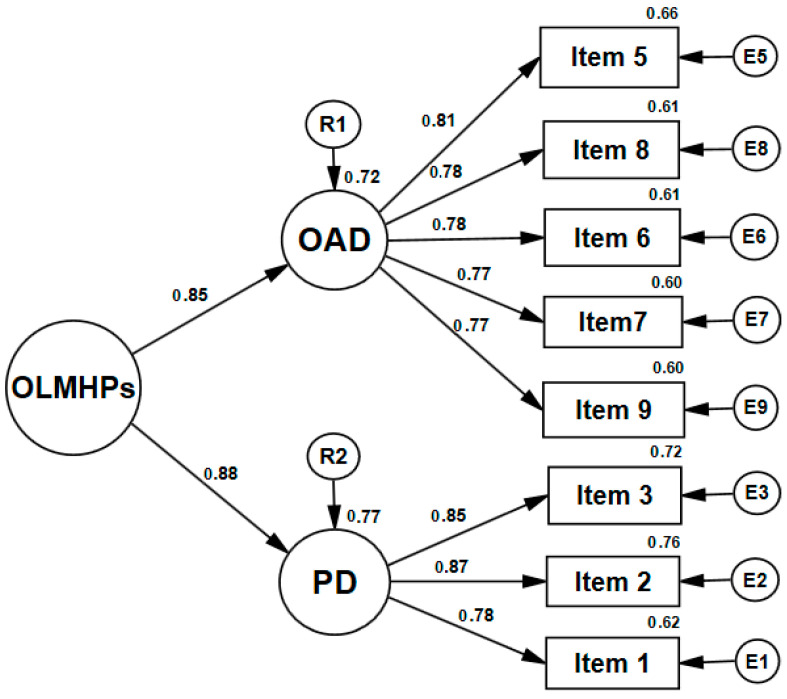
In the present study, a short instrument (eight-item self-report, five-point Likert scales) was developed and validated to assess self-perceived mental health problems in online learning. The participants were 398 Romanian university students from nine different faculties. The factor structure of the scale was assessed using Exploratory Factor Analysis (Principal Axis Factoring extraction method) and Confirmatory Factor Analysis. The high goodness-of-fit indices validated a second-order factor model of mental health problems, with two distinct but correlated sub-constructs, psychological distress, and online academic difficulties, integrated under a single higher-level factor. Psychological distress comprises indicators such as anxiety and stress, while online academic difficulties contain, for instance, indicators such as decreased performance, fatigue or lack of motivation. The results of applying multiple assessment criteria showed good reliability (e.g., McDonald's omega), as well as convergent validity (e.g., Average Variance Extracted) and discriminant validity (e.g., the heterotrait-monotrait ratio of correlations) of the scale. Also, correlations analysis between mental health problems occurred in online learning context and other measures indicated a strong negative relation with online course satisfaction and weak negative relations with subjective academic performance, perceived social competence, and perceived digital competence. In conclusion, the scale appears to be a valid instrument for measuring some negative mental health outcomes in online learning, perceived by university students. The implications of the results and limitations of this study are also discussed. In conclusion, the scale has multiple possible applications, the most important being (1) the assessment of mental health problems both in ordinary online learning situations and in emergency ones, which would allow the early detection of these issues, (2) the possibility of assessing relations between the sub-constructs of the scale and other psychological constructs of interest in scientific research, and (3) the feedback for teaching staff involved in the online learning system.
在本研究中,开发并验证了一种简短的工具(八项自我报告,五点李克特量表),以评估在线学习中的自我感知心理健康问题。参与者是来自九个不同学院的398名罗马尼亚大学生。使用探索性因素分析(主轴因子提取法)和验证性因素分析来评估该量表的因子结构。高拟合优度指标验证了心理健康问题的二阶因子模型,该模型有两个不同但相关的子结构,即心理困扰和在线学习困难,它们整合在一个单一的更高层次因子之下。心理困扰包括焦虑和压力等指标,而在线学习困难例如包含成绩下降、疲劳或缺乏动力等指标。应用多种评估标准的结果显示该量表具有良好的信度(如麦克唐纳ω系数),以及收敛效度(如平均方差抽取量)和区分效度(如相关系数的异质特质-同质特质比率)。此外,在线学习环境中出现的心理健康问题与其他测量指标之间的相关性分析表明,它与在线课程满意度呈强烈负相关,与主观学业成绩、感知社会能力和感知数字能力呈弱负相关。总之,该量表似乎是测量大学生感知到的在线学习中一些负面心理健康结果的有效工具。还讨论了本研究结果的意义和局限性。总之,该量表有多种可能的应用,其中最重要的是:(1)评估普通在线学习情况和紧急情况下的心理健康问题,这将有助于早期发现这些问题;(2)评估该量表子结构与科学研究中其他感兴趣的心理结构之间关系的可能性;(3)为参与在线学习系统的教师提供反馈。