Chayab Lara, Leighl Natasha B, Tadrous Mina, Warren Christine M, Wong William W L
Leslie Dan Faculty of Pharmacy, University of Toronto, Toronto, ON M5S 3M2, Canada.
Princess Margaret Cancer Centre, Toronto, ON M5G 2M9, Canada.
Curr Oncol. 2024 Dec 27;32(1):13. doi: 10.3390/curroncol32010013.
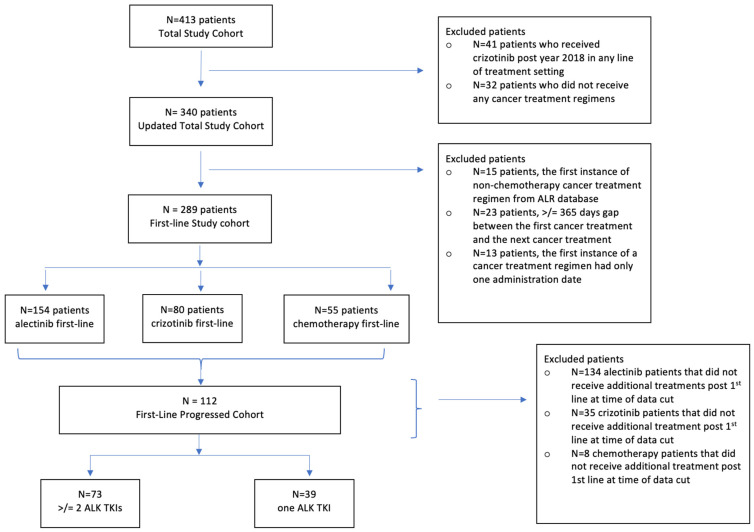
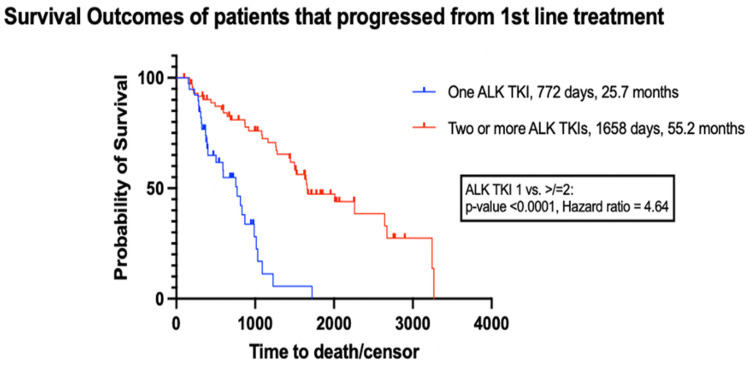
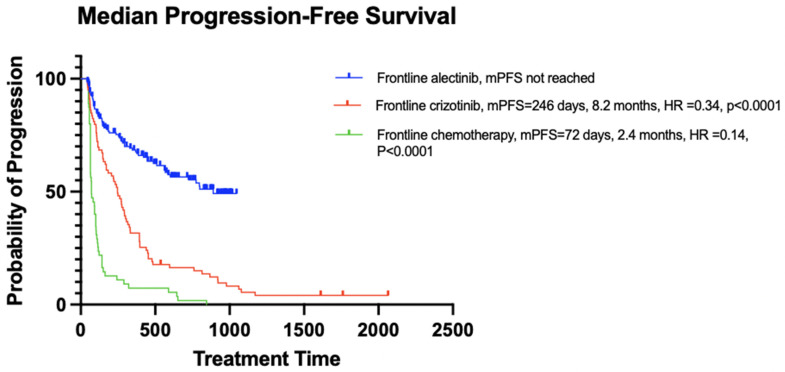
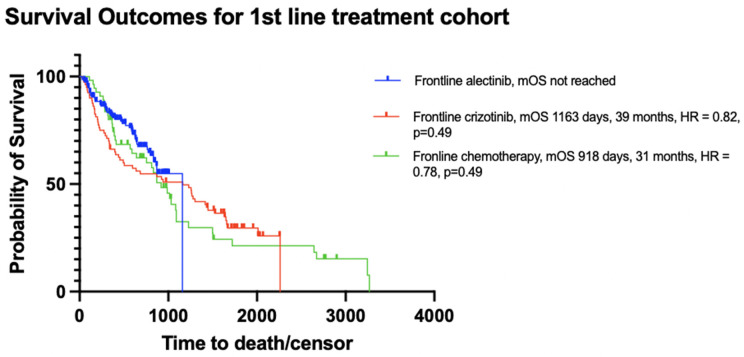
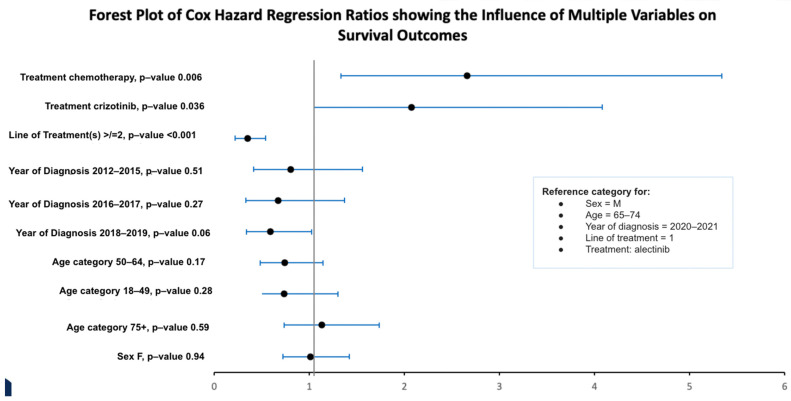
The treatment landscape for patients with advanced ALK-positive NSCLC has rapidly evolved following the approval of several ALK TKIs in Canada. However, public funding of ALK TKIs is mostly limited to the first line treatment setting. Using linked provincial health administrative databases, we examined real-world outcomes of patients with advanced ALK-positive NSCLC receiving ALK TKIs in Ontario between 1 January 2012 and 31 December 2021. Demographic, clinical characteristics and treatment patterns were summarized using descriptive statistics. Kaplan-Meier analysis was performed to evaluate progression-free survival (PFS) and overall survival (OS) among the treatment groups. A total of 413 patients were identified. Patients were administered alectinib (n = 154), crizotinib (n = 80), or palliative-intent chemotherapy (n = 55) in the first-line treatment. There was a significant difference in first-line PFS between the treatment groups. The median PFS (mPFS) was not reached for alectinib (95% CI, 568 days-not reached), compared to 8.2 months (95% CI, 171-294 days) for crizotinib (HR = 0.34, < 0.0001) and 2.4 months (95% CI, 65-100 days) for chemotherapy (HR = 0.14, < 0.0001). There was no significant difference in first-line OS between the treatment groups. In patients who received more than one line of treatment, there was a significant difference in mOS between patients who received two or more lines of ALK TKIs compared to those who received one line of ALK TKI (mOS = 55 months (95% CI, 400-987 days) and 26 months (95% CI, 1448-2644 days), respectively, HR = 4.64, < 0.0001). This study confirms the effectiveness of ALK TKIs in real-world practice and supports the potential benefit of multiple lines of ALK TKI on overall survival in patients with ALK-positive NSCLC.
在加拿大批准了几种ALK酪氨酸激酶抑制剂(ALK TKIs)之后,晚期ALK阳性非小细胞肺癌(NSCLC)患者的治疗格局迅速演变。然而,ALK TKIs的公共资金大多仅限于一线治疗环境。我们利用省级卫生行政数据库的关联数据,研究了2012年1月1日至2021年12月31日期间安大略省接受ALK TKIs治疗的晚期ALK阳性NSCLC患者的真实世界结局。使用描述性统计总结人口统计学、临床特征和治疗模式。进行Kaplan-Meier分析以评估各治疗组的无进展生存期(PFS)和总生存期(OS)。共识别出413例患者。一线治疗中,患者接受阿来替尼(n = 154)、克唑替尼(n = 80)或姑息性化疗(n = 55)。各治疗组一线PFS存在显著差异。阿来替尼组的中位PFS(mPFS)未达到(95%CI,568天 - 未达到),相比之下,克唑替尼组为8.2个月(95%CI,171 - 294天)(HR = 0.34,< 0.0001),化疗组为2.4个月(95%CI,65 - 100天)(HR = 0.14,< 0.0001)。各治疗组一线OS无显著差异。在接受多线治疗的患者中,接受两条或更多线ALK TKIs治疗的患者与接受一线ALK TKI治疗的患者相比,mOS存在显著差异(mOS分别为55个月(95%CI,400 - 987天)和26个月(95%CI,1448 - 2644天),HR = 4.64,< 0.0001)。本研究证实了ALK TKIs在真实世界实践中的有效性,并支持多线ALK TKI治疗对ALK阳性NSCLC患者总生存期的潜在益处。