Guo Huanyu, Sun Yingzi, Gao Wei, Liu Yuqing, Han Tianshu, Zhang Dandan
Department of Obstetrics and Gynecology, the First Affiliated Hospital of Harbin Medical University, 23 Postal Street, Harbin, 150081, Heilongjiang, P. R. China.
National Key Discipline Laboratory, Department of Nutrition and Food Hygiene, School of Public Health, Harbin Medical University, Harbin, P. R. China.
BMC Public Health. 2025 Jan 24;25(1):312. doi: 10.1186/s12889-025-21576-z.
Little is known about the role of timing of physical activity in female reproductive disorders. These disorders include polycystic ovary syndrome (PCOS), heavy menstrual bleeding (HMB), endometriosis, infertility, and pregnancy-related disorders. This study aims to investigate the associations of activity patterns with female reproductive diseases.
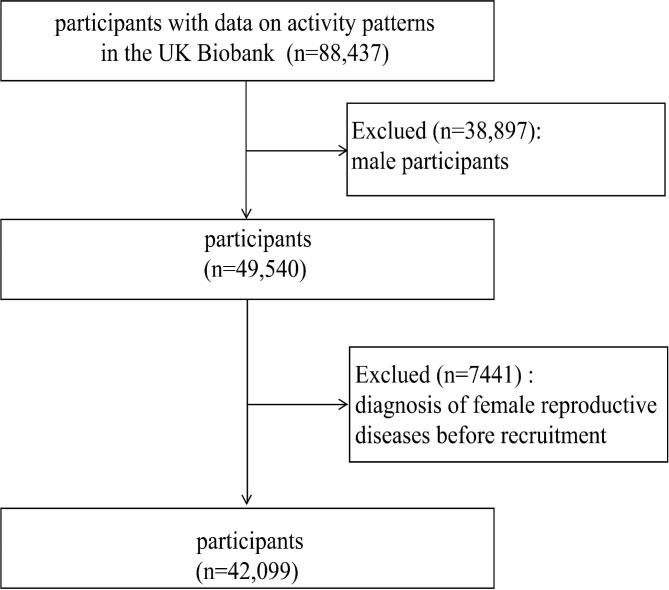
A total of 49,540 female participants from the UK Biobank with valid accelerometer data were enrolled at baseline. Activity patterns were defined based on the timing of moderate-to-vigorous intensity physical activity (MVPA) throughout the day. Participants were categorized into four groups according to the timing of their MVPA: "morning, evening, mixed, midday-afternoon", with the midday-afternoon group serving as the reference. Cox proportional hazards models were utilized to evaluate the association between activity patterns and female reproductive diseases.
During a median follow-up of 12.6 years, a total of 1044 cases of female reproductive diseases were documented. After adjustment for potential confounders, compared to women with midday-afternoon exercise, women with morning exercise and mixed-timing exercise were associated with lower risks for female reproductive diseases (HR=0.81, 95% CI: 0.67-0.98; HR=0.79, 95% CI: 0.69-0.91, P-trend < 0.05). Moreover, morning exercise and mixed-timing exercise had lower risks of PCOS (HR=0.38, 95% CI: 0.15-0.97; HR=0.27, 95% CI: 0.13-0.57, P-trend<0.001), and mixed-timing exercise was associated with a lower risk for HMB (HR=0.81, 95% CI: 0.70-0.95, P-trend < 0.05), compared with the reference group.
Compared with midday-afternoon group, morning and mixed MVPA timing groups, but not evening group, were associated with decreased risks for female reproductive diseases and PCOS. In addition, we found that women with mixed MVPA timing exercise had a lower risk of HMB, compared with the reference group.
关于体育活动时间在女性生殖系统疾病中的作用,人们了解甚少。这些疾病包括多囊卵巢综合征(PCOS)、月经过多(HMB)、子宫内膜异位症、不孕症以及与妊娠相关的疾病。本研究旨在调查活动模式与女性生殖疾病之间的关联。
共有49540名来自英国生物银行且拥有有效加速度计数据的女性参与者在基线时被纳入研究。活动模式是根据全天中等至剧烈强度体育活动(MVPA)的时间来定义的。参与者根据其MVPA的时间被分为四组:“早晨、晚上、混合、中午 - 下午”,其中中午 - 下午组作为参照组。采用Cox比例风险模型来评估活动模式与女性生殖疾病之间的关联。
在中位随访12.6年期间,共记录了1044例女性生殖疾病病例。在对潜在混杂因素进行调整后,与中午 - 下午锻炼的女性相比,早晨锻炼和混合时间锻炼的女性患女性生殖疾病的风险较低(风险比[HR]=0.81,95%置信区间[CI]:0.67 - 0.98;HR=0.79,95%CI:0.69 - 0.91,P趋势<0.05)。此外,与参照组相比,早晨锻炼和混合时间锻炼患PCOS的风险较低(HR=0.38,95%CI:0.15 - 0.97;HR=0.27,95%CI:0.13 - 0.57,P趋势<0.001),并且混合时间锻炼与HMB风险较低相关(HR=0.81,95%CI:0.70 - 0.95,P趋势<0.05)。
与中午 - 下午组相比,早晨和混合MVPA时间组(而非晚上组)与女性生殖疾病和PCOS风险降低相关。此外,我们发现与参照组相比,进行混合MVPA时间锻炼的女性患HMB的风险较低。