Omadang Leonard, Emmanuel Othieno, Ikwap Kokas, Joseph Erume, Ejobi Francis, Ocaido Michael
College of Veterinary Medicine, Animal Resources and Biosecurity, Makerere University, Kampala, Uganda.
Faculty of Agriculture and Animal Sciences, Department of Animal Production and Management, Busitema University, Arapai Campus, Soroti, Uganda.
BMC Vet Res. 2025 Jan 24;21(1):34. doi: 10.1186/s12917-025-04489-2.
Cystic echinococcosis is a parasitic cyclo-zoonotic disease caused by the taeniid Echinococcus and causes significant economic losses in livestock production, yet its impact is often overlooked and under estimated.
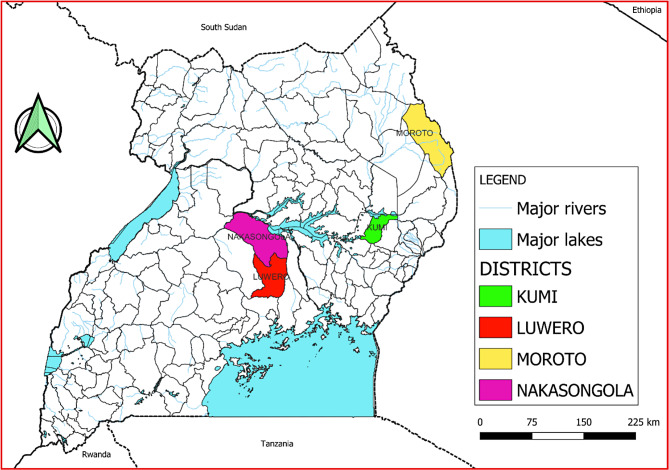
This study investigated the risk factors and economic impact of cystic echinococcosis in livestock, in Uganda's pastoral and agro-pastoral communities. In the study, 14,937 livestock were examined at selected slaughterhouses in Moroto, Kumi, Luwero and Nakasongola districts from March 2019 to February 2020. The visceral organs were examined for hydatid cysts during slaughter and the prevalence correlated with the risk factors got from livestock traders and livestock owners through questionnaire survey. Production losses and economic losses due to organ condemnations were also estimated.
This is the first study to provide insights into the financial impacts and risk factors towards Cystic Echinococcosis (CE) in livestock in Uganda. The key significant risk factors for the persistence of CE in goats were place of origin from Lira (P ≤ 0.000), Nakasongola (P ≤ 0.002), Luwero and Bukedea (P ≤ 0.002), and tethering (P ≤ 0.001); in cattle was communal grazing (P ≤ 0.0000); and in sheep was being kept in large flocks (P ≤ 0.004). The total annual economic losses due to CE on livestock inspected in abattoirs in the study districts was USD 21,352.7 (1 USD = 3,809.3 UGX) of which 11.7% was due to organ condemnation and 88.3% due to livestock production losses. More significant mean annual economic losses per livestock species examined occurred in Moroto district among Zebu cattle USD 8.4, goats USD 1.4 and sheep USD 1.4 than other districts.
Results show that CE is a disease of significant economic and public health importance in PAP areas in Uganda with urgent need to create awareness and institute community-based control measures involving multistakeholder particiapation.to break livestock-dog cycle.
囊型棘球蚴病是由带科棘球绦虫引起的一种寄生性环带动物病,在畜牧生产中造成重大经济损失,但其影响往往被忽视和低估。
本研究调查了乌干达牧区和农牧结合区家畜囊型棘球蚴病的风险因素及经济影响。研究期间,于2019年3月至2020年2月在莫罗托、库米、卢韦罗和纳卡松戈拉地区的选定屠宰场检查了14937头家畜。屠宰时检查内脏器官是否有包虫囊肿,并通过问卷调查将患病率与从牲畜交易商和牲畜所有者处获得的风险因素相关联。还估计了因器官废弃造成的生产损失和经济损失。
这是第一项深入了解乌干达家畜囊型棘球蚴病(CE)的财务影响和风险因素的研究。山羊中CE持续存在的关键显著风险因素是来自利拉(P≤0.000)、纳卡松戈拉(P≤0.002)、卢韦罗和布凯德亚(P≤0.002)的产地,以及拴系(P≤0.001);牛的是 communal grazing(P≤0.0000);绵羊的是大群饲养(P≤0.004)。研究区屠宰场检查的家畜因CE造成的年度总经济损失为21352.7美元(1美元=3809.3乌干达先令),其中11.7% 是由于器官废弃,88.3% 是由于家畜生产损失。在所检查的每个家畜品种中,莫罗托地区的平均年度经济损失比其他地区更显著,在瘤牛中为8.4美元,山羊中为1.4美元,绵羊中为1.4美元。
结果表明,CE在乌干达农牧结合区是一种具有重大经济和公共卫生重要性的疾病,迫切需要提高认识并制定涉及多利益相关方参与的社区控制措施,以打破家畜 - 狗循环。