Huang Hung-Yi, Lin Meng-Hao, Hsu Chu-Hsiang, Kuo Liang-Tseng
Department of Education, Chang Gung Memorial Hospital, Chiayi 613016, Taiwan.
Department of Orthopaedic Surgery, Chang Gung Memorial Hospital, Yunlin 638502, Taiwan.
Diagnostics (Basel). 2025 Jan 9;15(2):146. doi: 10.3390/diagnostics15020146.
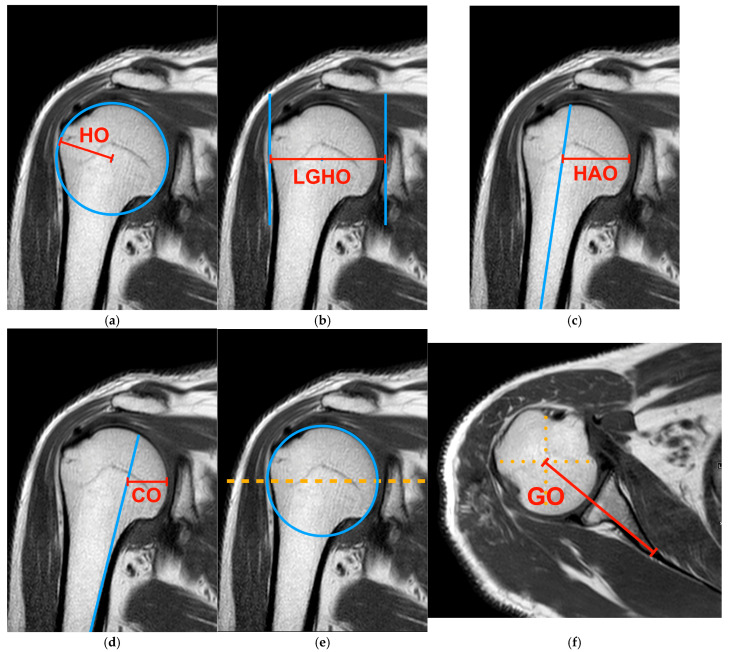
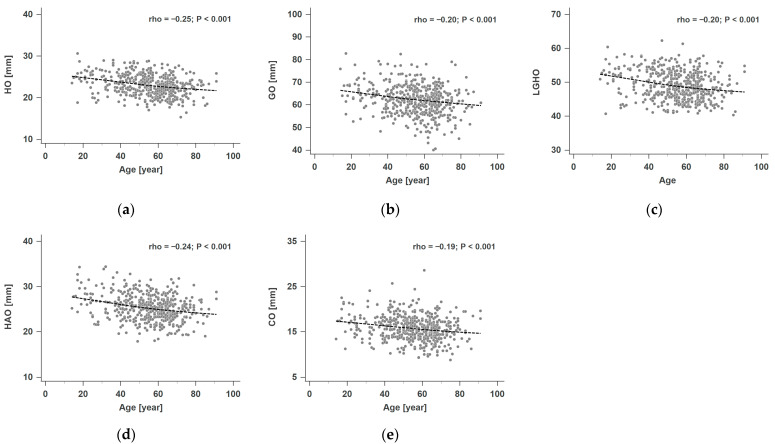
: Physical shoulder offset parameters (SOPs) play important roles in the diagnosis and treatment of shoulder diseases. However, there is little research analyzing SOPs in healthy shoulders using cross-sectional MRI images, especially in Asians. Therefore, this study aimed to establish physiological reference values of shoulder parameters for Asian populations. : This was a retrospective imaging study using MRI images of the shoulder joints of 500 patients (mean age: 55.9 ± 14.0 years). We measured the following SOPs of the normal joint: HO, GO, lateral glenoidal humeral offset (LGHO), humeral shaft axis offset (HAO), and cortical offset (CO). In addition, the offset parameters were examined for associations with age, gender, side, and osteoarthritis. : The mean HO was 22.9 (±2.4) mm, the mean GO was 62.3 (±6.6) mm, the mean LGHO was 48.9 (±4.2) mm, the mean HAO was 25.2 (±2.8) mm, and the mean CO was 15.7 (±2.7) mm. Male patients exhibited significantly higher values across all SOPs compared to female patients. In addition, there was a significantly lower mean value for HAO in left shoulders (HAO: 24.7± 2.8 mm vs. 25.5 ± 2.8 mm, = 0.011). There was a negatively significant correlation between age and all SOPs. No significant difference in mean values was noted between shoulders with osteoarthritis and non-osteoarthritis in any SOPs. : Significant gender- and age-specific differences were noted for all measured SOPs. In addition, right shoulders did not show higher mean SOP values than left shoulders, except for HAO, suggesting that the contralateral joint is a reliable reference for surgical planning. These findings should be considered in shoulder surgery planning.
物理性肩关节偏移参数(SOPs)在肩部疾病的诊断和治疗中发挥着重要作用。然而,利用横断面MRI图像分析健康肩部SOPs的研究较少,尤其是在亚洲人群中。因此,本研究旨在建立亚洲人群肩部参数的生理参考值。
这是一项回顾性影像学研究,使用了500例患者(平均年龄:55.9±14.0岁)肩关节的MRI图像。我们测量了正常关节的以下SOPs:肱骨头偏移(HO)、关节盂偏移(GO)、外侧关节盂肱骨头偏移(LGHO)、肱骨干轴线偏移(HAO)和皮质偏移(CO)。此外,还检查了偏移参数与年龄、性别、患侧以及骨关节炎之间的关联。
平均HO为22.9(±2.4)mm,平均GO为62.3(±6.6)mm,平均LGHO为48.9(±4.2)mm,平均HAO为25.2(±2.8)mm,平均CO为15.7(±2.7)mm。与女性患者相比,男性患者在所有SOPs上的值均显著更高。此外,左肩的HAO平均值显著更低(HAO:24.7±2.8mm对25.5±2.8mm,P = 0.011)。年龄与所有SOPs之间存在显著的负相关。在任何SOPs中,骨关节炎肩部和非骨关节炎肩部的平均值均无显著差异。
所有测量的SOPs均存在显著的性别和年龄特异性差异。此外,除HAO外,右肩的平均SOP值并不高于左肩,这表明对侧关节是手术规划的可靠参考。在肩部手术规划中应考虑这些发现。