
足月等效年龄时的脑超声检查:与矫正年龄12至24个月时神经运动结局的相关性。
Cerebral Ultrasound at Term-Equivalent Age: Correlations with Neuro-Motor Outcomes at 12-24 Months Corrected Age.
作者信息
Toma Adrian Ioan, Dima Vlad, Rusu Lidia, Nemeș Alexandra Floriana, Gonț Bogdan Florin, Arghirescu Alexandra, Necula Andreea, Fieraru Alina, Stoiciu Roxana, Andrășoaie Larisa, Mitran Loredana, Mehedințu Claudia, Isam Al Jashi
机构信息
Life Memorial Hospital, 010719 Bucharest, Romania.
Faculty of Medicine, University Titu Maiorescu, 040441 Bucharest, Romania.
出版信息
Children (Basel). 2024 Dec 28;12(1):30. doi: 10.3390/children12010030.
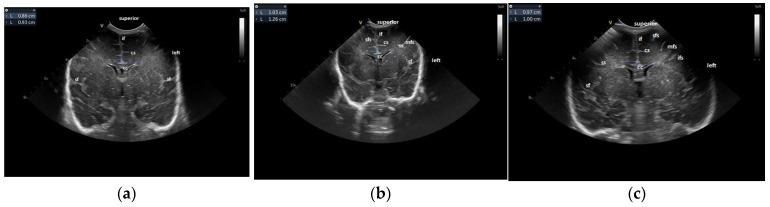
Our research aimed to assess if correlations could be found between items evaluated at the cerebral ultrasound performed at term-equivalent age (TEA) and neuro-motor outcomes evaluated at 12 and 24 months of corrected age in a group of preterm infants. The following were assessed: the Levine Index, the diagonals of the lateral ventricles, the size of the ventricular midbody, the sinocortical distance, the width of the basal ganglia, the cortical depth at the level of the cingular sulcus and the maturation of the gyral folding. The neurologic evaluation was performed at 12 and 24 months of corrected age, according to the Amiel Tison neurologic examination, and the items from the calendar of motor acquisitions were used as outcome measures of the study-gross and fine motor subsets. The comparisons between the different groups were performed using the FANOVA test, with a statistically significant association for a < 0.05. The abnormal gross motor acquisitions at 12 months were significantly associated with an increased size of the ventricular midbody ( < 0.009) and a significantly decreased diameter of the basal ganglia ( < 0.011) on the TEA cerebral ultrasound. At 24 months, a significant association was found with increased size of the ventricular midbody (>10.33 mm) ( < 0.001), a decreased diameter of the basal ganglia (<12.9 mm) ( < 0.016), a decreased cortical depth ( < 0.021) and an immature gyral maturation pattern ( < 0.001). In the case of severely abnormal fine motor outcomes, at 12 months, there were statistically significant associations with an increased size of the ventricular midbody ( < 0.001) and an immature gyral folding pattern ( < 0.0180); at 24 months, significant associations were noted with the size of ventricular midbody ( < 0.001), a decreased diameter of the basal ganglia ( < 0.016), a decreased cortical depth ( < 0.021) and an immature gyration folding ( < 0.001). The abnormal gross and fine motor outcome in former premature infants at 12-24 months corrected age is significantly associated with abnormal findings in the head ultrasound examination performed at TEA reflecting both white matter (increased midbody distance) and grey matter (decreased diameter of the basal ganglia, decreased cortical depth and an immature gyration pattern) involvement.
我们的研究旨在评估在一组早产儿中,足月等效年龄(TEA)时进行的脑超声评估项目与矫正年龄12个月和24个月时评估的神经运动结局之间是否存在相关性。评估了以下指标:莱文指数、侧脑室对角线、脑室中间部大小、脑沟皮质距离、基底神经节宽度、扣带回沟水平的皮质深度以及脑回折叠的成熟度。根据阿米尔·蒂松神经学检查,在矫正年龄12个月和24个月时进行神经学评估,并将运动发育日程中的项目用作研究的粗大运动和精细运动亚组的结局指标。使用FANOVA检验对不同组进行比较,P<0.05具有统计学意义的关联。在TEA脑超声检查中,12个月时粗大运动发育异常与脑室中间部增大(P<0.009)和基底神经节直径显著减小(P<0.011)显著相关。在24个月时,发现与脑室中间部增大(>10.33mm)(P<0.001)、基底神经节直径减小(<12.9mm)(P<0.016)、皮质深度减小(P<0.021)和脑回成熟模式不成熟(P<0.001)存在显著关联。对于严重异常的精细运动结局,在12个月时,与脑室中间部增大(P<0.001)和脑回折叠模式不成熟(P<0.0180)存在统计学显著关联;在24个月时,与脑室中间部大小(P<0.001)、基底神经节直径减小(P<0.016)、皮质深度减小(P<0.021)和脑回折叠不成熟(P<0.001)存在显著关联。矫正年龄12至24个月的前早产儿的粗大和精细运动异常结局与TEA时进行的头部超声检查中的异常发现显著相关,这反映了白质(中间部距离增加)和灰质(基底神经节直径减小、皮质深度减小和脑回模式不成熟)均受累。



 Zotero 插件