Sepolvere Giuseppe, Tedesco Mario, Cibelli Mario, Cirillo Dario, Sparaco Angelo, Gagliardi Giuseppe, Costagliola Giuseppina, Cristiano Loredana, Scialdone Valeria Rita, Pasquariello Maria Rosaria, Di Zazzo Fabrizio, Merola Luigi, Della Valle Mirco, Arminio Daniela, Bottazzo Leonardo Maria, Folliero Marco, Ranieri Giorgio, Santonastaso Domenico Pietro, Coviello Antonio
Department of Anaesthesia, S. Michele Hospital, 81024 Maddaloni, Italy.
Department of Anaesthesia, Mater Dei Hospital, 70125 Bari, Italy.
Medicina (Kaunas). 2025 Jan 10;61(1):100. doi: 10.3390/medicina61010100.
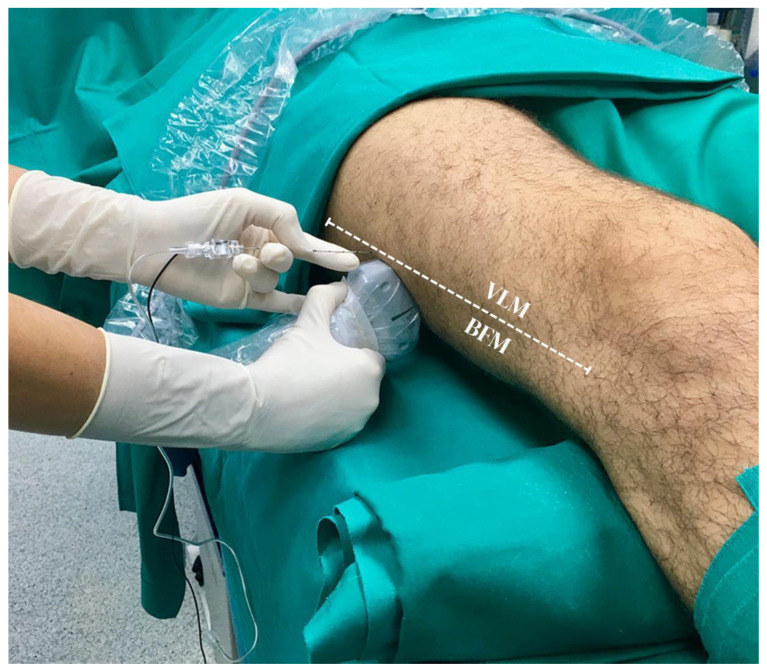
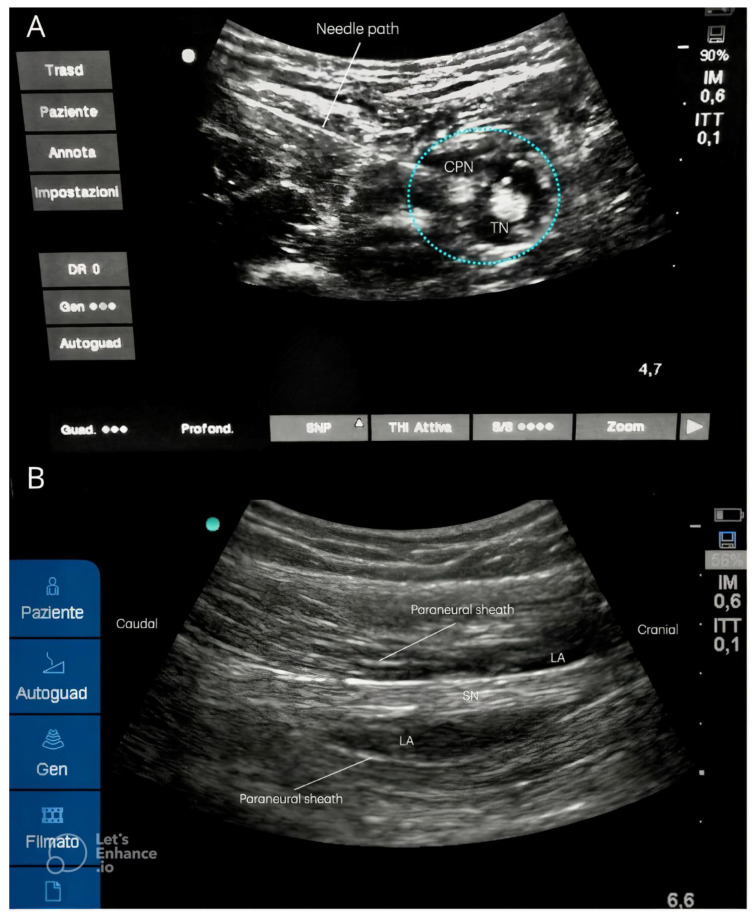
The anatomy of the sciatic nerve allows it to be blocked at different levels using various anesthetic approaches. However, for several reasons, performing these approaches may be challenging or disadvantageous in specific categories of patients, particularly in obese patients. The objective of this brief technical report is to describe a new technical approach to sciatic nerve block, designed to simplify the procedure for certain categories of patients and less experienced practitioners. Since 2010, more than 5000 procedures have been performed by both experienced anesthesiologists and novice trainees in several hospitals. The ultrasound lateral mid-shaft technique appears to be a safe and effective method for performing a sciatic nerve block, even in obese patients with significant subcutaneous fat and unclear ultrasound images. This approach is particularly beneficial given the various anatomical variations that can occur. By targeting the mid-thigh area, the ultrasound beam accesses anatomical structures that are more superficial, improving the technique's efficacy. Various hospital groups have been performing this technique as a routine procedure, achieving a success rate of nearly 100%. This impressive success rate exceeds that of other conventional techniques documented in the literature. Additionally, there have been significant improvements in comfort and ease for anesthetists. This method allows the anesthetic to spread around the paraneural sheath, covering the posterior femoral cutaneous nerve. Finally, it is performed in the supine position without the need to mobilize the lower limbs, ensuring patient comfort, especially in cases of fractures or lower limb injuries. Further studies are needed to confirm these results.
坐骨神经的解剖结构使得可以使用各种麻醉方法在不同水平对其进行阻滞。然而,由于多种原因,在特定类型的患者中,尤其是肥胖患者,实施这些方法可能具有挑战性或存在不利之处。本简短技术报告的目的是描述一种新的坐骨神经阻滞技术方法,旨在简化某些类型患者以及经验较少的从业者的操作流程。自2010年以来,几家医院的经验丰富的麻醉医生和新手学员已进行了5000多次该操作。超声外侧中轴技术似乎是一种安全有效的坐骨神经阻滞方法,即使对于皮下脂肪较多且超声图像不清晰的肥胖患者也是如此。鉴于可能出现的各种解剖变异,这种方法特别有益。通过将目标定位在大腿中部区域,超声束可以接触到更浅表的解剖结构,从而提高该技术的有效性。多个医院团队已将此技术作为常规操作,成功率接近100%。这一令人印象深刻的成功率超过了文献中记载的其他传统技术。此外,麻醉医生在舒适度和操作简便性方面也有了显著改善。这种方法可使麻醉剂在神经旁鞘周围扩散,覆盖股后皮神经。最后,该操作在仰卧位进行,无需移动下肢,确保了患者的舒适度,尤其是在骨折或下肢受伤的情况下。需要进一步研究来证实这些结果。