Abozaid Ghada Mohammed, Kerr Katie, Alomary Hiba, Al-Omar Hussain A, McKnight Amy
Centre for Public Health, Institute of Clinical Sciences B, Royal Victoria Hospital, Queen's University Belfast School of Medicine, Dentistry and Biomedical Sciences, Belfast, UK
Pharmacy Practice, Princess Nourah bint Abdulrahman University, Riyadh, Saudi Arabia.
BMJ Open. 2025 Jan 25;15(1):e086527. doi: 10.1136/bmjopen-2024-086527.
This study sheds light on the available global definitions, classifications, and criteria used for rare diseases (RDs), ultrarare diseases (URDs), orphan drugs (ODs) and ultraorphan drugs (UODs) and provides insights into the rationale behind these definitions.
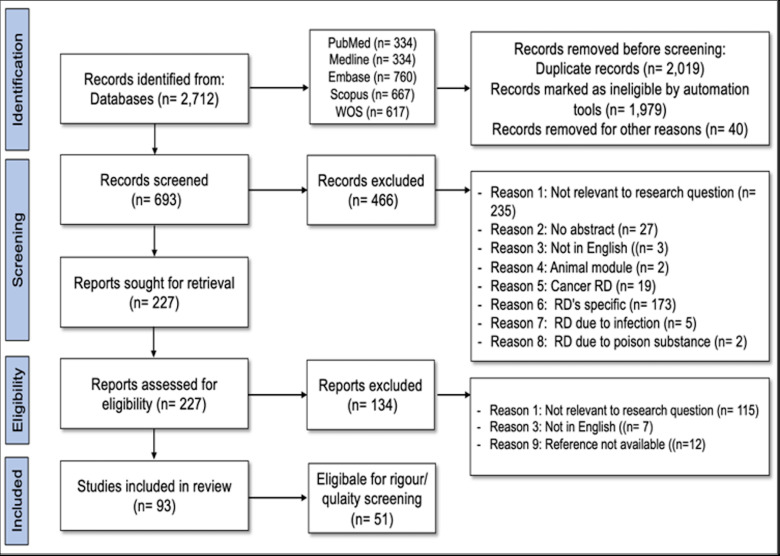
A systematic literature review was conducted to identify existing definitions and the criteria used to define RDs, ODs and their subtypes.
Searches were performed in the PubMed/Medline, Embase, Scopus and Web of Science (Science and Social Sciences Citation Index) databases covering articles published from 1985 to 2021.
English-language studies on the general human population were included if they provided definitions or criteria for RDs, ODs and/or their subtypes without restrictions on publication year, country or jurisdiction.
Two independent reviewers conducted the search, screening and data extraction. Narrative synthesis, content analysis and descriptive analyses were conducted to extract and categorise definitions and criteria from these sources. Study quality was assessed using the Joanna Briggs Institute (JBI) critical appraisal tools.
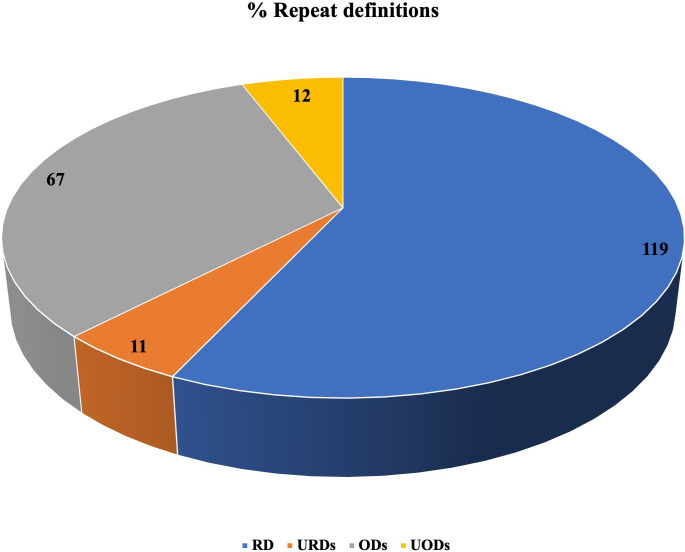
Online searches identified 2712 published articles. Only 93 articles met the inclusion criteria, with 209 distinct definitions extracted. Specifically, 93 of these articles pertained to 119 RDs, 11 URDs, 67 ODs and 12 UODs. These definitions varied in their reliance on prevalence based and other contextual criteria.
Prevalence-based criteria alone pose challenges, as disease frequencies differ by country. Establishing country-specific definitions can enhance understanding, support intercountry evaluations, improve healthcare efficiency and access to ODs, and strengthen equity and equality in healthcare. Such efforts would also promote research and development and support better outcomes for patients with complex and rare conditions.
CRD42021252701.
本研究阐明了全球用于罕见病(RDs)、超罕见病(URDs)、孤儿药(ODs)和超孤儿药(UODs)的现有定义、分类及标准,并深入探讨了这些定义背后的基本原理。
进行了一项系统的文献综述,以确定现有的定义以及用于界定罕见病、孤儿药及其亚型的标准。
在PubMed/Medline、Embase、Scopus和Web of Science(科学与社会科学引文索引)数据库中进行检索,涵盖1985年至2021年发表的文章。
纳入针对一般人群的英文研究,只要其提供了罕见病、孤儿药和/或其亚型的定义或标准,对发表年份、国家或管辖区域无限制。
两名独立评审员进行检索、筛选和数据提取。进行叙述性综合、内容分析和描述性分析,以从这些来源中提取并分类定义和标准。使用乔安娜·布里格斯研究所(JBI)的批判性评价工具评估研究质量。
在线检索共识别出2712篇已发表文章。只有93篇文章符合纳入标准,共提取出209个不同的定义。具体而言,这些文章中有93篇涉及119种罕见病、11种超罕见病、67种孤儿药和12种超孤儿药。这些定义在对基于患病率的标准和其他背景标准的依赖程度上各不相同。
仅基于患病率的标准存在挑战,因为各国疾病发病率不同。制定针对特定国家的定义可增进理解、支持跨国评估、提高医疗效率和孤儿药可及性,并加强医疗保健中的公平和平等。此类努力还将促进研发,并为患有复杂罕见病症的患者带来更好的治疗效果。
PROSPERO注册号:CRD4 2021252701。