
日本长期暴露于细颗粒物中的全因死亡率和特定病因死亡率:茨城县健康研究
All-Cause and Cause-Specific Mortality Associated with Long-Term Exposure to Fine Particulate Matter in Japan: The Ibaraki Prefectural Health Study.
作者信息
Michikawa Takehiro, Nishiwaki Yuji, Asakura Keiko, Okamura Tomonori, Takebayashi Toru, Hasegawa Shuichi, Milojevic Ai, Minami Mihoko, Taguri Masataka, Takeuchi Ayano, Ueda Kayo, Sairenchi Toshimi, Yamagishi Kazumasa, Iso Hiroyasu, Irie Fujiko, Nitta Hiroshi
机构信息
Department of Environmental and Occupational Health, School of Medicine, Toho University.
Department of Public Health Medicine, Institute of Medicine, and Health Services Research and Development Centre, University of Tsukuba.
出版信息
J Atheroscler Thromb. 2025 Aug 1;32(8):982-993. doi: 10.5551/jat.65424. Epub 2025 Jan 25.
AIMS
Long-term exposure to fine particulate matter (PM) is causally associated with mortality and cardiovascular disease. However, in terms of cardiovascular cause-specific outcomes, there are fewer studies about stroke than about coronary heart disease, particularly in Asia. Furthermore, there remains uncertainty regarding the PM-respiratory disease association. We examined whether long-term exposure to PM is associated with all-cause, cardiovascular and respiratory disease mortality in Japan.
METHODS
We used data of 46,974 participants (19,707 men; 27,267 women), who were enrolled in 2009 and followed up until 2019, in a community-based prospective cohort study (the second cohort of the Ibaraki Prefectural Health Study). We estimated PM concentrations using the inverse distance weighing methods based on ambient air monitoring data, and assigned each participant to administrative area level concentrations. A Cox proportional hazard model was applied to estimate hazard ratios (HRs) and 95% confidence intervals (CIs) of mortality.
RESULTS
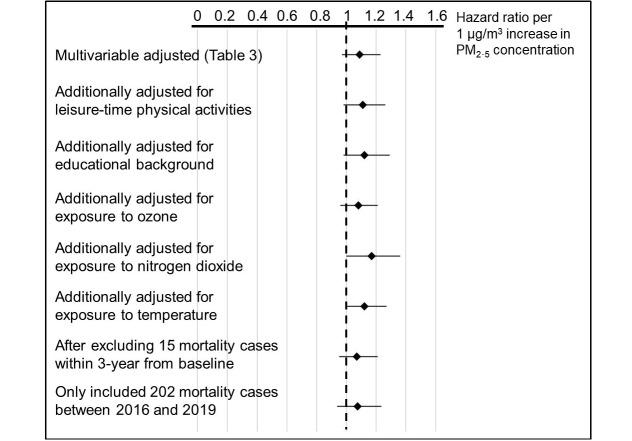
During the average follow-up of 10 years, we confirmed 2,789 all-cause deaths. All outcomes including stroke mortality did not significantly increase as the PM concentration increased. For non-malignant respiratory disease mortality, the multivariable adjusted HR per 1 µg/m increase in the PM concentration was 1.09 (95% CI = 0.97-1.23).
CONCLUSIONS
In this population exposed to PM at concentrations of 8.3-13.1 µg/m, there was no evidence that long-term exposure to PM had adverse effects on mortality. Weak evidence of positive association observed for non-malignant respiratory disease mortality needs further studies in other populations.
目的
长期暴露于细颗粒物(PM)与死亡率和心血管疾病存在因果关系。然而,就心血管疾病的特定病因结局而言,关于中风的研究比冠心病少,尤其是在亚洲。此外,PM与呼吸系统疾病之间的关联仍存在不确定性。我们研究了在日本长期暴露于PM是否与全因、心血管和呼吸系统疾病死亡率相关。
方法
我们使用了46974名参与者(19707名男性;27267名女性)的数据,这些参与者于2009年入组,并随访至2019年,这是一项基于社区的前瞻性队列研究(茨城县健康研究的第二个队列)。我们基于环境空气监测数据使用反距离加权法估算PM浓度,并将每位参与者分配到行政区层面的浓度。应用Cox比例风险模型来估计死亡率的风险比(HRs)和95%置信区间(CIs)。
结果
在平均10年的随访期间,我们确认了2789例全因死亡。随着PM浓度的增加,包括中风死亡率在内的所有结局均未显著增加。对于非恶性呼吸系统疾病死亡率,PM浓度每增加1µg/m³,多变量调整后的HR为1.09(95%CI=0.97-1.23)。
结论
在这个PM浓度为8.3-13.1µg/m³的人群中,没有证据表明长期暴露于PM对死亡率有不良影响。观察到的非恶性呼吸系统疾病死亡率呈正相关的微弱证据需要在其他人群中进一步研究。


 Zotero 插件