Xu Zhe, Ding Yi, Deng Xue-Mei, Mao Xiu-Xiu, Xia Ping-Fan, Li Deng-Ran, Lu Yong-Ping
Department of Pediatrics, Guangyuan Central Hospital, Guangyuan, People's Republic of China.
Science & Technology Innovation Center, Guangyuan Central Hospital, Guangyuan, People's Republic of China.
Infect Drug Resist. 2025 Jan 21;18:419-426. doi: 10.2147/IDR.S502880. eCollection 2025.
To explore the application of short-peptide enteral nutrition formulation in mechanically ventilated pediatric patients with severe pneumonia and its impact on rehabilitation outcomes, providing practical clinical evidence for the nutritional support strategy in critically ill pneumonia children.
This study retrospectively analyzed the clinical data of 90 neonatal pneumonia patients undergoing mechanical ventilation from May 2022 to December 2023. The patients were divided into an experimental group receiving short peptide enteral nutrition formulation via nasogastric tube and a control group receiving whole-protein enteral nutrition formulation via nasogastric tube. The nutritional risk was assessed using STRONGkids, and the nutritional status was analyzed through biochemical protein indicators. Additionally, mechanical ventilation time, hospitalization duration, incidence of ventilator-associated pneumonia (VAP), and disease outcomes were recorded and compared between the two groups.
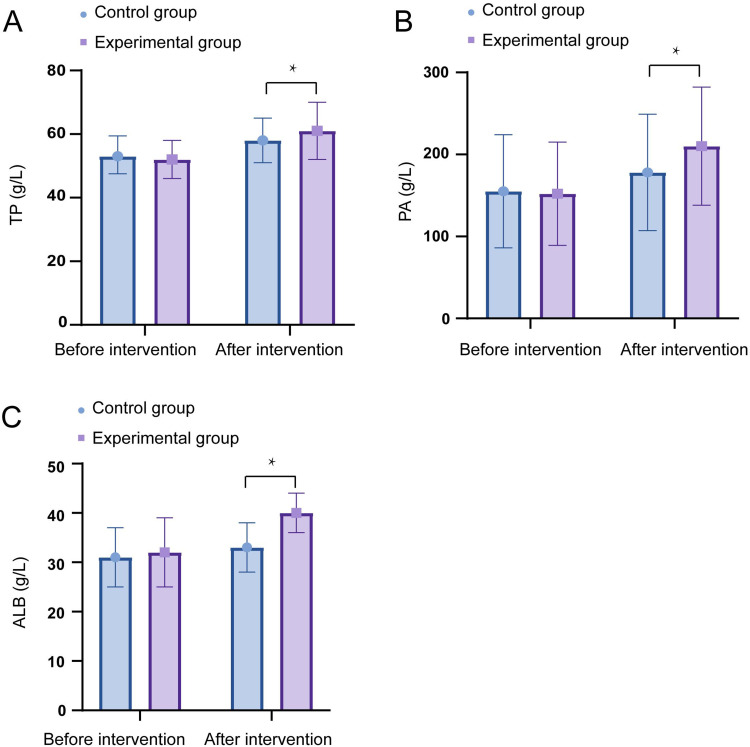
Both groups were assessed with medium to high nutritional risk, with no significant difference in the degree of nutritional risk (P > 0.05). After intervention, total protein, albumin, and prealbumin levels increased in both groups, with the experimental group showing significantly higher levels than the control group (P < 0.05). VAP predominantly occurred in the control group, with an incidence rate of 7% (3/45), showing a statistically significant difference between the two groups (P < 0.05). The experimental group exhibited significantly shorter Length of hospital stay and mechanical ventilation duration compared to the control group (P < 0.05). Moreover, there was no statistically significant difference in disease outcomes between the two groups (P > 0.05).
Short peptide enteral nutrition formulation contributes to improving the treatment outcomes of mechanically ventilated pneumonia patients, providing a therapeutic approach for the nutritional support of critically ill children requiring mechanical ventilation.
探讨短肽肠内营养制剂在机械通气的重症肺炎患儿中的应用及其对康复结局的影响,为重症肺炎患儿的营养支持策略提供切实的临床依据。
本研究回顾性分析了2022年5月至2023年12月期间90例接受机械通气的新生儿肺炎患者的临床资料。将患者分为经鼻胃管接受短肽肠内营养制剂的实验组和经鼻胃管接受整蛋白肠内营养制剂的对照组。使用STRONGkids评估营养风险,并通过生化蛋白质指标分析营养状况。此外,记录并比较两组的机械通气时间、住院时间、呼吸机相关性肺炎(VAP)的发生率和疾病结局。
两组均评估为中至高度营养风险,营养风险程度无显著差异(P>0.05)。干预后,两组的总蛋白、白蛋白和前白蛋白水平均升高,实验组的水平显著高于对照组(P<0.05)。VAP主要发生在对照组,发生率为7%(3/45),两组间差异有统计学意义(P<0.05)。与对照组相比,实验组的住院时间和机械通气时间显著缩短(P<0.05)。此外,两组的疾病结局差异无统计学意义(P>0.05)。
短肽肠内营养制剂有助于改善机械通气肺炎患者的治疗结局,为需要机械通气的重症患儿的营养支持提供了一种治疗方法。