Feng Chenchen, Pan Haotian, Zhang Yanan, Ye Zi, Zhou Yiren, Zou Hong, Wang Ke
Acupuncture Anesthesia Clinical Research Institute, Yueyang Hospital of Integrated Traditional Chinese and Western Medicine, Shanghai University of Traditional Chinese Medicine, Shanghai, People's Republic of China.
School of Pharmacy, Nanjing University of Traditional Chinese Medicine, Nanjing, People's Republic of China.
J Pain Res. 2025 Jan 21;18:341-352. doi: 10.2147/JPR.S501642. eCollection 2025.
Neuropathic pain (NP) is a prevalent chronic condition frequently accompanied by adverse emotional states. Previous research has demonstrated the clinical efficacy of electroacupuncture (EA) in mitigating neuropathic pain and its associated mood disorders. Recent studies have underscored a correlation between gut microbiota and both NP and negative emotional states. Nevertheless, the relationship between the modulation of gut microbiota by EA and the amelioration of NP remains inadequately understood.
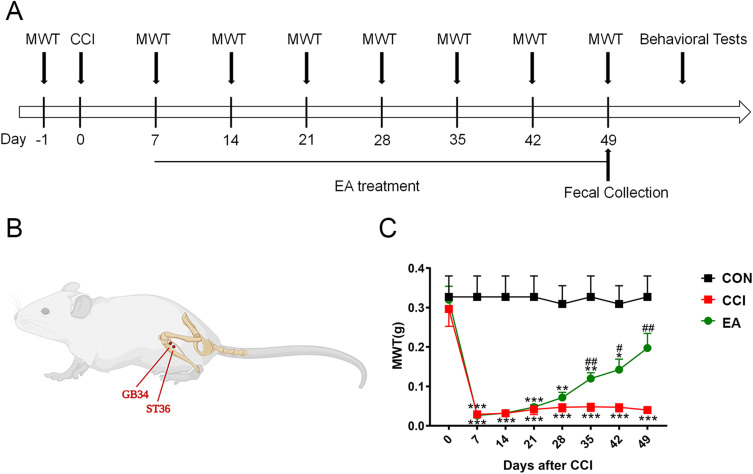
Mice were randomly assigned to one of the three groups: the Control (Con) group, the EA group, and the Chronic Constrictive Injury (CCI) group (n = 12 each). Starting from the 8th day post-CCI induction, the EA group underwent EA treatment once every two days, for a total of 20 sessions. To investigate the impact of gut microbiota on CCI mice, we employed a variety of methods, including various behavioral tests and 16S ribosomal DNA (rDNA) sequencing.
The results indicated that EA significantly ameliorated mechanical allodynia and emotional dysfunction induced by CCI in mice. Analysis through 16S rDNA sequencing revealed that the gut microbiota of NP model mice exhibited a marked increase in diversity. However, EA could partially reverse changes in the diversity of gut microbiota. The abundance of , and was increased, and the abundance levels of were decreased at the level in CCI mice. Following EA treatment, the relative abundance of , and was decreased, whereas the relative abundance of and was increased in EA group when compared with the CCI group.
These findings suggested that EA exerted a significant therapeutic effect on NP, potentially through modulation of the gut microbiota.
神经性疼痛(NP)是一种常见的慢性疾病,常伴有不良情绪状态。先前的研究已证明电针(EA)在减轻神经性疼痛及其相关情绪障碍方面的临床疗效。最近的研究强调了肠道微生物群与NP和负面情绪状态之间的相关性。然而,EA对肠道微生物群的调节与NP改善之间的关系仍未得到充分理解。
将小鼠随机分为三组之一:对照组(Con)、EA组和慢性缩窄性损伤(CCI)组(每组n = 12)。从CCI诱导后的第8天开始,EA组每两天接受一次EA治疗,共20次。为了研究肠道微生物群对CCI小鼠的影响,我们采用了多种方法,包括各种行为测试和16S核糖体DNA(rDNA)测序。
结果表明,EA显著改善了CCI诱导的小鼠机械性异常疼痛和情绪功能障碍。通过16S rDNA测序分析发现,NP模型小鼠的肠道微生物群多样性显著增加。然而,EA可以部分逆转肠道微生物群多样性的变化。在CCI小鼠的 水平上, 、 和 的丰度增加, 、 和 的丰度水平降低。与CCI组相比,EA治疗后,EA组中 、 和 的相对丰度降低,而 和 的相对丰度增加。
这些发现表明,EA对NP具有显著的治疗作用,可能是通过调节肠道微生物群实现的。