Fink Andrew J P, Muscinelli Samuel P, Wang Shuqi, Hogan Marcus I, English Daniel F, Axel Richard, Litwin-Kumar Ashok, Schoonover Carl E
Department of Neurobiology, Northwestern University Evanston, IL.
Mortimer B. Zuckerman Mind Brain Behavior Institute Department of Neuroscience Columbia University New York, NY.
bioRxiv. 2025 Jan 16:2025.01.16.633450. doi: 10.1101/2025.01.16.633450.
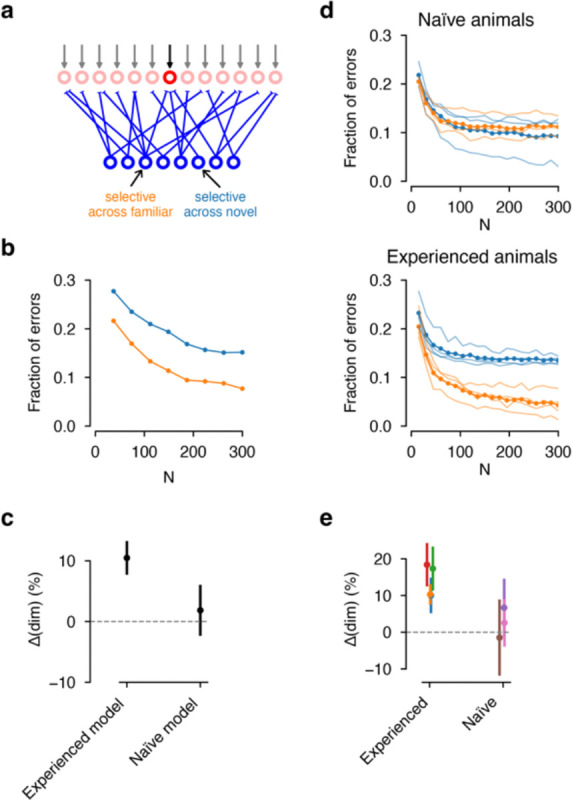
Organisms continually tune their perceptual systems to the features they encounter in their environment. We have studied how ongoing experience reorganizes the synaptic connectivity of neurons in the olfactory (piriform) cortex of the mouse. We developed an approach to measure synaptic connectivity , training a deep convolutional network to reliably identify monosynaptic connections from the spike-time cross-correlograms of 4.4 million single-unit pairs. This revealed that excitatory piriform neurons with similar odor tuning are more likely to be connected. We asked whether experience enhances this like-to-like connectivity but found that it was unaffected by odor exposure. Experience did, however, alter the logic of interneuron connectivity. Following repeated encounters with a set of odorants, inhibitory neurons that responded differentially to these stimuli exhibited a high degree of both incoming and outgoing synaptic connections within the cortical network. This reorganization depended only on the odor tuning of the inhibitory interneuron and not on the tuning of its pre- or postsynaptic partners. A computational model of this reorganized connectivity predicts that it increases the dimensionality of the entire network's responses to familiar stimuli, thereby enhancing their discriminability. We confirmed that this network-level property is present in physiological measurements, which showed increased dimensionality and separability of the evoked responses to familiar versus novel odorants. Thus, a simple, non-Hebbian reorganization of interneuron connectivity may selectively enhance an organism's discrimination of the features of its environment.
生物体不断调整其感知系统以适应在环境中遇到的特征。我们研究了持续的经验如何重组小鼠嗅觉(梨状)皮质中神经元的突触连接。我们开发了一种测量突触连接的方法,训练一个深度卷积网络,以从440万个单神经元对的尖峰时间互相关图中可靠地识别单突触连接。这表明,具有相似气味调谐的兴奋性梨状神经元更有可能相互连接。我们询问经验是否会增强这种同类连接,但发现它不受气味暴露的影响。然而,经验确实改变了中间神经元连接的逻辑。在反复接触一组气味剂后,对这些刺激有不同反应的抑制性神经元在皮质网络内表现出高度的传入和传出突触连接。这种重组仅取决于抑制性中间神经元的气味调谐,而不取决于其突触前或突触后伙伴的调谐。这种重组连接的计算模型预测,它会增加整个网络对熟悉刺激的反应维度,从而提高它们的可辨别性。我们证实,这种网络层面的特性存在于生理测量中,这表明对熟悉气味与新气味的诱发反应的维度和可分离性增加。因此,中间神经元连接的一种简单的、非赫布式重组可能会选择性地增强生物体对其环境特征的辨别能力。