Bokwa-Dąbrowska Katarzyna, Zych Rafał, Mocanu Dan, Huuskonen Michael, Dziedzic Dawid, Szaro Pawel
Department of Radiology, Institute of Clinical Sciences, Sahlgrenska Academy, University of Gothenburg, Gothenburg, Sweden.
Department of Musculoskeletal Radiology, Sahlgrenska University Hospital, Gothenburg, Sweden.
Eur J Radiol Open. 2025 Jan 8;14:100633. doi: 10.1016/j.ejro.2024.100633. eCollection 2025 Jun.
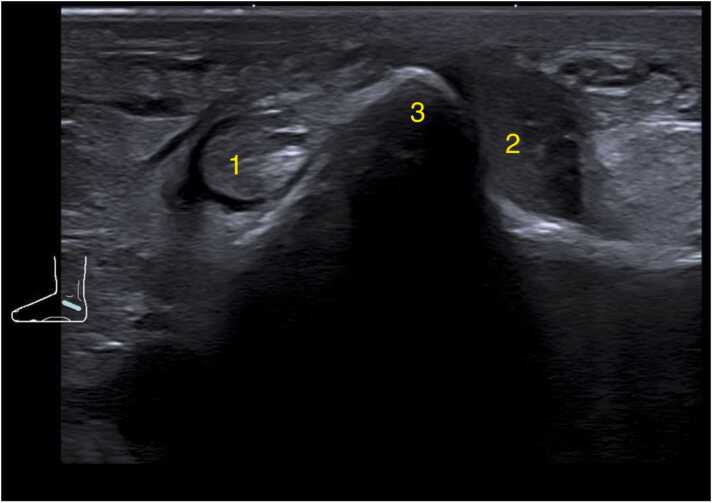
Diagnosing peroneus brevis split tears is a significant challenge, as many cases are missed both clinically and on imaging. Anatomical variations within the superior peroneal tunnel can contribute to peroneus brevis split tears or instability of the peroneal tendons. However, determining which anatomical variations predispose patients to these injuries remains challenging due to conflicting data in the literature. In this review, we present the current understanding of the role of anatomical variants in the development of peroneus brevis split tears. Many studies emphasize the significance of the retromalleolar groove and retromalleolar tubercle, the impact of a low-lying muscle belly, and the presence of accessory muscles within the superior peroneal tunnel as contributors to peroneal pathology. Hypertrophy of the peroneal tubercle or post-traumatic irregularities in the surface of the retromalleolar groove can accelerate degenerative changes in the peroneal tendons, potentially leading to peroneus brevis split tears. The topographic anatomy of the superior peroneal tunnel is essential for systematically performing ultrasound and interpreting magnetic resonance imaging of the ankle. The first part of this review focuses on the anatomical foundations of imaging diagnostics for peroneus brevis pathology. In the second part, we will examine the radiological spectrum of peroneal tendon injuries, offering a framework to enhance diagnostic confidence in this frequently underdiagnosed pathology.
诊断腓骨短肌撕裂是一项重大挑战,因为许多病例在临床和影像学检查中都被漏诊。腓骨上支持带内的解剖变异可能导致腓骨短肌撕裂或腓骨肌腱不稳定。然而,由于文献中的数据相互矛盾,确定哪些解剖变异使患者易患这些损伤仍然具有挑战性。在这篇综述中,我们阐述了目前对解剖变异在腓骨短肌撕裂发生中所起作用的理解。许多研究强调了外踝后沟和外踝后结节的重要性、低位肌腹的影响以及腓骨上支持带内副肌的存在对腓骨病变的影响。腓骨结节肥大或外踝后沟表面的创伤后不规则可加速腓骨肌腱的退行性改变,可能导致腓骨短肌撕裂。腓骨上支持带的局部解剖对于系统地进行超声检查和解读踝关节磁共振成像至关重要。本综述的第一部分重点关注腓骨短肌病变影像学诊断的解剖学基础。在第二部分中,我们将研究腓骨肌腱损伤的影像学表现,提供一个框架以增强对这种经常被漏诊的病变的诊断信心。