Jacquot Adrien, Cuinet Thomas, Peduzzi Lisa, Wong Patrice, Gauci Marc-Olivier, Uhring Julien
Clinique Louis PASTEUR SAS, Unité de Chirurgie Orthopédique, Essey-les-Nancy, France.
Centre ARTICS, Chirurgie des Articulations et du Sport, Essey-lès-Nancy, France.
JSES Rev Rep Tech. 2024 Nov 7;5(1):14-21. doi: 10.1016/j.xrrt.2024.09.006. eCollection 2025 Feb.
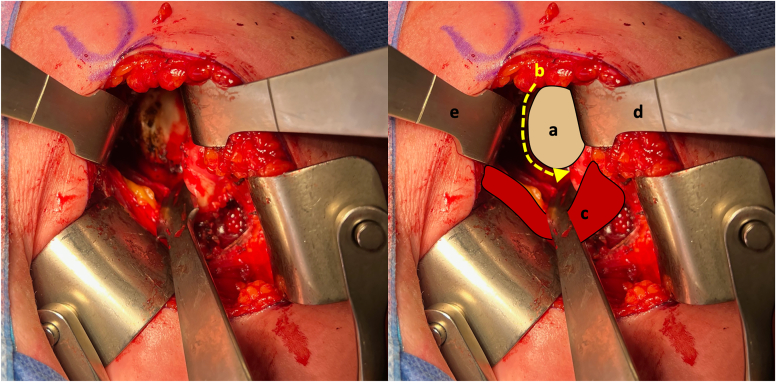
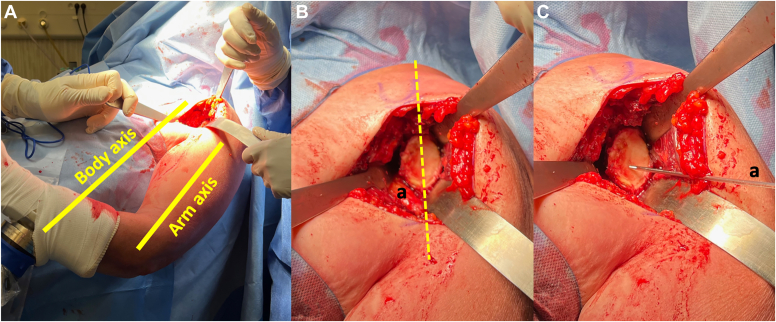
The importance of the subscapularis for reverse total shoulder arthroplasty has been demonstrated, especially for internal rotation and stability. In a deltopectoral approach, a detachment of the subscapularis is performed (tenotomy, tuberosity peeling, or osteotomy), but the tendon is not always repairable at the end. When it is repaired, healing is obtained in only 40%-76% of the cases, with potential consequences for the outcomes. The anterior muscle-sparing (AMS) approach is a deltopectoral approach with preservation of the subscapularis, providing a solution to these problems. We present the surgical technique and results.
In a retrospective study, we included our first 45 cases of reverse total shoulder arthroplasty performed with the AMS approach for a degenerative affection of the shoulder (massive rotator cuff tear, cuff tear arthropathy, primary glenohumeral arthritis, or rheumatoid arthritis), excluding traumatic and revision cases. The subscapularis was intact in all the cases. The mean age at inclusion was 74.1 years. No patients were lost at the minimum 24-month follow-up. All the patients underwent a clinical evaluation preoperatively and at the last follow-up, including Constant score, simple shoulder value, pain scale, and range of motion. An X-ray evaluation was conducted postoperatively and at the last follow-up to assess implant positioning and evolution.
There was no intraoperative complication, and the mean operative time was 62 minutes. We observed a significant improvement in Constant score (from 36 to 70, <.001), simple shoulder value (from 33 to 81, <.001), pain (from 6.3 to 0.7, <.001), strength (from 0.5 to 3.5, <.001), and most of the active mobilities. Regarding internal rotation, 95% of the patients reached level L3 or higher. Glenoid positioning was considered optimal in more than 90% of the cases (inferior tilt and low position) without any occurrence of superior tilt or high position. The osteophytes could be totally removed in 8 out of 9 cases (88.9%). Six postoperative complications (13.3%) were reported: 1 infection (2.2%), 2 cases of traumatic glenoid loosening (4.4%), 2 acromion fractures (4.4%), and 1 hematoma (2.2%). There was no instability. Eighty percent of the patients could return home, with a mean hospital stay of 1.8 days.
The AMS approach is a safe and reproducible technique. The preservation of the subscapularis has potential benefits regarding internal rotation and stability. In the absence of tendon suture, rehabilitation can be started immediately without motion restriction, allowing for a fast recovery and return to autonomy.
肩胛下肌对反式全肩关节置换术的重要性已得到证实,尤其是在维持内旋和稳定性方面。在胸大肌三角肌入路中,需对肩胛下肌进行松解(肌腱切断术、结节剥离术或截骨术),但手术结束时肌腱并非总能修复。即便进行修复,愈合率也仅为40%-76%,这可能会对手术效果产生潜在影响。前侧肌肉保留(AMS)入路是一种保留肩胛下肌的胸大肌三角肌入路,为解决这些问题提供了一种方案。我们在此介绍该手术技术及结果。
在一项回顾性研究中,我们纳入了首例采用AMS入路进行的45例因肩部退行性病变(巨大肩袖撕裂、肩袖撕裂性关节病、原发性盂肱关节炎或类风湿关节炎)而行反式全肩关节置换术的病例,排除创伤性病例和翻修病例。所有病例的肩胛下肌均完整。纳入时的平均年龄为74.1岁。在至少24个月的随访期内无患者失访。所有患者在术前及最后一次随访时均接受了临床评估,包括Constant评分、简易肩关节功能评分、疼痛量表及活动范围。术后及最后一次随访时进行了X线评估,以评估植入物的位置及进展情况。
术中无并发症发生,平均手术时间为62分钟。我们观察到Constant评分(从36分提高到70分,P<.001)、简易肩关节功能评分(从33分提高到81分,P<.001)、疼痛程度(从6.3分降至0.7分,P<.001)、肌力(从0.5分提高到3.5分,P<.001)以及大部分主动活动度均有显著改善。在内旋方面,95%的患者达到L3级或更高水平。在超过90%的病例中(下倾和低位),关节盂位置被认为是最佳的,未出现上倾或高位情况。9例中有8例(88.9%)的骨赘能够完全清除。术后报告了6例并发症(13.3%):1例感染(2.2%)、2例创伤性关节盂松动(4.4%)、2例肩峰骨折(4.4%)和1例血肿(2.2%)。未出现不稳定情况。80%的患者能够回家,平均住院时间为1.8天。
AMS入路是一种安全且可重复的技术。保留肩胛下肌在内旋和稳定性方面具有潜在益处。由于无需进行肌腱缝合,康复可立即开始且不受活动限制,从而实现快速恢复并恢复自主生活能力。