Li Jiasi, Li Guangchao, Tsang Shik Chi Edman
The Wolfson Catalysis Centre, Department of Chemistry, University of Oxford, Oxford OX1 3QR, U.K.
Crystallography Group, Diamond Light Source, Diamond House, Harwell Science and Innovation Campus, Fermi Avenue, Didcot OX11 0DE, U.K.
Acc Chem Res. 2025 Feb 18;58(4):555-569. doi: 10.1021/acs.accounts.4c00683. Epub 2025 Jan 28.
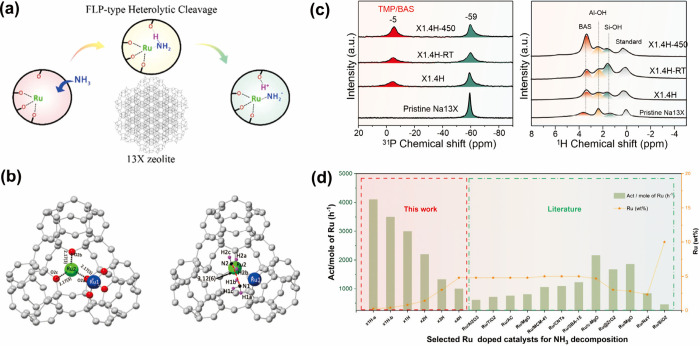
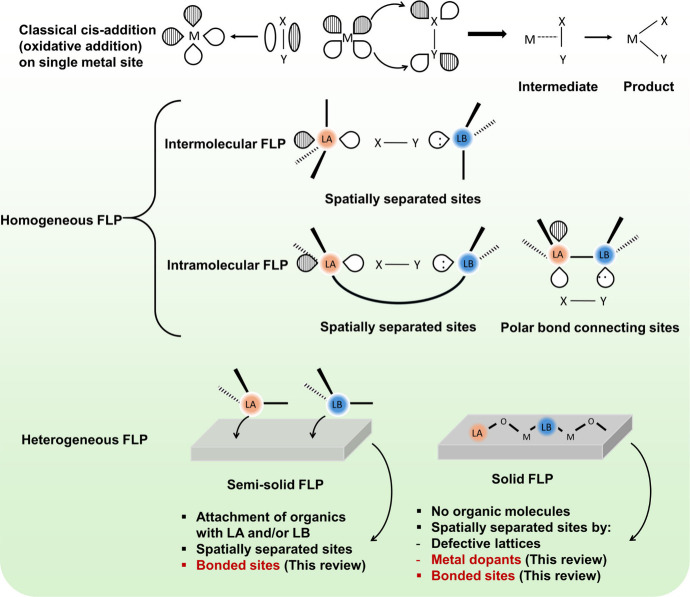
ConspectusThe discovery of reversible hydrogenation using metal-free phosphoborate species in 2006 marked the official advent of frustrated Lewis pair (FLP) chemistry. This breakthrough revolutionized homogeneous catalysis approaches and paved the way for innovative catalytic strategies. The unique reactivity of FLPs is attributed to the Lewis base (LB) and Lewis acid (LA) sites either in spatial separation or in equilibrium, which actively react with molecules. Since 2010, heterogeneous FLP catalysts have gained increasing attention for their ability to enhance catalytic performance through tailored surface designs and improved recyclability, making them promising for industrial applications. Over the past 5 years, our group has focused on investigating and strategically modifying various types of solid catalysts with FLPs that are unique from classic solid FLPs. We have explored systematic characterization techniques to unravel the underlying mechanisms between the active sites and reactants. Additionally, we have demonstrated the critical role of catalysts' intrinsic electronic and geometric properties in promoting FLP formation and stimulating synergistic effects. The characterization of FLP catalysts has been greatly enhanced by the use of advanced techniques such as synchrotron X-ray diffraction, neutron powder diffraction, X-ray photoelectron spectroscopy, extended X-ray absorption fine structure, elemental mapping in scanning transmission electron microscopy, electron paramagnetic resonance spectroscopy, diffuse-reflectance infrared Fourier transform spectroscopy, and solid-state nuclear magnetic resonance spectroscopy. These techniques have provided deeper insights into the structural and electronic properties of FLP systems for the future design of catalysts.Understanding electron distribution in the overlapping orbitals of LA and LB pairs is essential for inducing FLPs in operando in heterogeneous catalysts through target electron reallocation by external stimuli. For instance, in silicoaluminophosphate-type zeolites with weak orbital overlap, the adsorption of polar gas molecules leads to heterolytic cleavage of the Al-O bond, creating unquenched LA-LB pairs. In a Ru-doped metal-organic framework, the Ru-N bond can be polarized through metal-ligand charge transfer under light, forming Ru-N pairs. This activation of FLP sites from the framework represents a groundbreaking innovation that expands the catalytic potential of existing materials. For catalysts already employing FLP chemistry to dynamically generate products from substrates, a complete mechanistic interpretation requires a thorough examination of the surface electronic properties and the surrounding environment. The hydrogen spillover ability on the Ru-doped FLP surfaces improves conversion efficiency by suppressing hydrogen poisoning at metal sites. In situ H-HO conditions enable the production of organic chemicals with excellent activity and selectivity by creating new bifunctional sites via FLP chemistry. By highlighting the novel FLP systems featuring FLP induction and synergistic effects and the selection of advanced characterization techniques to elucidate reaction mechanisms, we hope that this Account will offer innovative strategies for designing and characterizing FLP chemistry in heterogeneous catalysts to the research community.
概述
2006年无金属磷硼酸盐物种可逆氢化反应的发现标志着受阻路易斯酸碱对(FLP)化学的正式诞生。这一突破彻底改变了均相催化方法,为创新催化策略铺平了道路。FLP独特的反应活性归因于空间分离或处于平衡状态的路易斯碱(LB)和路易斯酸(LA)位点,它们能与分子发生积极反应。自2010年以来,多相FLP催化剂因其通过定制表面设计提高催化性能和改善可回收性的能力而受到越来越多的关注,使其在工业应用方面颇具前景。在过去5年里,我们团队专注于研究和战略性修饰各类固体催化剂,这些催化剂中的FLP与经典固体FLP不同。我们探索了系统的表征技术,以揭示活性位点与反应物之间的潜在机制。此外,我们还证明了催化剂的固有电子和几何性质在促进FLP形成和激发协同效应方面的关键作用。同步辐射X射线衍射、中子粉末衍射、X射线光电子能谱、扩展X射线吸收精细结构、扫描透射电子显微镜中的元素映射、电子顺磁共振光谱、漫反射红外傅里叶变换光谱和固态核磁共振光谱等先进技术的使用极大地增强了FLP催化剂的表征。这些技术为未来催化剂设计中FLP体系的结构和电子性质提供了更深入的见解。
了解LA和LB对重叠轨道中的电子分布对于通过外部刺激进行目标电子重新分配在多相催化剂中原位诱导FLP至关重要。例如,在轨道重叠较弱的硅铝磷酸盐型沸石中,极性气体分子的吸附导致Al - O键的异裂,产生未淬灭的LA - LB对。在钌掺杂的金属有机框架中,Ru - N键在光照下可通过金属 - 配体电荷转移发生极化,形成Ru - N对。这种从框架中激活FLP位点代表了一项开创性的创新,扩展了现有材料的催化潜力。对于已经采用FLP化学从底物动态生成产物的催化剂,完整的机理解释需要全面考察表面电子性质和周围环境。钌掺杂的FLP表面上的氢溢流能力通过抑制金属位点的氢中毒提高了转化效率。原位H - HO条件通过FLP化学创建新的双功能位点,能够以优异的活性和选择性生产有机化学品。通过突出具有FLP诱导和协同效应的新型FLP体系以及选择先进的表征技术来阐明反应机制,我们希望本综述能为研究界提供设计和表征多相催化剂中FLP化学的创新策略。