
晚期非小细胞肺癌治疗中潜在预测生物标志物的超早期卫生技术评估
Very Early Health Technology Assessment for Potential Predictive Biomarkers in the Treatment of Advanced Non-Small Cell Lung Cancer.
作者信息
Otten Leila-Sophie, Buma Alessandra I G, Piet Berber, Ter Heine Rob, van den Heuvel Michel M, Retèl Valesca P
机构信息
Department of Pharmacy, Research Institute for Medical Innovation, Radboud University Medical Center, Nijmegen, Gelderland, The Netherlands.
Department of Respiratory Medicine, Research Institute for Medical Innovation, Radboud University Medical Center, Nijmegen, Gelderland, The Netherlands.
出版信息
Pharmacoecon Open. 2025 May;9(3):471-485. doi: 10.1007/s41669-025-00557-3. Epub 2025 Jan 28.
OBJECTIVES
Immune checkpoint inhibitor (ICI)-containing treatment is currently prescribed as first-line treatment for all patients with advanced non-small cell lung cancer (NSCLC) without targetable driver mutations. However, only 30-45% of patients show no progression within 12 months after treatment start. Various biomarkers are being studied to save costly and potentially harmful treatment in non-responders. We evaluated the cost-effectiveness of implementing a hypothetical predictive biomarker for ICI-containing treatment response compared with standard of care (e.g., no implemented biomarker) for pembrolizumab-containing treatment in patients with advanced NSCLC in the Netherlands.
MATERIALS AND METHODS
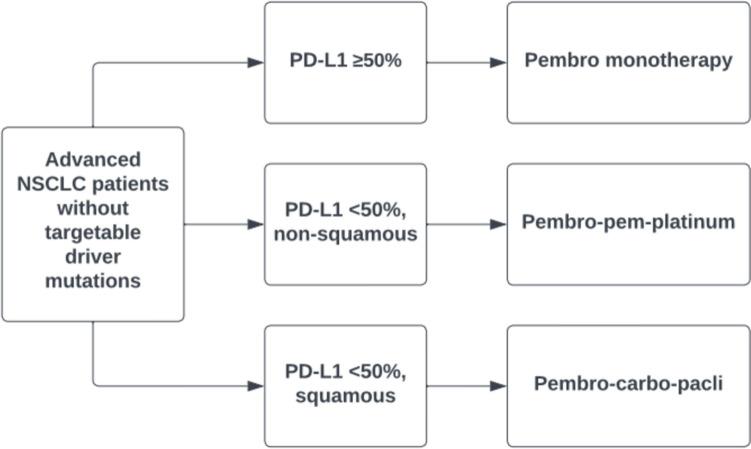
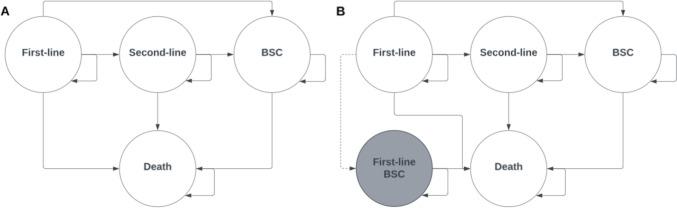
Standard-of-care-based and predictive-biomarker-based strategies were compared using Markov models for three first-line pembrolizumab-containing treatments depending on a patient's tumor programmed cell death ligand-1 (PD-L1) expression and histology. A Dutch healthcare system perspective was adopted. Assuming a receiver operating characteristic-area under the curve of 1.0 in identifying responders, alternative treatments were offered for non-responders in the predictive-biomarker-based strategy. Parameters and assumptions were based on real-world data from surveys, literature using a targeted search, expert opinion, and registries. Outcomes included differences in costs, survival (life years (LYs)), and survival corrected for health-related quality of life (QoL) quality-adjusted life-years (QALYs) between the predictive-biomarker- and standard-of-care-based strategy.
RESULTS
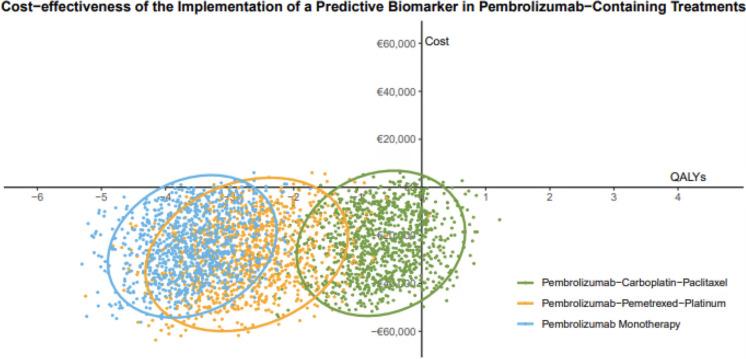
Implementing a predictive biomarker in pembrolizumab-carboplatin-paclitaxel treatment led to a mean survival reduction of 24 days (- 0.067 LYs) (18 days corrected for QoL (- 0.049 QALYs)), with cost savings of €22,606 compared with standard of care. Pembrolizumab monotherapy and pembrolizumab-pemetrexed-platinum treatments showed survival reductions of 4.5 and 3.9 months, respectively (3.6 and 2.8 months corrected for QoL), with cost savings of €24,345 and €28,456. Sensitivity analyses confirmed consistent cost savings and survival reductions. Survival losses were mainly observed due to the lower survival rates associated with the alternative first-line treatment options available for non-responders in the predictive-biomarker-based strategy within each pembrolizumab-containing treatment regimen. Pembrolizumab-carboplatin-paclitaxel treatment also showed survival gains under certain conditions related to QoL and survival estimates.
CONCLUSIONS
Our study highlights the importance of careful de-implementation of ICI-treatments in advanced NSCLC, balancing costs reductions and side effects without comprising survival. In the pembrolizumab-carboplatin-paclitaxel treatment regimen, the survival loss could be considered negligible. Future research should define acceptable tradeoffs and thresholds for de-implementation, considering factors such as survival of alternative treatments and responder classification to guide predictive biomarker implementation and optimize health resource allocation.
目的
目前,含免疫检查点抑制剂(ICI)的治疗方案被规定为所有无可靶向驱动基因突变的晚期非小细胞肺癌(NSCLC)患者的一线治疗方案。然而,只有30%-45%的患者在开始治疗后的12个月内无疾病进展。目前正在研究各种生物标志物,以避免在无反应者中进行昂贵且可能有害的治疗。我们评估了在荷兰晚期NSCLC患者中,与含帕博利珠单抗治疗的标准治疗方案(例如,未应用生物标志物)相比,实施一种假设的预测性生物标志物以预测含ICI治疗反应的成本效益。
材料与方法
使用马尔可夫模型,根据患者的肿瘤程序性细胞死亡配体-1(PD-L1)表达和组织学,对三种含帕博利珠单抗的一线治疗方案,比较基于标准治疗和基于预测性生物标志物的策略。采用荷兰医疗保健系统的视角。假设在识别反应者方面曲线下面积为1.0的受试者工作特征,在基于预测性生物标志物的策略中,为无反应者提供替代治疗。参数和假设基于来自调查的真实世界数据、使用定向搜索的文献、专家意见和登记处。结果包括基于预测性生物标志物的策略和基于标准治疗的策略在成本、生存(生命年(LYs))以及校正了健康相关生活质量(QoL)的生存质量调整生命年(QALYs)方面的差异。
结果
在帕博利珠单抗-卡铂-紫杉醇治疗中实施预测性生物标志物导致平均生存期缩短24天(-0.067 LYs)(校正QoL后缩短18天(-0.049 QALYs)),与标准治疗相比节省成本22,606欧元。帕博利珠单抗单药治疗和帕博利珠单抗-培美曲塞-铂治疗分别显示生存期缩短4.5个月和3.9个月(校正QoL后分别缩短3.6个月和2.8个月),节省成本24,345欧元和28,456欧元。敏感性分析证实了一致的成本节省和生存期缩短。生存期损失主要是由于在基于预测性生物标志物的策略中,每种含帕博利珠单抗的治疗方案中无反应者可获得的替代一线治疗方案生存率较低。在与QoL和生存估计相关的某些条件下,帕博利珠单抗-卡铂-紫杉醇治疗也显示出生存期获益。
结论
我们的研究强调了在晚期NSCLC中谨慎停用ICI治疗的重要性,在不影响生存的情况下平衡成本降低和副作用。在帕博利珠单抗-卡铂-紫杉醇治疗方案中,生存期损失可被视为微不足道。未来的研究应确定可接受的权衡和停用阈值,考虑替代治疗的生存期和反应者分类等因素,以指导预测性生物标志物的实施并优化卫生资源分配。
 Zotero 插件