Comabella Manuel, Pappolla Agustín, Monreal Enric, Fissolo Nicolás, Sao-Avilés Augusto Cesaar, Arrambide Georgina, Carbonell-Mirabent Pere, Gutierrez Lucía, Cobo-Calvo Álvaro, Tur Carmen, Villacieros-Álvarez Javier, Vidal-Jordana Ángela, Castilló Joaquín, Galán Ingrid, Espiño Mercedes, Ariño Helena, Bollo Luca, Rodríguez Barranco Marta, Midaglia Luciana Soledad, Carvajal René, Villarrubia Noelia, Fernández Velasco José Ignacio, Rodríguez Acevedo Breogán, Costa Frossard Lucienne F, Vilaseca Andreu, Auger Cristina, Zabalza Ana, Sainz De La Maza Susana, Mongay-Ochoa Neus, Río Jordi, Sastre-Garriga Jaume, Rovira Àlex, Tintoré Mar, Villar Luisa M, Montalban Xavier
Servei de Neurologia, Centre d'Esclerosi Múltiple de Catalunya (Cemcat), Institut de Recerca Vall d'Hebron (VHIR), Hospital Universitari Vall d'Hebron, Universitat Autònoma de Barcelona, Barcelona, Spain.
Center for Networked Biomedical Research on Neurodegenerative Diseases (CIBERNED)-ISCIII, Madrid, Spain.
Neurol Neuroimmunol Neuroinflamm. 2025 Mar;12(2):e200370. doi: 10.1212/NXI.0000000000200370. Epub 2025 Jan 29.
Invasive procedures may delay the diagnostic process in multiple sclerosis (MS). We investigated the added value of serum neurofilament light chain (sNfL), glial fibrillary acidic protein (sGFAP), chitinase-3-like 1 (sCHI3L1), and the immune responses to the Epstein-Barr virus-encoded nuclear antigen 1 to current MS diagnostic criteria.
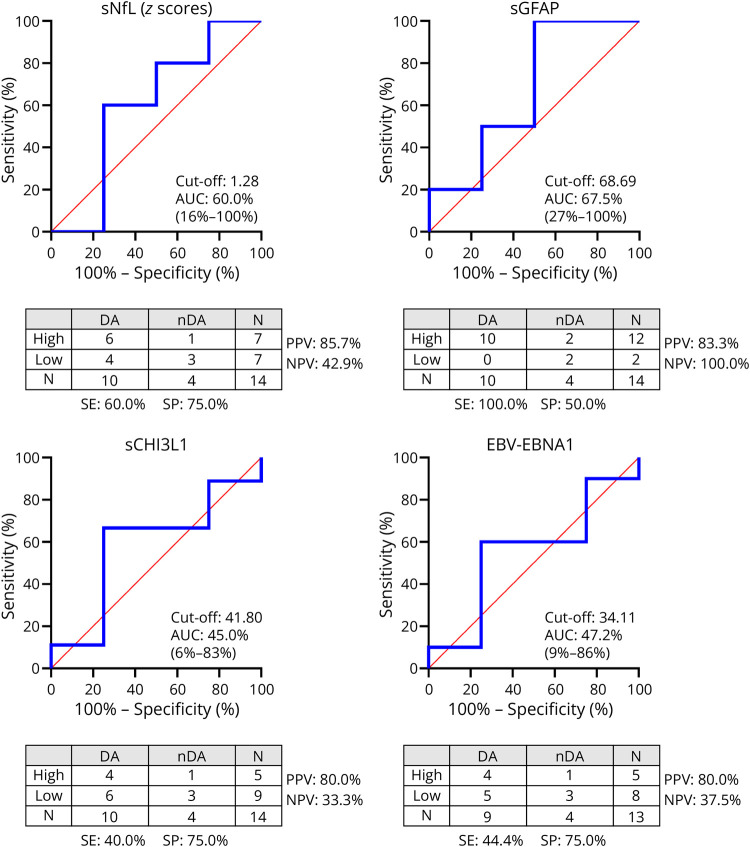
In this multicentric study, we selected patients from 2 prospective cohorts presenting a clinically isolated syndrome (CIS). Patients were classified as (1) not presenting dissemination in space (DIS) nor dissemination in time (DIT) (noDIS and noDIT); (2) presenting DIS without DIT (DIS and noDIT); and (3) presenting both (DIS and DIT), which were used as a reference. sNfL, sGFAP, and sCHI3L1 levels were measured with single-molecule array immunoassays and EBNA1-specific IgG levels with ELISA. Biomarker levels were compared between groups using linear regression models. Receiver operating characteristic curve analyses and Youden Index were used to determine cutoff values associated with MS diagnosis during follow-up.
We included 181 patients (66.3% females, mean [SD] age of 35.0 [9.7] years). At baseline, 25 (13.8%) were classified as noDIS and noDIT, 62 (34.3%) as DIS and noDIT, and 94 (51.9%) as DIS and DIT. Only sNfL Z-scores discriminated between groups (DIS and DIT vs DIS and noDIT [ = 0.002], DIS and DIT vs noDIS and noDIT [ < 0.001], and DIS and noDIT vs noDIS and noDIT [ = 0.026]). In noDIS and noDIT patients (median interquartile range [IQR] follow-up of 8.1 [5.0-11.7] years), high sNfL Z-scores best predicted MS diagnosis (specificity [SP] and 95% CI of 93.3% [68.1-99.8] and positive predictive value [PPV] of 87.5% [47.3-99.7]). Among DIS and noDIT patients (median [IQR] follow-up of 6.8 [4.0-9.1] years), high sNfL Z-scores best predicted MS diagnosis (SP of 80% [28.4-99.5] and PPV of 97.3% [85.8-99.9]) without considering oligoclonal band (OB) status. In the subset of patients of this group with negative OBs, a combination of high sNfL Z-scores and sGFAP levels predicted MS diagnosis (SP of 100% [39.8-100] and PPV of 100% [54.1-100]).
These results suggest that sNfL and sGFAP may be incorporated in particular scenarios to diagnose MS in patients with CIS not fulfilling current diagnostic criteria.
侵入性检查可能会延迟多发性硬化症(MS)的诊断进程。我们研究了血清神经丝轻链(sNfL)、胶质纤维酸性蛋白(sGFAP)、几丁质酶-3样蛋白1(sCHI3L1)以及针对爱泼斯坦-巴尔病毒编码核抗原1的免疫反应对当前MS诊断标准的附加价值。
在这项多中心研究中,我们从2个前瞻性队列中选取了表现为临床孤立综合征(CIS)的患者。患者被分为:(1)无空间扩散(DIS)且无时间扩散(DIT)(无DIS且无DIT);(2)有DIS但无DIT(DIS且无DIT);(3)两者皆有(DIS且DIT),后者用作对照。采用单分子阵列免疫分析法测定sNfL、sGFAP和sCHI3L1水平,采用酶联免疫吸附测定法测定EBNA1特异性IgG水平。使用线性回归模型比较各组间的生物标志物水平。采用受试者工作特征曲线分析和尤登指数来确定随访期间与MS诊断相关的临界值。
我们纳入了181例患者(66.3%为女性,平均[标准差]年龄35.0[9.7]岁)。基线时,25例(13.8%)被分类为无DIS且无DIT,62例(34.3%)为DIS且无DIT,94例(51.9%)为DIS且DIT。只有sNfL Z评分能区分各组(DIS且DIT与DIS且无DIT相比[ = 0.002],DIS且DIT与无DIS且无DIT相比[ < 0.001],DIS且无DIT与无DIS且无DIT相比[ = 0.026])。在无DIS且无DIT的患者中(随访时间中位数[四分位间距]为8.1[5.0 - 11.7]年),高sNfL Z评分最能预测MS诊断(特异性[SP]及95%置信区间为93.3%[68.1 - 99.8],阳性预测值[PPV]为87.5%[47.3 - 99.7])。在有DIS但无DIT的患者中(随访时间中位数[四分位间距]为6.8[4.0 - 9.1]年),不考虑寡克隆带(OB)状态时,高sNfL Z评分最能预测MS诊断(SP为80%[28.4 - 99.5]),PPV为97.3%[85.8 - 99.9])。在该组OB阴性的患者亚组中,高sNfL Z评分与sGFAP水平的组合可预测MS诊断(SP为100%[39.8 - 100],PPV为100%[54.1 - 100])。
这些结果表明,在特定情况下,sNfL和sGFAP可能有助于诊断不符合当前诊断标准的CIS患者的MS。