Riedel Maximilian, Herrmann Helene, Bartl Thomas, Rossner Anna-Maria, Tatzber Anna, Flethe Chiara, Zocholl Dario, Schmalfeldt Barbara, Sehouli Jalid, Pietzner Klaus
Young Academy of Gynecologic Oncology (JAGO), Nord-Ostdeutsche Gesellschaft für Gynäkologische Onkologie (NOGGO), Berlin, Germany.
Department of Obstetrics and Gynecology, TUM University Hospital, Technical University of Munich, Ismaninger Straße 22, D-81675, Munich, Germany.
BMC Cancer. 2025 Jan 29;25(1):170. doi: 10.1186/s12885-025-13432-5.
The integration of immune checkpoint inhibitors (ICIs) into routine gynecologic cancer treatment requires a thorough understanding of how to manage immune-related adverse events (irAEs) to ensure patient safety. However, reports on real-world clinical experience in the management of ICIs in gynecologic oncology are very limited. The aim of this survey was to provide a real-world overview of the experiences and the current state of irAE management of ICIs in Germany, Switzerland, and Austria.
We designed a questionnaire consisting of 34 items focused on physicans' clinical experiences with ICIs and their management of irAEs. The survey was distributed between October 2022 and May 2023 to medical professionals with experience in the field of gynecologic oncology.
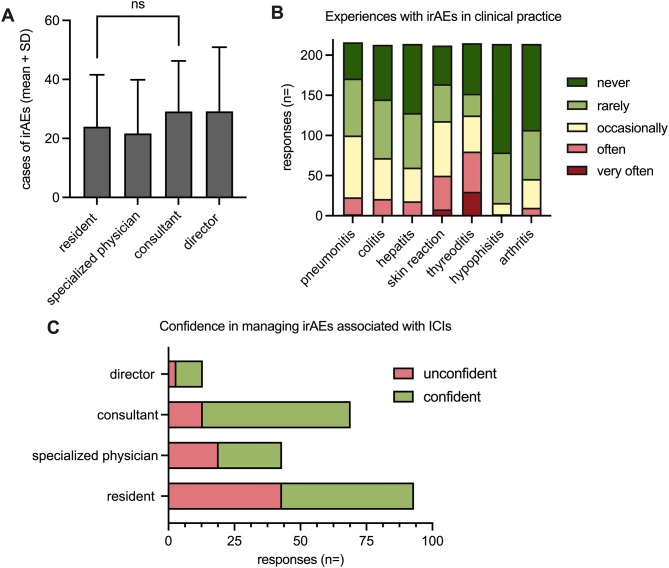
A total of 221 gynecologists participated in the study. Most respondents (n = 130, 59.1%) were primarily engaged in gynecologic oncology at the time of the survey, with an average of ten years of clinical experience. Individual experiences with regard to irAEs varied significantly. When asked which irAEs they had observed "frequently" or "very frequently", respondents most commonly reported thyroiditis (37.2%), followed by skin reactions (23.6%), and pneumonitis (10.6%). A total of n = 16 (7.4%) reported at least one death of a patient due to irAEs. Feeling "unconfident" or "very unconfident" about managing irAEs was reported by 35.6% (n = 78). With regard to clinical management of adverse events after discontinuation of treatment, 32.4% (n = 68) ceased to inquire about irAEs after six months.
The results of this survey provide valuable insights into physicians' real-world experiences with irAEs associated with ICI treatment. Dealing with serious immune-related and potentially life-threatening side effects has become a routine aspect of clinical practice. Many physicians, however, express a lack of sufficient familiarity with irAEs and their management. Therefore, it is essential to improve medical education, specialized oncological training, and close interdisciplinary collaboration to improve patient care.
将免疫检查点抑制剂(ICIs)纳入妇科癌症常规治疗需要全面了解如何管理免疫相关不良事件(irAEs)以确保患者安全。然而,关于妇科肿瘤学中ICIs管理的真实世界临床经验报告非常有限。本次调查的目的是提供德国、瑞士和奥地利ICIs的irAE管理经验及现状的真实世界概述。
我们设计了一份包含34个项目的问卷,重点关注医生使用ICIs的临床经验及其对irAEs的管理。该调查于2022年10月至2023年5月分发给有妇科肿瘤学领域经验的医学专业人员。
共有221名妇科医生参与了该研究。大多数受访者(n = 130,59.1%)在调查时主要从事妇科肿瘤学工作,平均有十年临床经验。关于irAEs的个人经验差异很大。当被问及他们“频繁”或“非常频繁”观察到哪些irAEs时,受访者最常报告甲状腺炎(37.2%),其次是皮肤反应(23.6%)和肺炎(10.6%)。共有n = 16(7.4%)报告至少有一名患者因irAEs死亡。35.6%(n = 78)的人表示对管理irAEs“不自信”或“非常不自信”。关于治疗中断后不良事件的临床管理,32.4%(n = 68)在六个月后不再询问irAEs。
本次调查结果为医生在与ICI治疗相关的irAEs方面的真实世界经验提供了有价值的见解。处理严重的免疫相关且可能危及生命的副作用已成为临床实践的常规方面。然而,许多医生表示对irAEs及其管理缺乏足够的熟悉度。因此,必须改善医学教育、专业肿瘤学培训以及密切的跨学科合作以改善患者护理。