Zhang Mengyao, Sun Lan
Department of Oncology, Bishan Hospital of Chongqing Medical University, Chongqing, China.
Front Oncol. 2025 Jan 15;14:1498518. doi: 10.3389/fonc.2024.1498518. eCollection 2024.
Several head-to-head meta-analyses have compared the efficacy and safety of different first-line treatments in patients with EGFR mutation-positive (M+) advanced or metastatic non-squamous non-small cell lung cancer (nsq-NSCLC). However, there is a lack of comprehensive evaluation encompassing multiple treatment strategies. Our objective is to conduct a network meta-analysis that includes various treatment modalities, enabling both direct and indirect comparisons for a more thorough assessment.
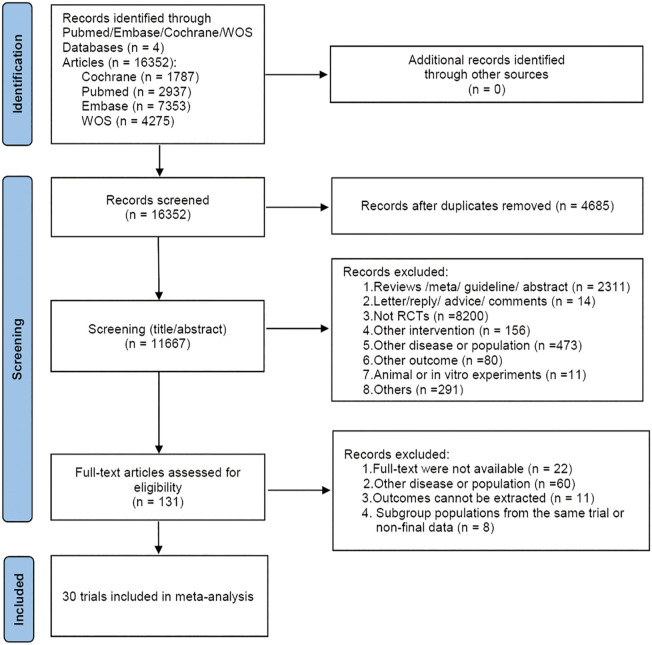
We conducted a search of PubMed, Embase, Cochrane Library, and Web of Science databases from inception until May 8, 2024, to identify eligible randomized controlled trials (RCTs). The primary endpoints were progression-free survival (PFS) and overall survival (OS), while secondary outcomes included objective response rate (ORR) and grade 3 or higher adverse events (≥3AEs). Stata 15.0 and R 4.3.2 software were utilized for the network meta-analysis.
A total of 30 RCTs, comprising 8654 participants, were included. The study encompassed the following 19 treatments: Chemotherapy; Afatinib; Afatinib + Cetuximab; Apatinib + Gefitinib; Befotertinib; Cetuximab + Chemotherapy; Erlotinib; Erlotinib + Bevacizumab; Erlotinib + Chemotherapy; Gefitinib; Gefitinib + Chemotherapy; Gefitinib + Olaparib; Icotinib; Icotinib + Chemotherapy; Lazertinib; Naquotinib; Osimertinib; Osimertinib + Bevacizumab; Osimertinib + Chemotherapy. The network meta-analysis results indicated that, in terms of PFS, Osimertinib + Chemotherapy (SUCRAs: 93.4%) and Osimertinib (SUCRAs: 84.61%) were the most effective. Regarding OS, Lazertinib (SUCRAs: 89.72%), Gefitinib (SUCRAs: 72.07%), and Osimertinib + Chemotherapy (SUCRAs: 70.74%) emerged as the top three options. Afatinib (SUCRAs: 92.27%) was associated with the best ORR improvement. For ≥3AEs, Afatinib (SUCRAs: 74.93%) and Osimertinib (SUCRAs: 69.42%) were likely the best choices.
Current evidence suggests that, considering both survival and safety, Osimertinib stands out as the preferred first-line treatment for untreated EGFR M + advanced or metastatic nsq-NSCLC. Notably, the combination of Osimertinib with chemotherapy demonstrated superior survival benefits. However, due to the limitations in the number and quality of included studies, these conclusions await further validation through more high-quality research.
https://www.crd.york.ac.uk/prospero/display_record.php?ID=CRD42024562981, identifier CRD42024562981.
多项头对头荟萃分析比较了表皮生长因子受体(EGFR)突变阳性(M+)的晚期或转移性非鳞状非小细胞肺癌(nsq-NSCLC)患者中不同一线治疗方案的疗效和安全性。然而,缺乏对多种治疗策略的全面评估。我们的目的是进行一项网络荟萃分析,纳入各种治疗方式,以便进行直接和间接比较,从而进行更全面的评估。
我们检索了PubMed、Embase、Cochrane图书馆和Web of Science数据库,检索时间从数据库建立至2024年5月8日,以确定符合条件的随机对照试验(RCT)。主要终点为无进展生存期(PFS)和总生存期(OS),次要结局包括客观缓解率(ORR)和3级或更高等级不良事件(≥3级不良事件)。使用Stata 15.0和R 4.3.2软件进行网络荟萃分析。
共纳入30项RCT,涉及8654名参与者。该研究涵盖以下19种治疗方法:化疗;阿法替尼;阿法替尼+西妥昔单抗;阿帕替尼+吉非替尼;贝福替尼;西妥昔单抗+化疗;厄洛替尼;厄洛替尼+贝伐单抗;厄洛替尼+化疗;吉非替尼;吉非替尼+化疗;吉非替尼+奥拉帕利;埃克替尼;埃克替尼+化疗;拉泽替尼;纳科替尼;奥希替尼;奥希替尼+贝伐单抗;奥希替尼+化疗。网络荟萃分析结果表明,就PFS而言,奥希替尼+化疗(累积排序曲线下面积:93.4%)和奥希替尼(累积排序曲线下面积:84.61%)最为有效。关于OS,拉泽替尼(累积排序曲线下面积:89.72%)、吉非替尼(累积排序曲线下面积:72.07%)和奥希替尼+化疗(累积排序曲线下面积:70.74%)位居前三。阿法替尼(累积排序曲线下面积:92.27%)与最佳ORR改善相关。对于≥3级不良事件,阿法替尼(累积排序曲线下面积:74.93%)和奥希替尼(累积排序曲线下面积:69.42%)可能是最佳选择。
目前的证据表明,综合生存和安全性考虑,奥希替尼是未经治疗的EGFR M+晚期或转移性nsq-NSCLC的首选一线治疗药物。值得注意的是,奥希替尼与化疗联合显示出更好的生存获益。然而,由于纳入研究的数量和质量存在局限性,这些结论有待通过更多高质量研究进一步验证。
https://www.crd.york.ac.uk/prospero/display_record.php?ID=CRD42024562981,标识符CRD42024562981。