Xu Hongkun, Lu Tingting, Liu Yajie, Yang Jingqi, Ren Simeng, Han Baojin, Lai Honghao, Ge Long, Liu Jie
Graduate School, Beijing University of Chinese Medicine, Beijing, China.
Guang'anmen Hospital, China Academy of Chinese Medical Sciences, Beijing, China.
Front Oncol. 2025 Jan 15;14:1506366. doi: 10.3389/fonc.2024.1506366. eCollection 2024.
The prevalence of long COVID among cancer patients remains unknown. This study aimed to determine the prevalence of long COVID and explore potential risk factors among cancer patients.
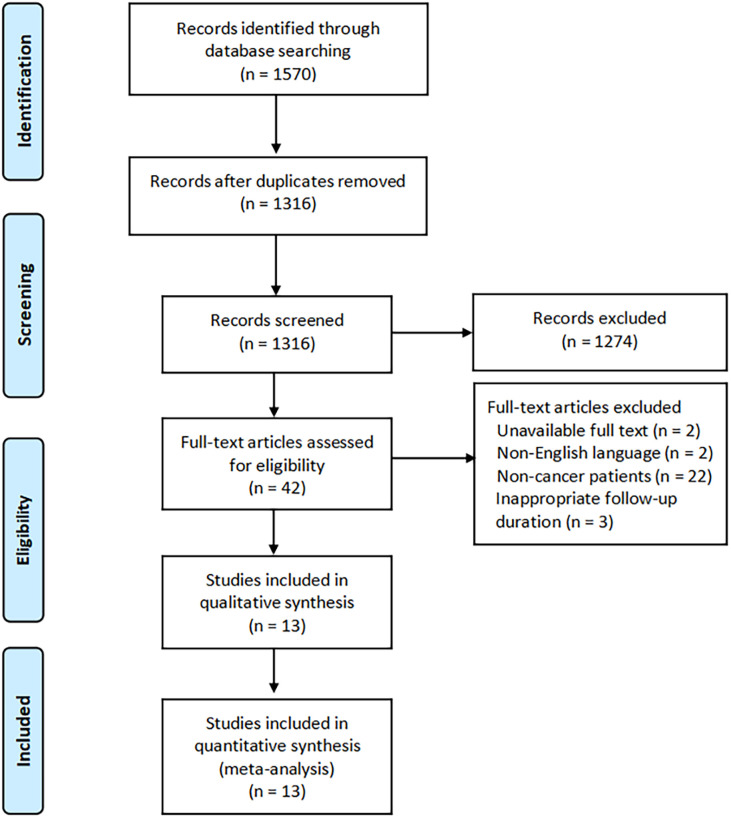
A systematic search was performed on PubMed, Web of Science, and Embase from database inception until 21 March 2024, to identify studies that reported long COVID in cancer patients. Two investigators independently screened the studies and extracted all information about long COVID in cancer patients for subsequent analysis. Methodological quality was assessed using the "Joannagen Briggs Institute (JBI) Critical Appraisal Checklist for Studies Reporting Prevalence Data".
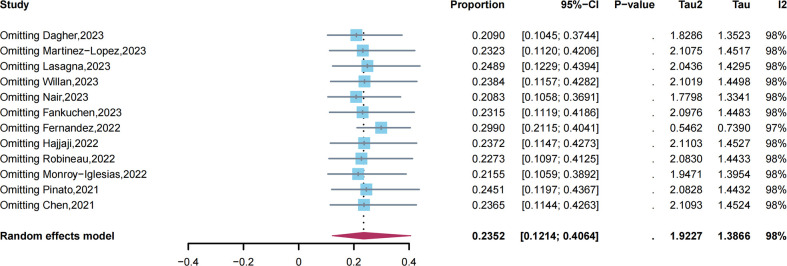
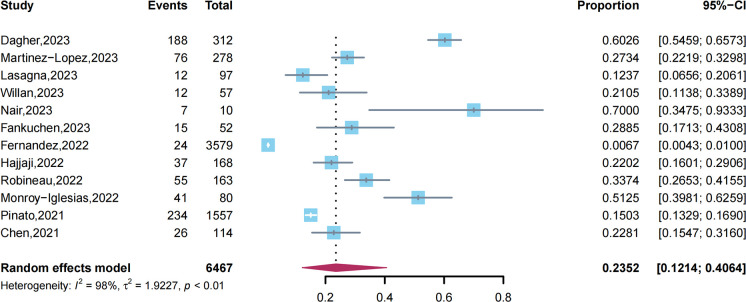
A total of 13 studies involving 6,653 patients were included. The pooled prevalence of long COVID was 23.52% [95% confidence interval (CI), 12.14% to 40.64%] among cancer patients reported experiencing long COVID after acute severe acute respiratory syndrome coronavirus 2 (SARS-CoV-2) infection. The pooled prevalence of any long COVID in cancer patients was 20.51% (95% CI, 15.91% to 26.03%), 15.79% (95% CI, 11.39% to 21.47%), and 12.54% (95% CI, 6.38% to 23.18%) in 3, 6, and 12 months follow-up duration. Fatigue was the most common symptom, followed by respiratory symptoms, myalgia, and sleep disturbance. Patients with comorbidities had a significantly higher risk of experiencing long COVID [odds ratio (OR) = 1.72; 95% CI, 1.09 to 2.70; = 0.019]. No statistically significant differences in sex, primary tumor, or tumor stage were detected.
Nearly a quarter of cancer patients will experience long COVID after surviving from SARS-CoV-2 infection, and this would even last for 1 year or longer. Fatigue, respiratory symptoms, myalgia, and sleep disturbance need to be more addressed and managed to reduce symptom burden on cancer patients and improve quality of life. Patients with comorbidities are at a high risk of developing long COVID. Further randomized controlled trials with rigorous methodological designs and large sample sizes are needed for future validation.
https://www.crd.york.ac.uk/PROSPERO/, identifier CRD42023456665.
癌症患者中长新冠的患病率尚不清楚。本研究旨在确定癌症患者中长新冠的患病率,并探索潜在风险因素。
从数据库建立至2024年3月21日,在PubMed、科学网和Embase上进行系统检索,以识别报告癌症患者长新冠情况的研究。两名研究者独立筛选研究,并提取所有关于癌症患者长新冠的信息以供后续分析。使用“乔安娜布里格斯研究所(JBI)报告患病率数据研究的批判性评价清单”评估方法学质量。
共纳入13项研究,涉及6653例患者。在报告急性严重急性呼吸综合征冠状病毒2(SARS-CoV-2)感染后出现长新冠的癌症患者中,长新冠的合并患病率为23.52%[95%置信区间(CI),12.14%至40.64%]。在3、6和十二个月随访期内,癌症患者中任何长新冠的合并患病率分别为20.51%(95%CI,15.91%至26.03%)、15.79%(95%CI,11.39%至21.47%)和12.54%(95%CI,6.38%至23.18%)。疲劳是最常见的症状,其次是呼吸道症状、肌痛和睡眠障碍。合并症患者出现长新冠的风险显著更高[比值比(OR)=1.72;95%CI,1.09至2.