Kaewjiw Nuttapong, Thaingtamtanha Thanawat, Mehra Damini, Chawnawa Wanida, Prommool Tanapan, Puttikhunt Chunya, Songjaeng Adisak, Kongmanas Kessiri, Avirutnan Panisadee, Luangaram Prasit, Srisawat Chatchawan, Roytrakul Sittiruk, Bäurle Stephan A, Noisakran Sansanee
Division of Dengue Hemorrhagic Fever Research, Research Department, Faculty of Medicine Siriraj Hospital, Mahidol University, Bangkok, Thailand.
Siriraj Center of Research Excellence in Dengue and Emerging Pathogens, Faculty of Medicine Siriraj Hospital, Mahidol University, Bangkok, Thailand.
Sci Rep. 2025 Jan 30;15(1):3817. doi: 10.1038/s41598-025-87146-w.
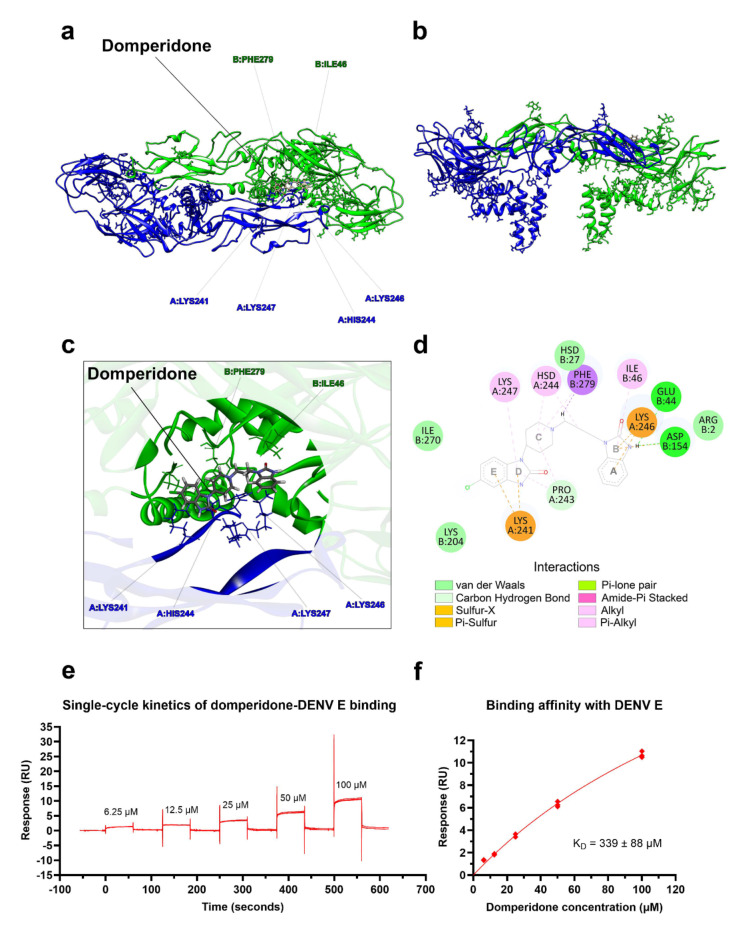
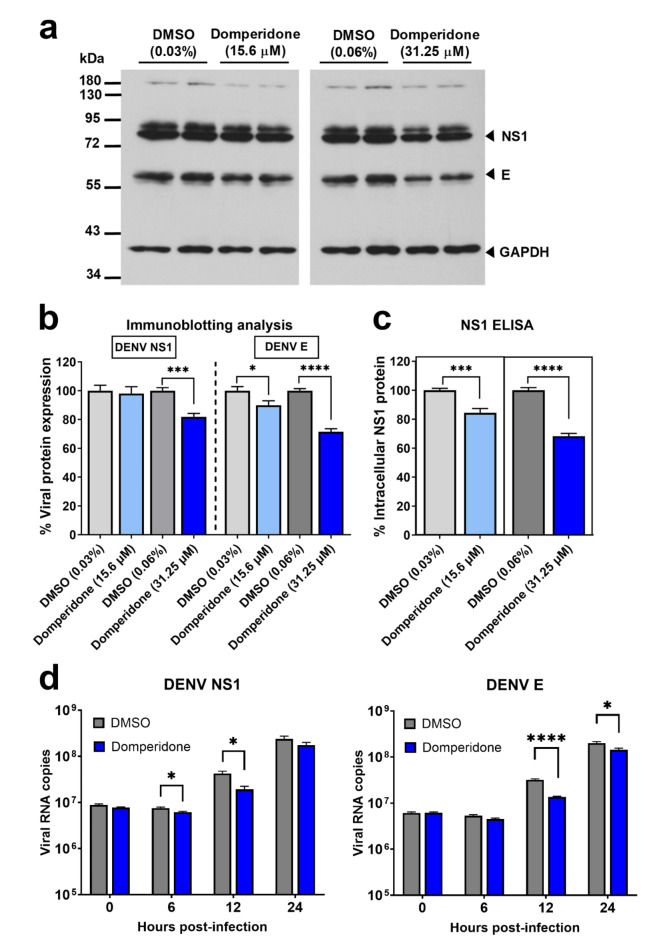
Dengue is a mosquito-borne disease caused by dengue virus (DENV) infection, which remains a major public health concern worldwide owing to the lack of specific treatments or antiviral drugs available. This study investigated the potential repurposing of domperidone, an antiemetic and gastrokinetic agent, to control DENV infection. Domperidone was identified by pharmacophore-based virtual screening as a small molecule that can bind to both the viral envelope (E) and the nonstructural protein 1 (NS1) of DENV. Molecular dynamics (MD) simulations and surface plasmon resonance (SPR) analysis were subsequently performed to determine specific interactions of domperidone with the DENV E and NS1 proteins and their binding affinity. Treatment of immortalized human hepatocyte-like cells (imHC) with domperidone could inhibit DENV production and NS1 secretion in a dose-dependent manner following infection with DENV serotype 2. These inhibitory effects were mediated by reduction in viral RNA replication and viral E and NS1 protein expression, but not by interference with virus entry into cells or NS1 oligomerization. The suppression of DENV production and NS1 secretion by domperidone was observed across all four DENV serotypes to varying degrees between different virus strains. The findings from our study suggest viral target-based repurposing of domperidone for modulating DENV.
登革热是一种由登革病毒(DENV)感染引起的蚊媒疾病,由于缺乏可用的特效治疗方法或抗病毒药物,它仍然是全球主要的公共卫生问题。本研究调查了一种止吐和促胃肠动力药物多潘立酮重新用于控制DENV感染的可能性。通过基于药效团的虚拟筛选,多潘立酮被确定为一种能够与DENV的病毒包膜(E)和非结构蛋白1(NS1)结合的小分子。随后进行了分子动力学(MD)模拟和表面等离子体共振(SPR)分析,以确定多潘立酮与DENV E和NS1蛋白的特异性相互作用及其结合亲和力。用多潘立酮处理永生化人肝样细胞(imHC),在感染2型DENV后,可剂量依赖性地抑制DENV产生和NS1分泌。这些抑制作用是通过减少病毒RNA复制以及病毒E和NS1蛋白表达介导的,而不是通过干扰病毒进入细胞或NS1寡聚化介导的。在所有四种DENV血清型中均观察到多潘立酮对DENV产生和NS1分泌的抑制作用,不同病毒株之间的抑制程度有所不同。我们的研究结果表明,基于病毒靶点对多潘立酮进行重新利用可用于调节DENV。