Duff Eugene P, Zetterberg Henrik, Heslegrave Amanda, Dehghan Abbas, Elliott Paul, Allen Naomi, Runz Heiko, Laban Rhiannon, Veleva Elena, Whelan Christopher D, Sun Benjamin B, Matthews Paul M
UK Dementia Research Institute Centre at Imperial College London, London, UK.
Department of Brain Sciences, Faculty of Medicine, Imperial College London, London, UK.
Nat Med. 2025 Mar;31(3):797-806. doi: 10.1038/s41591-024-03426-4. Epub 2025 Jan 30.
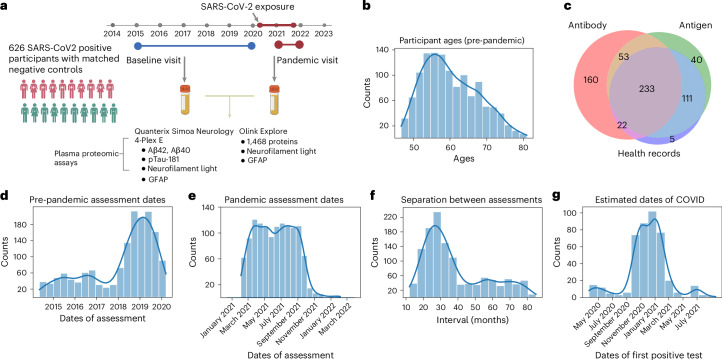
Previous studies have suggested that systemic viral infections may increase risks of dementia. Whether this holds true for severe acute respiratory syndrome coronavirus 2 (SARS-CoV-2) virus infections is unknown. Determining this is important for anticipating the potential future incidence of dementia. To begin to do this, we measured plasma biomarkers linked to Alzheimer's disease pathology in the UK Biobank before and after serology-confirmed SARS-CoV-2 infections. SARS-CoV-2 infection was associated with biomarkers associated with β-amyloid pathology: reduced plasma Aβ42:Aβ40 ratio and, in more vulnerable participants, lower plasma Aβ42 and higher plasma pTau-181. The plasma biomarker changes were greater in participants who had been hospitalized with COVID-19 or had reported hypertension previously. We showed that the changes in biomarkers were linked to brain structural imaging patterns associated with Alzheimer's disease, lower cognitive test scores and poorer overall health evaluations. Our data from this post hoc case-control matched study thus provide observational biomarker evidence that SARS-CoV-2 infection can be associated with greater brain β-amyloid pathology in older adults. While these results do not establish causality, they suggest that SARS-CoV-2 (and possibly other systemic inflammatory diseases) may increase the risk of future Alzheimer's disease.
先前的研究表明,全身性病毒感染可能会增加患痴呆症的风险。严重急性呼吸综合征冠状病毒2(SARS-CoV-2)感染是否也是如此尚不清楚。确定这一点对于预测未来痴呆症的潜在发病率很重要。为了开始进行这项研究,我们在英国生物银行中测量了血清学确诊的SARS-CoV-2感染前后与阿尔茨海默病病理相关的血浆生物标志物。SARS-CoV-2感染与β-淀粉样蛋白病理相关的生物标志物有关:血浆Aβ42:Aβ40比值降低,在更易患病的参与者中,血浆Aβ42水平降低,血浆pTau-181水平升高。在因COVID-19住院或先前报告患有高血压的参与者中,血浆生物标志物的变化更大。我们表明,生物标志物的变化与阿尔茨海默病相关的脑结构成像模式、较低的认知测试分数和较差的总体健康评估有关。因此,我们这项事后病例对照匹配研究的数据提供了观察性生物标志物证据,表明SARS-CoV-2感染可能与老年人脑β-淀粉样蛋白病理增加有关。虽然这些结果并未确立因果关系,但它们表明SARS-CoV-2(以及可能的其他全身性炎症性疾病)可能会增加未来患阿尔茨海默病的风险。