Zhang Weigao, Liu Hu, Zhang Danyang, Yi Yuguo, Tao Liang, Zhu Yunfeng, Huang Shuxian, Zhao Xunan, Shao Qianchao, Li Peiqi, Weng Yiwen, Lu Wei, Zhang Jianfa, Zhang Haibing, Chen Yuxin, Weng Dan
School of Environmental and Biological Engineering, Key Laboratory of Metabolic Engineering and Biosynthesis Technology, Ministry of Industry and Information Technology, Nanjing University of Science and Technology, Nanjing, China.
Department of Laboratory Medicine, Nanjing Drum Tower Hospital, Affiliated Hospital of Medical School, Nanjing University, Nanjing, China.
Elife. 2025 Jan 31;13:RP96798. doi: 10.7554/eLife.96798.
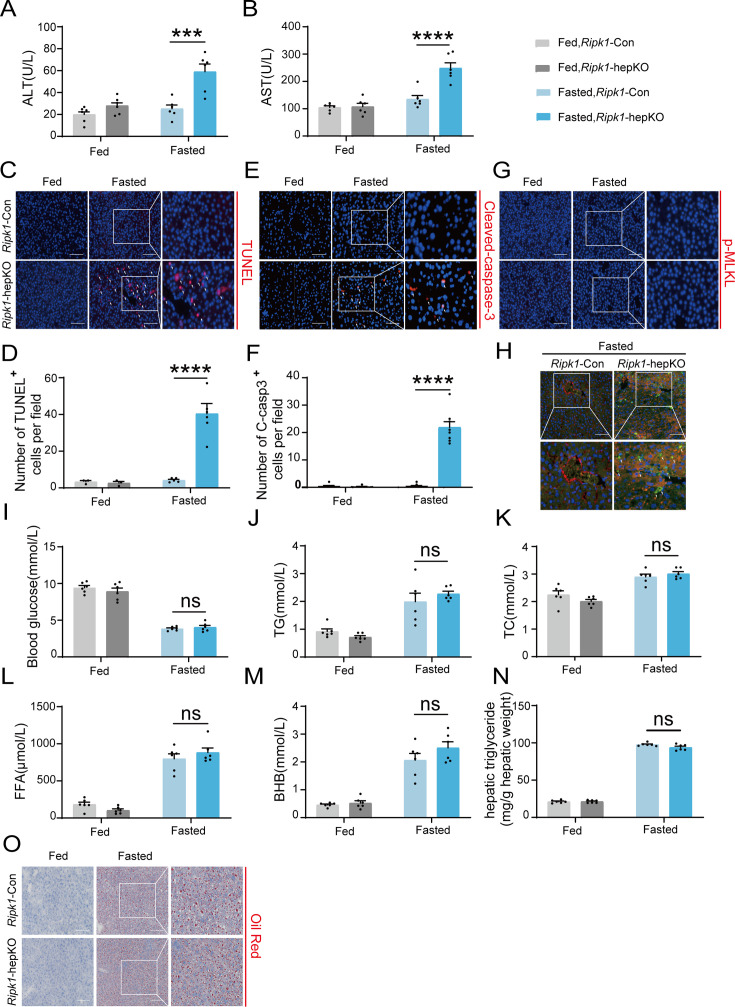
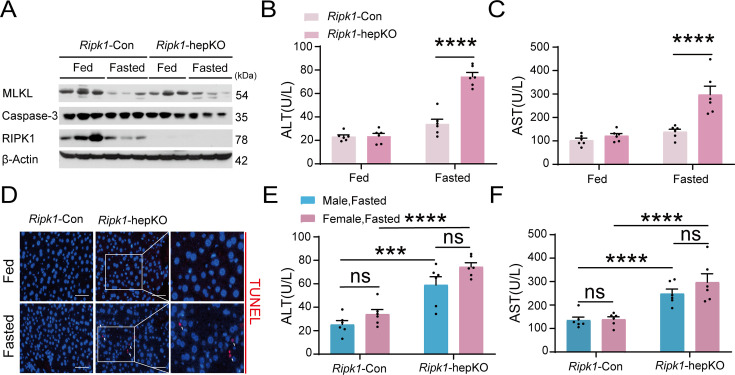
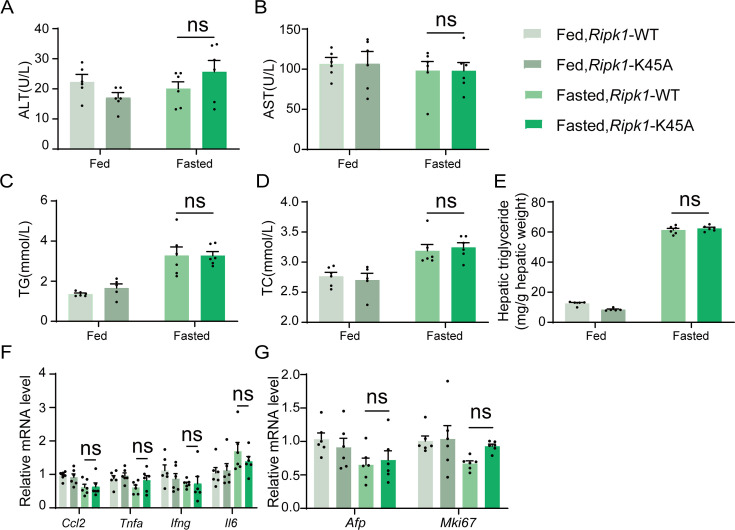
As a central hub for metabolism, the liver exhibits strong adaptability to maintain homeostasis in response to food fluctuations throughout evolution. However, the mechanisms governing this resilience remain incompletely understood. In this study, we identified Receptor interacting protein kinase 1 (RIPK1) in hepatocytes as a critical regulator in preserving hepatic homeostasis during metabolic challenges, such as short-term fasting or high-fat dieting. Our results demonstrated that hepatocyte-specific deficiency of RIPK1 sensitized the liver to short-term fasting-induced liver injury and hepatocyte apoptosis in both male and female mice. Despite being a common physiological stressor that typically does not induce liver inflammation, short-term fasting triggered hepatic inflammation and compensatory proliferation in hepatocyte-specific RIPK1-deficient (-hepKO) mice. Transcriptomic analysis revealed that short-term fasting oriented the hepatic microenvironment into an inflammatory state in -hepKO mice, with up-regulated expression of inflammation and immune cell recruitment-associated genes. Single-cell RNA sequencing further confirmed the altered cellular composition in the liver of -hepKO mice during fasting, highlighting the increased recruitment of macrophages to the liver. Mechanically, our results indicated that ER stress was involved in fasting-induced liver injury in -hepKO mice. Overall, our findings revealed the role of RIPK1 in maintaining liver homeostasis during metabolic fluctuations and shed light on the intricate interplay between cell death, inflammation, and metabolism.
作为新陈代谢的中枢枢纽,肝脏在整个进化过程中表现出强大的适应性,以应对食物波动来维持体内平衡。然而,控制这种恢复力的机制仍未完全了解。在本研究中,我们确定肝细胞中的受体相互作用蛋白激酶1(RIPK1)是在代谢挑战(如短期禁食或高脂饮食)期间维持肝脏内稳态的关键调节因子。我们的结果表明,RIPK1在肝细胞中的特异性缺失使雄性和雌性小鼠的肝脏对短期禁食诱导的肝损伤和肝细胞凋亡更加敏感。尽管短期禁食是一种通常不会诱发肝脏炎症的常见生理应激源,但在肝细胞特异性RIPK1缺陷(-hepKO)小鼠中,短期禁食引发了肝脏炎症和肝细胞代偿性增殖。转录组分析显示,短期禁食使-hepKO小鼠的肝脏微环境转变为炎症状态,炎症和免疫细胞募集相关基因的表达上调。单细胞RNA测序进一步证实了禁食期间-hepKO小鼠肝脏中细胞组成的改变,突出了巨噬细胞向肝脏募集的增加。从机制上讲,我们的结果表明内质网应激参与了-hepKO小鼠禁食诱导的肝损伤。总体而言,我们的研究结果揭示了RIPK1在代谢波动期间维持肝脏内稳态中的作用,并阐明了细胞死亡、炎症和代谢之间复杂的相互作用。