Lu Min, Hong Xiaoshan, Liu Tingyan, Mai Bi, Hu Guiying, Sun Xiaoli
Department of Gynecology, Guangdong Women and Children Hospital, 521 Xingnan Avenue, Panyu District, Guangzhou, 511442, China.
BMC Womens Health. 2025 Feb 1;25(1):44. doi: 10.1186/s12905-025-03585-7.
To date, few studies have investigated the factors associated with high-grade vaginal intraepithelial neoplasia (VaIN). This study aimed to analyze the characteristics of high-grade VaIN and identify its underlying risk factors.
This cross-sectional study included women with histologically confirmed high-grade VaIN and high-grade cervical intraepithelial neoplasia (CIN), conducted between 2017 and 2021 at a single center. Baseline clinical characteristics, human papillomavirus (HPV) infection status, cytology results, and pathology findings were analyzed using standard statistical methods.
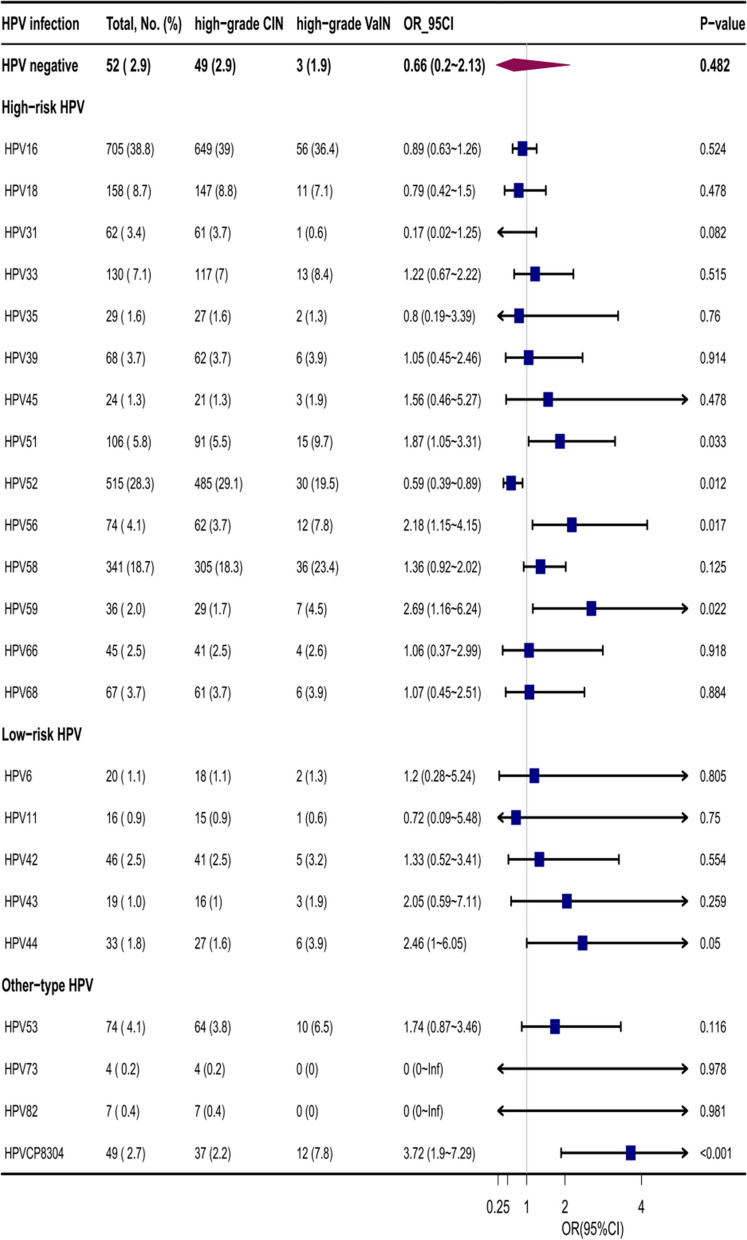
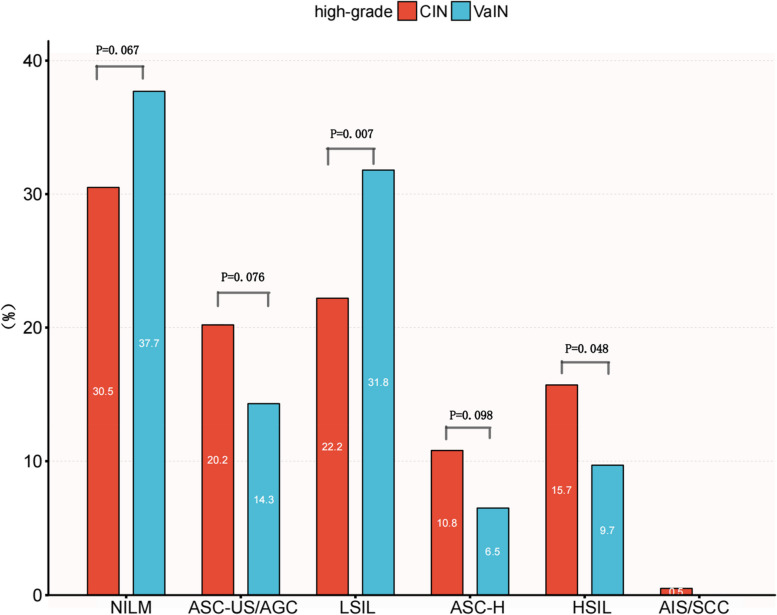
Among 1819 patients, 8.47% (154/1819) were diagnosed with high-grade VaIN (mean age: 42.1 ± 12.4 years), while 91.53% (1665/1819) had high-grade CIN (mean age: 36.7 ± 10.0 years). Older age, longer sexual life duration, higher gravidity and parity, menopause, and prior cervical treatment were identified as risk factors for high-grade VaIN (p < 0.001). High-grade VaIN was more likely to present with low-grade squamous intraepithelial lesion (LSIL) cytology among abnormal cytological results (p = 0.007). HPV was detected in 98.1% of VaIN2/3 cases (151/154), with HPV 16 being the most prevalent genotype, accounting for 39.89% (705/1767) of all infections, 36.4% of high-grade VaIN, and 39% of high-grade CIN cases. Single-genotype HPV infections were observed in 58.4% of high-grade VaIN and 64.3% of high-grade CIN, while multiple infections were found in 39.6% and 32.8%, respectively. The sensitivities of cytology for detecting high-grade VaIN and high-grade CIN were 62.3% and 69.5%, respectively (p = 0.067). HPV testing sensitivities were 98.4% and 97.1%, respectively (p = 0.578). Combined cytology and HPV testing improved sensitivities to 100% and 99.8%, respectively.
High-grade VaIN is significantly associated with older age. The sensitivity of cytology and HPV testing for detecting high-grade VaIN is comparable to that for high-grade CIN. Thus, these tests may facilitate early detection of high-grade VaIN.
迄今为止,很少有研究调查与高级别阴道上皮内瘤变(VaIN)相关的因素。本研究旨在分析高级别VaIN的特征并确定其潜在风险因素。
这项横断面研究纳入了2017年至2021年在单一中心组织学确诊为高级别VaIN和高级别宫颈上皮内瘤变(CIN)的女性。使用标准统计方法分析基线临床特征、人乳头瘤病毒(HPV)感染状况、细胞学结果和病理发现。
在1819例患者中,8.47%(154/1819)被诊断为高级别VaIN(平均年龄:42.1±12.4岁),而91.53%(1665/1819)患有高级别CIN(平均年龄:36.7±10.0岁)。年龄较大、性生活持续时间较长、妊娠和产次较高、绝经以及既往宫颈治疗被确定为高级别VaIN的风险因素(p<0.001)。在异常细胞学结果中,高级别VaIN更有可能表现为低级别鳞状上皮内病变(LSIL)细胞学(p=0.007)。98.1%的VaIN2/3病例(151/154)检测到HPV,其中HPV 16是最常见的基因型,占所有感染的39.89%(705/1767)、高级别VaIN的36.4%和高级别CIN病例的39%。58.4%的高级别VaIN和64.3%的高级别CIN观察到单基因型HPV感染,而多重感染分别为39.6%和32.8%。细胞学检测高级别VaIN和高级别CIN的敏感性分别为62.3%和69.5%(p=0.067)。HPV检测敏感性分别为98.4%和97.1%(p=0.578)。联合细胞学和HPV检测可将敏感性分别提高到100%和99.8%。
高级别VaIN与年龄较大显著相关。细胞学和HPV检测检测高级别VaIN的敏感性与检测高级别CIN的敏感性相当。因此,这些检测可能有助于高级别VaIN的早期检测。