
患者赋权:对基础定义的批判性评估与建议
Patient empowerment: a critical evaluation and prescription for a foundational definition.
作者信息
Varela Antonio J, Gallamore Michael J, Hansen Noah R, Martin Dakota C
机构信息
Physical Intelligence, Fort Smith, AR, United States.
Arkansas Colleges of Health Education, Fort Smith, AR, United States.
出版信息
Front Psychol. 2025 Jan 17;15:1473345. doi: 10.3389/fpsyg.2024.1473345. eCollection 2024.
INTRODUCTION
The evolution of healthcare continues to display an incongruence between delivery and outcomes. Current healthcare paradigms for patient empowerment warrants analysis. A lacking operational application for and agree upon assessment of patient empowerment contributes to healthcare's incongruence. Interchangeable psychosocial concepts and specific patient contextual factors associated with health-related behavioral change have escaped an applicable definition of empowerment. The aim of this theoretical perspective review is to support a comprehensive and contextual understanding of patient empowerment that frames a definition for future consensus research.
METHODS AND MECHANISMS
A theoretical perspective review of patient empowerment including interchangeable concepts and patient contextual factors such as personal suffering and resilience; self-determined meaning and purpose; and autonomy, competence, and self-efficacy are critically analyzed. This analysis builds on adjacent concepts including therapeutic alliance, communication, motivation, and trust. The inclusion of specific patient contextual factors that relate to behavioral change elevate the need to reinforce coping and self-management skills as mechanism for patient empowerment. Practice gaps for those experiencing chronic disease, pain, and mental health disorders in rehabilitation setting are specific populations who benefit from healthcare providers unifying the variables associated with patient empowerment.
RESULTS AND DISCUSSION
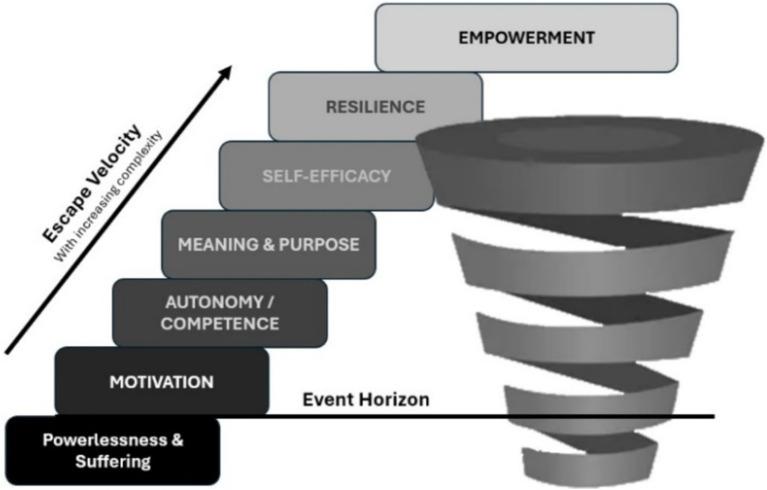
The review of associated concepts synthesized an actionable definition of patient empowerment that serves as a foundation for future research. Behavior related changes occur through the evolution in one's identity, perceptions, and abilities. Interventions that inspire autonomy, competence, and relatedness with a renewed sense of purpose establish resilience and self-efficacy. The totality of this inspired self-determined plan of care establishes the mechanisms required for behavioral change and sustainable transformation. The cumulative experience becomes patient empowerment.
引言
医疗保健的发展在服务提供与结果之间持续呈现出不一致性。当前用于增强患者权能的医疗保健范式值得分析。在增强患者权能方面缺乏可操作的应用方法以及对其评估的共识,这导致了医疗保健的不一致性。与健康相关行为改变相关的可互换心理社会概念和特定患者背景因素,尚未有关于赋权的适用定义。本理论视角综述的目的是支持对患者赋权进行全面且基于背景的理解,从而为未来的共识研究构建一个定义。
方法与机制
对患者赋权进行理论视角综述,包括对可互换概念以及患者背景因素(如个人痛苦与恢复力、自我决定的意义和目的、自主性、能力和自我效能感)进行批判性分析。该分析建立在包括治疗联盟、沟通、动机和信任等相关概念的基础之上。纳入与行为改变相关的特定患者背景因素,增加了强化应对和自我管理技能作为患者赋权机制的必要性。在康复环境中,患有慢性病、疼痛和精神健康障碍的人群所面临的实践差距,是受益于医疗服务提供者整合与患者赋权相关变量的特定人群。
结果与讨论
对相关概念的综述综合得出了一个可操作的患者赋权定义,为未来研究奠定了基础。与行为相关的改变通过个人身份、认知和能力的演变而发生。激发自主性、能力以及具有新目标感的关联性的干预措施能够建立恢复力和自我效能感。这种受启发的自我决定的护理计划的整体建立了行为改变和可持续转变所需的机制。累积的经验即成为患者赋权。


 Zotero 插件