Álvarez-Barrera Lucila, Mateos-Nava Rodrigo Aníbal, Hernández-Córdova Keyla Nahomi, Lezama-Sánchez Eduardo, Alcántara-Mejía Víctor Alan, Rodríguez-Mercado Juan José
Unidad de Investigación en Genética y Toxicología Ambiental (UNIGEN), Laboratorio 5, primer piso, Unidad Multidisciplinaria de Investigación Experimental (UMIEZ-Z). Facultad de Estudios Superiores-Zaragoza, Campus II, UNAM, Ciudad de México, Mexico.
Carrera Médico Cirujano, Ciencias Biomédicas, BQ. FES-Zaragoza, UNAM, Mexico.
Toxicol Rep. 2025 Jan 6;14:101896. doi: 10.1016/j.toxrep.2025.101896. eCollection 2025 Jun.
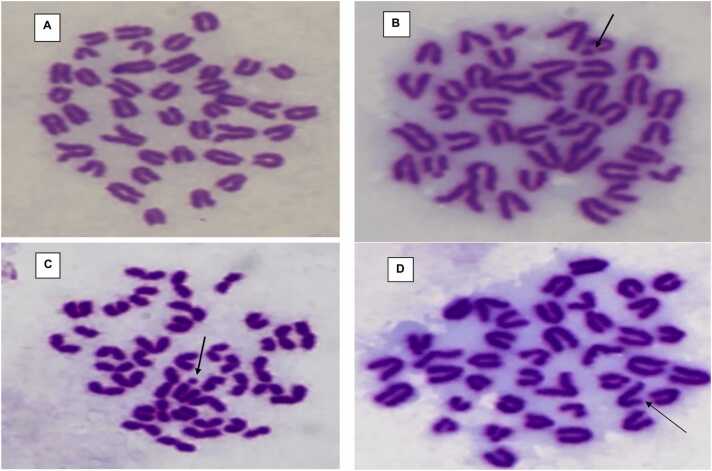
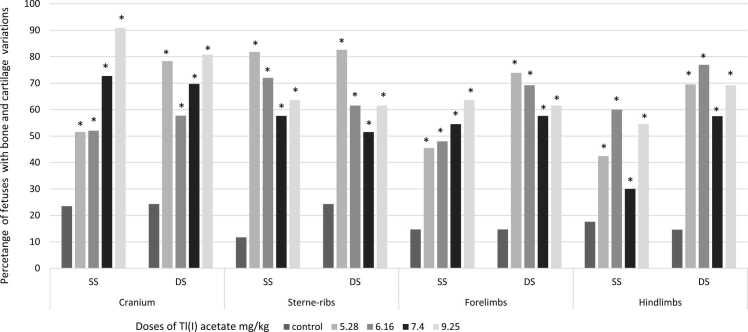
The increased concentration of thallium (Tl) in the environment is a cause for concern because the entire population, including pregnant women, is exposed, and this metal crosses the placenta and reaches the conceptus during development. In biological models such as mice, some abnormalities and delays in ossification occur in the fetuses of mice administered Tl on day 7 of gestation, but exposure to environmental Tl is constant during fetal development; therefore, in this study, the effects of several administrations of TI during organogenesis on the external morphology, skeletal development and genotoxicity of fetuses were evaluated. Four groups of 10 pregnant mice were administered 5.28, 6.16, 7.4 or 9.25 mg/kg body weight Tl(I) acetate intraperitoneally during fetal organogenesis. Additionally, samples were taken from fetuses from pregnant mice treated with 5.28 and 6.16 mg/kg body weight to evaluate the transplacental genotoxicity. The results revealed that the 9.25 mg/kg body weight dose produced maternal and fetal toxicity, and all of the treatment groups presented relatively high percentages of fetuses with external abnormalities, reduced bone ossification, and an increased percentage of liver cells with structural chromosomal aberrations (SCAs) and micronuclei (MNs) in blood cells. These results show that Tl(I) acetate administered during organogenesis produces abnormalities, including a delay in ossification and transplacental genotoxicity, in mouse fetuses. These findings are important because Tl has negative effects on development and may affect the health of offspring in the future because it can damage genetic material.
环境中铊(Tl)浓度的增加令人担忧,因为包括孕妇在内的全体人群都暴露于其中,而且这种金属会穿过胎盘并在发育过程中到达胚胎。在小鼠等生物学模型中,妊娠第7天给小鼠施用铊后,其胎儿会出现一些骨化异常和延迟,但胎儿发育过程中对环境铊的暴露是持续的;因此,在本研究中,评估了器官发生期多次施用铊对胎儿外部形态、骨骼发育和遗传毒性的影响。四组各10只怀孕小鼠在胎儿器官发生期经腹腔注射5.28、6.16、7.4或9.25mg/kg体重的醋酸铊(Tl)。此外,从接受5.28和6.16mg/kg体重处理的怀孕小鼠的胎儿中取样,以评估经胎盘的遗传毒性。结果显示,9.25mg/kg体重的剂量产生了母体和胎儿毒性,所有处理组中出现外部异常、骨化减少的胎儿比例相对较高,并且血细胞中具有结构染色体畸变(SCA)和微核(MN)的肝细胞百分比增加。这些结果表明,器官发生期施用醋酸铊(Tl)会使小鼠胎儿出现异常,包括骨化延迟和经胎盘的遗传毒性。这些发现很重要,因为铊对发育有负面影响,并且由于它会损害遗传物质,可能会影响后代未来的健康。